
Spanish PM lashes Trump over Iran strikes and soaring war costs
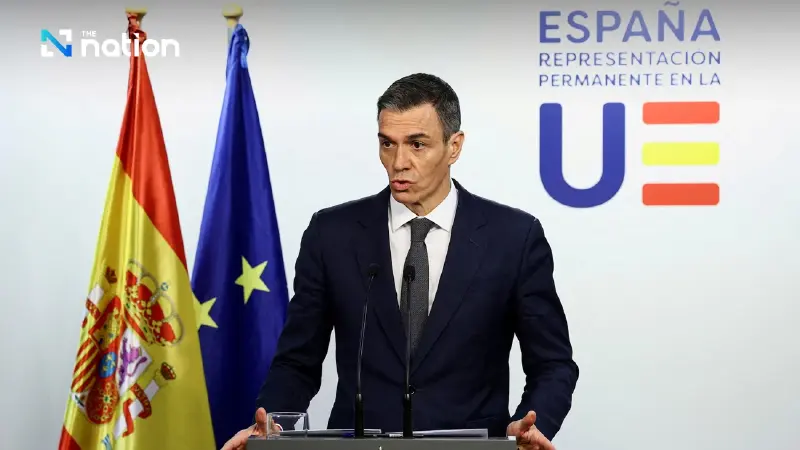


Pedro Sánchez condemns Trump over Iran war, warning of economic fallout, higher living costs and deepening global instability
Spanish Prime Minister Pedro Sánchez has delivered his strongest remarks yet since the conflict began, condemning the military operations by the United States and Israel in Iran and warning that the war is inflicting enormous economic damage far beyond the Middle East.
According to foreign media reports from Madrid on March 25, 2026, Sánchez told the Spanish Congress that the military action by the US and Israel in Iran amounted to a violation of international law and had severely destabilised the Middle East. He warned that the current crisis was a scenario even worse than the 2003 invasion of Iraq.
Turning to the economic toll, Sánchez revealed that the war had already caused severe damage to Spanish businesses, with cumulative losses approaching 100 billion euros, or around 116 billion US dollars, in less than a month.
He said every bomb that falls in the Middle East ultimately lands in the wallets of ordinary families. To cushion the blow from rising living costs, the Spanish government has approved a 5-billion-euro support package aimed at helping stabilise fuel prices and cutting oil taxes for the public.
Sánchez added that it was unfair for some to set the world on fire while others were left to carry the ashes.
He also drew a comparison with the Iraq war, arguing that the invasion had failed to achieve its aims but instead triggered a refugee crisis and led to acts of terrorism in Europe. The reference carries deep resonance in Spain, where the conservative government that supported the Iraq war was later defeated in an election after the 2004 Madrid train bombings, which Al-Qaeda claimed were revenge for Spain’s deployment of troops to Iraq.
Spain’s tough stance has also brought it into direct conflict with US President Donald Trump. Sánchez has ordered the suspension of US access to Rota Air Base and Morón Naval Base for any operation involving strikes on Iran.
The decision reportedly angered the US leader, with Trump criticising Spain in front of the German leadership as being led by a very bad government and threatening to cut all trade ties with Spain in retaliation.
However, opinion polls indicate that 68% of Spaniards oppose the war, while more than 53.2% support the government’s move to block US use of the bases.
On the Iranian side, Tehran has reportedly informed the International Maritime Organization that vessels deemed non-hostile, including Spanish ships, would be allowed to pass through the Strait of Hormuz in coordination with Iranian authorities. At the same time, it has imposed a total ban on ships linked to the United States and Israel.
There were also reports that Iran had laid large numbers of advanced Maham 3 and Maham 7 naval mines in the strait, a strategic chokepoint through which about one-fifth of the world’s oil is transported. Iranian authorities further claimed to have launched missiles at a US aircraft carrier, forcing it to change position.
As tensions continue to escalate, the United States has sent two additional Marine special combat units towards the Middle East, while North Korean leader Kim Jong Un has condemned US actions as state terrorism.
The developments underline how the war is no longer a regional crisis alone, but is increasingly expanding into a broader international confrontation that could prove far harder to contain.
