
Japan marks 10 years since landmark security legislation took effect
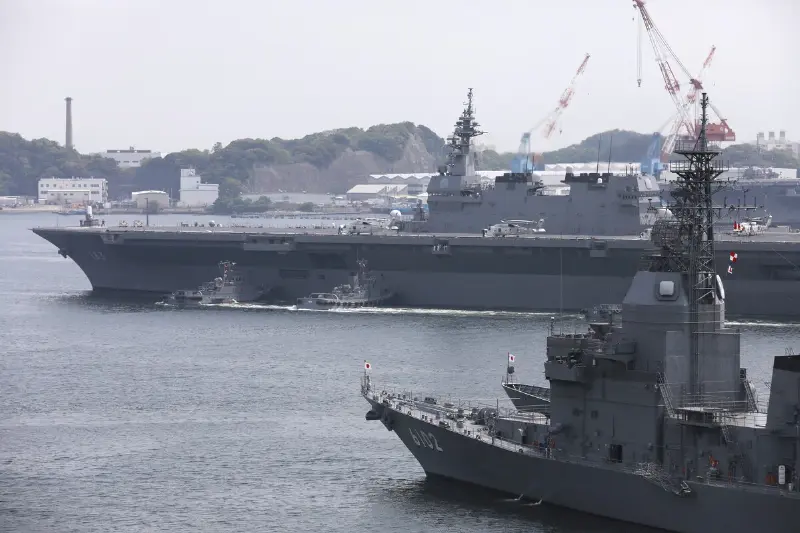


Ten years after the law took effect, rising Iran tensions have sharpened the debate over Japan’s use of collective self-defence and Diet oversight of the SDF.
- The legislation, marking its 10th anniversary, expanded the role of Japan's Self-Defence Forces (SDF) by partially lifting the constitutional ban on collective self-defence.
- Over the past decade, the law has strengthened the Japan-US alliance and enabled the SDF to conduct numerous armed escort missions for US, Australian, and British military assets.
- The law's provision for a "survival-threatening situation" is now being considered for potential conflicts involving Iran or Taiwan, prompting renewed calls for stronger parliamentary oversight of the SDF.
Japan marked the 10th anniversary of the implementation of its landmark national security legislation on Sunday (March 29), as the scope of activity of its Self-Defence Forces continues to expand.
The rapidly deteriorating situation involving Iran since late February has raised speculation that Japan may recognise a "survival-threatening situation" under the legislation for the first time. In such a situation, the country is allowed to exercise its right to collective self-defence.
Meanwhile, growing uncertainty over the international situation has prompted opposition parties to renew their calls for strengthening the Diet's supervision of the SDF.
"The legislation for peace and security has made the Japan-US alliance stronger than ever before and enhanced our deterrence and response capabilities," Chief Cabinet Secretary Minoru Kihara said at a press conference on Friday. "We are now able to contribute more actively to peace and security in the region and the international community."
The legislation clarified the SDF's expanded missions and partially lifted the ban on collective self-defence, which had previously been considered unconstitutional.
In addition to a survival-threatening situation, the concepts of an "armed attack situation" and situations significantly influencing the peace and security of Japan were introduced, paving the way for the SDF to protect foreign warships and aircraft and rescue civilians assaulted in remote areas.
The track record of these activities is steadily growing. As of the end of 2024, the SDF has conducted 140 armed escort missions for the United States and 10 for Australia. Last August, a Maritime Self-Defence Force destroyer escorted a British aircraft carrier for the first time.
"Trust (between the SDF and foreign militaries) has strengthened over the last decade," said Hiroaki Uchikura, chief of the SDF Joint Staff.
In 2016, an SDF unit deployed to the U.N. Mission in South Sudan was assigned a mission to protect civilians in remote areas. "The scope of our international contributions is expanding," said a Defence Ministry official.
In late February, the United States and Israel attacked Iran, leading to Iran's de facto closure of the Strait of Hormuz, a key chokepoint for crude oil shipments. This was exactly the scenario cited by then Prime Minister Shinzo Abe during parliamentary deliberations on the security legislation as an example of a survival-threatening situation.
According to informed sources, the government conducted behind-the-scenes simulations to assess whether the conflict could be designated as a survival-threatening situation.
Since the government has so far maintained a negative stance about recognising such a situation, the SDF's most likely contribution to the situation surrounding Iran is considered to be mine clearance operations after the fighting ends.
During a parliamentary meeting last November, Prime Minister Sanae Takaichi said that the government could declare a survival-threatening situation in the event of a contingency in Taiwan, leading to a rapid cooling of relations between Japan and China.
As the government has considerable discretion regarding whether to recognise a survival-threatening situation, Junya Ogawa, leader of the opposition Centrist Reform Alliance, argued that this discretion "should be extremely limited."
Before the enactment of the security legislation in September 2015, party leaders signed an agreement to consider establishing a parliamentary body to monitor and review SDF activities, noting that the Diet would fulfil its democratic oversight function.
Makoto Nishida, secretary-general of Komeito, which was in the ruling bloc at the time, said at a press conference on Friday: "We need to thoroughly deepen our discussions. This is all the more necessary given the current situation."

[Copyright The Jiji Press, Ltd.]
