
Artemis II launches four astronauts on historic moon mission
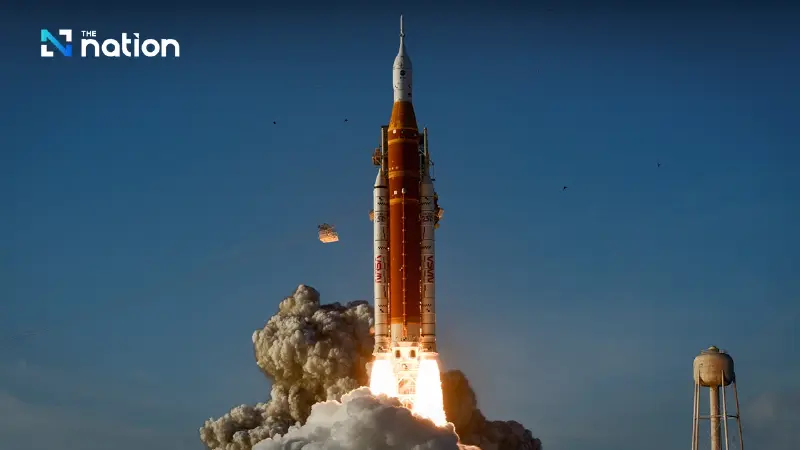


NASA sends its first Artemis crew around the moon and back on a 10-day mission that will push humans farther into space than ever before.
- The Artemis II mission has successfully launched four astronauts, Reid Wiseman, Victor Glover, Christina Koch, and Jeremy Hansen, on a nearly 10-day voyage around the moon.
- This is the first crewed flight of NASA's Artemis program, designed to test the Orion spacecraft and Space Launch System (SLS) rocket for future human lunar landings.
- The historic mission is expected to carry its crew farther into space than any humans have ever gone, surpassing the record set by the Apollo 13 mission.
NASA launched four astronauts from Florida on Wednesday (April 1) aboard Artemis II, sending them on a high-stakes, nearly 10-day journey around the moon and back in the United States’ boldest move yet towards returning humans to the lunar surface later this decade, ahead of China’s first planned crewed landing.
The agency’s Space Launch System rocket, with the Orion crew capsule mounted on top, lifted off just before sunset at 6.35pm EDT (2235 GMT) from Kennedy Space Centre. As the rocket climbed away from Earth, it trailed a vast plume of thick white vapour.
The flight carried NASA astronauts Reid Wiseman, Victor Glover and Christina Koch, along with Canadian Space Agency astronaut Jeremy Hansen, making them the first crew to fly in NASA’s Artemis programme. Their mission will take them around the moon and back, carrying them farther into space than any humans have ever gone.
“This is Jeremy, we are going for all humanity,” Hansen said from inside Orion just minutes before liftoff.
From launch control, launch director Charlie Blackwell-Thompson addressed the crew, saying: “Reid, Victor, Christina and Jeremy, on this historic mission, you take with you the heart of this Artemis team, the daring spirit of the American people and our partners across the globe, and the hopes and dreams of a new generation.”

“Good luck, godspeed, Artemis II. Let’s go,” she added.
After almost three years of training, the four astronauts became the first crew to fly under the multibillion-dollar Artemis programme, a series of missions created in 2017 to establish a long-term US presence on the moon over the next decade and beyond.
The launch was also a landmark moment for the SLS rocket, a project more than a decade in the making. For Boeing and Northrop Grumman, the rocket’s principal contractors, the mission offered long-awaited proof that the 30-storey launch system can safely send humans into space at a time when NASA is increasingly turning to newer and less costly rockets developed by Elon Musk’s SpaceX and other companies.
The gumdrop-shaped Orion capsule, built for NASA by Lockheed Martin, is due to detach from the SLS upper stage about 3-1/2 hours after launch while in Earth orbit. Once separated, the astronauts will manually fly Orion around the discarded upper stage to evaluate its steering and manoeuvrability, marking the first of dozens of test objectives planned during the mission.
Artemis II is an important early phase of NASA’s flagship moon programme, which now aims to return astronauts to the lunar surface in 2028 during Artemis IV.


NASA is under pressure to achieve that landing, which would be its first since the final Apollo mission in 1972, as China pushes ahead with its own lunar ambitions and is targeting a crewed moon landing as early as 2030.
The Artemis II crew is expected to travel about 252,000 miles (406,000 km), making it the farthest human spaceflight ever attempted.
That record is currently held by the three-man Apollo 13 crew, which flew roughly 248,000 miles in 1970. Apollo 13 was hit by technical trouble after an oxygen tank exploded, forcing the astronauts to abandon their planned moon landing.
NASA’s first Artemis mission flew without astronauts in 2022, sending Orion on a similar route around the moon and back.
This new mission will subject both Orion and the SLS rocket to a more demanding test. Boeing and Northrop Grumman have led development of the SLS since 2010, a programme that has drawn attention partly because of ballooning costs estimated at between US$2 billion and US$4 billion per launch.
Meanwhile, SpaceX and Jeff Bezos’ Blue Origin are competing to build the lunar landers that NASA intends to use to place astronauts on the moon.
Artemis III had originally been expected to carry out the agency’s first astronaut moon landing. But in February, new NASA Administrator Jared Isaacman inserted an additional test mission before that landing attempt.

