
NASA readies Artemis II crew for first crewed moon trip since 1972
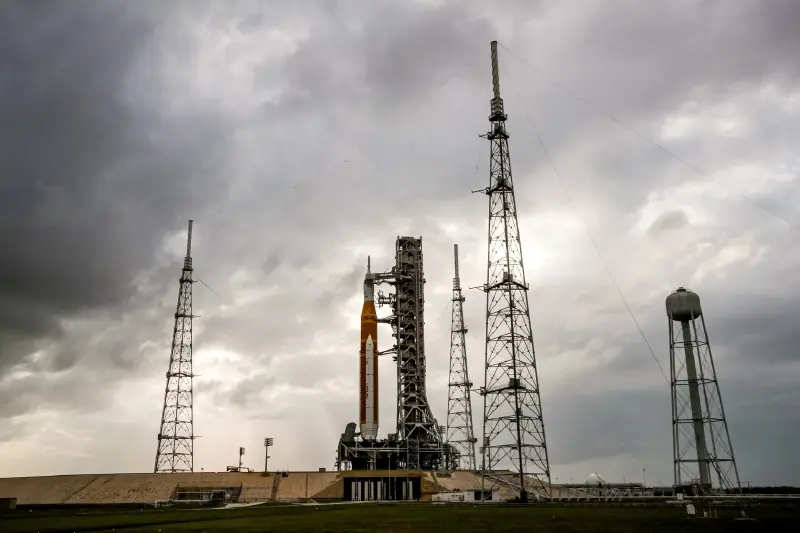


NASA will send three US astronauts and Canadian Jeremy Hansen around the moon on a 10-day Artemis II test, as the United States seeks to renew its edge in space amid China’s lunar push.
- The Artemis II mission will be NASA's first crewed flight towards the moon in over 50 years, since the final Apollo mission in 1972.
- A four-person crew, consisting of three American astronauts and one Canadian, will fly a 10-day mission to loop around the moon and return to Earth.
- This flight is a critical test of the Orion capsule and Space Launch System rocket, designed to assess life-support, navigation, and communication systems for future lunar missions.
- The mission is part of the broader Artemis program, a U.S. initiative to resume lunar exploration and reassert its position in space amid growing competition from China.
NASA is preparing to send astronauts towards the moon for the first time in more than 53 years, with Artemis II set to become the second mission in the programme and its first with a crew, in a crucial test of broader lunar ambitions as the United States seeks to reassert its position in space amid intensifying competition from China.
Three American astronauts and one Canadian are due to lift off on Wednesday aboard NASA’s Orion capsule and Space Launch System rocket for a 10-day mission looping around the moon and back, taking humans farther into deep space than ever before.
Artemis II will be the first crewed test flight in NASA’s Artemis programme, the flagship US effort to resume regular missions to the moon. The programme has cost at least US$93 billion since 2012. No one has returned to the lunar surface since Apollo 17 in 1972, and NASA is aiming to achieve another landing in 2028 at the moon’s rugged south pole.
The United States is still the only country to have landed humans on another celestial body, having carried out six moon landings under Apollo in competition with the former Soviet Union. In more recent years, however, US officials have increasingly turned their attention to China, a major technological rival that has steadily advanced its own lunar programme through a series of robotic landings and a target of placing astronauts on the moon by 2030.
On Sunday, Artemis II mission specialist Christina Koch described the moon as a “witness plate” of the solar system’s formation and a stepping stone to Mars, where scientists may have the strongest chance of finding evidence of past life. She said many countries now recognised the importance of pushing farther into the solar system, not only for tangible benefits but also for the chance to answer what she called “the question of our lifetime” - “are we alone?” For Koch, the search begins at the moon, and the real issue is no longer whether humanity should go, but whether it should lead or follow.
Through a succession of more advanced Artemis missions extending into the next decade, the United States hopes to help define how countries and companies will operate and coexist on the moon, where lunar resources may one day be used and where experience could be built for much harder missions to Mars.
The rest of the crew includes NASA astronauts Victor Glover and Reid Wiseman, while Jeremy Hansen is set to become the first Canadian astronaut to travel into the vicinity of the Moon.
Hansen’s role on the mission stems from a 2020 agreement between NASA and the Canadian Space Agency. Mathieu Caron, head of the CSA’s astronaut office, said Canada’s participation was the product of decades of contribution and strategic investment, including Canadian robotics work on the International Space Station.
NASA is relying on a range of companies for its moon programme and hopes that approach will help create a future commercial lunar market, although analysts say its value remains difficult to estimate.
Boeing and Northrop Grumman are leading work on the Space Launch System, while Lockheed Martin built Orion. SpaceX and Blue Origin are developing separate lunar landers with NASA funding, under contracts that also allow them to market the spacecraft to other customers.
A January report by PricewaterhouseCoopers estimated that activities on the lunar surface could generate US$127 billion in revenue by 2050, with investment over the same period potentially reaching between US$72 billion and US$88 billion.
For now, and for the foreseeable future, governments are expected to remain the main force behind corporate lunar strategies and revenues. Akhil Rao, an economist at Rational Futures who previously worked as a research economist at NASA, said it would take a long time for key infrastructure, such as energy and communications systems, to develop to the point where commercial growth on the moon could exist independently of government funding.
Rao, who was among NASA economists and space policy staff laid off last year during the Trump administration’s sweeping federal workforce cuts, said he did not see short-term economic value that would allow NASA to become hands-off.
Artemis II will place NASA’s Orion capsule and Space Launch System under a tougher test after a similar uncrewed mission in 2022. During the flight, the astronauts will assess life-support systems, crew interfaces, navigation and communications.
Liftoff is scheduled for April 1, although weather in Florida or any last-minute rocket problems could delay the launch to any day up to April 6. After that, another launch window, shaped largely by orbital mechanics between Earth and the moon, opens on April 30.
Artemis III, planned for 2027, is expected to involve Orion docking in Earth orbit with NASA’s two lunar landers - Blue Moon from Jeff Bezos’ Blue Origin and Starship from Elon Musk’s SpaceX. That delicate rendezvous is intended to demonstrate how the landers would collect astronauts before heading for the lunar surface.
That mission was added to the programme in February by NASA’s new administrator, Jared Isaacman, the billionaire private astronaut who has more broadly reshaped the programme with new objectives. His decision pushed the programme’s first crewed lunar landing back to Artemis IV.
Reuters
