
Thailand urged to speed up EU FTA talks as Brussels expands trade network
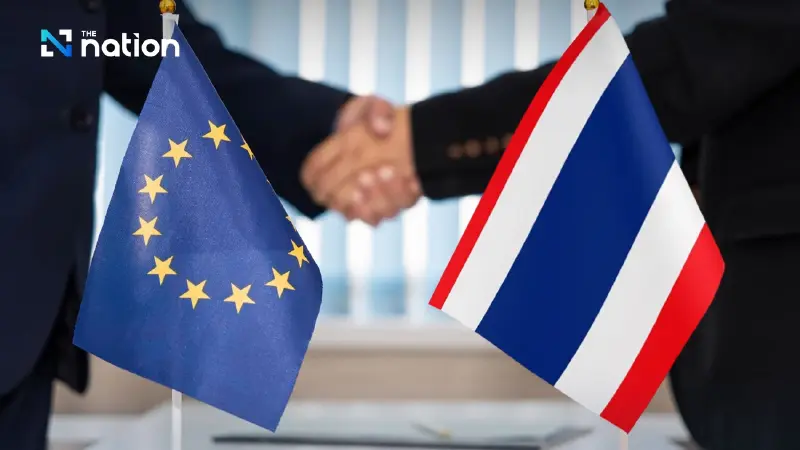


Thailand sees the EU’s accelerated FTA strategy as a chance to finalise the Thai-EU trade deal and boost exports, investment and supply chains.
The Trade Policy and Strategy Office (TPSO) said the European Union’s accelerated push to negotiate free trade agreements with partners around the world is aimed at diversifying trade risks amid global economic volatility and geopolitical tensions, creating an opportunity for Thailand to speed up efforts to conclude the Thai-EU FTA by the end of 2026.
Nantapong Chiralerspong, Director-General of the TPSO, said the EU’s move to accelerate FTAs with trading partners worldwide in early 2026 was an important development that would benefit Thailand in several dimensions, including market expansion, supply-chain linkages and attracting foreign investment.

This is especially relevant as Thailand is currently negotiating an FTA with the EU, which would serve as a key mechanism for strengthening the country’s long-term competitiveness. However, Thailand must accelerate its own adjustment to maintain its potential amid a rapidly changing global trade environment.
In the first quarter of 2026, the EU was able to reach and conclude negotiations on three FTAs covering six countries. These included the signing of an agreement with the Mercosur countries — Brazil, Argentina, Uruguay and Paraguay — as well as the conclusion of negotiations with India and Australia, after several talks had taken a long time and involved complex issues.

The EU’s accelerated push to conclude FTAs reflects its policy commitment to diversifying economic risks, reducing reliance on traditional major markets and building a wider network of trade partners in response to global economic uncertainty and geopolitical volatility. This development creates significant strategic opportunities for Thailand.
First, the EU’s expansion of trade agreements with various countries will support the reconfiguration of global supply chains, enabling Thailand to position itself as a production and export base in high-potential industries such as processed food, modern automotive, electrical appliances and electronics, as well as high-value agricultural products. This is particularly relevant as EU businesses increasingly diversify sourcing to reduce risks from overreliance on any single country.
Second, the expansion of the EU’s FTA network will help stimulate foreign direct investment (FDI). Multinational companies, especially those from the EU, are likely to choose to invest in countries with strong infrastructure, trade connectivity and the ability to make effective use of FTA networks. Thailand has an advantage as a hub of Southeast Asia and as a country with strong supply chains.
Third, FTA negotiations with the EU will be an important driving force for Thailand to raise product standards, regulations and trade systems in line with international standards, including on the environment, labour and transparency. This would help strengthen long-term confidence among consumers and investors.
However, Thailand still faces challenges from intensifying competition, especially from countries that already have FTAs with the EU, such as Vietnam and Singapore. These countries already enjoy tariff benefits and earlier access to the EU market, meaning some Thai products may face short-term disadvantages in terms of price and market share.
In addition, the EU’s trade measures related to the environment and sustainability are becoming stricter, which could become a constraint for Thai operators that are unable to adapt in time.
To seize the opportunities and reduce the impact of these challenges, Thailand should accelerate Thai-EU FTA negotiations so that Thai goods can access the EU market on terms comparable to those of competing countries.
Thailand should also raise production and sustainability standards, especially on the environment, carbon-emissions reduction and labour standards, to align with EU requirements.
At the same time, Thailand should strengthen the capacity of Thai entrepreneurs, especially SMEs, so they can adapt to new forms of trade such as digital trade and environmentally friendly production.
The country should also develop infrastructure and logistics systems to support supply-chain connectivity at both regional and global levels.
Nantapong said that on the latest progress of Thai-EU FTA negotiations, the two sides held the eighth round of talks in February in Chiang Mai. They were able to conclude three more chapters: trade remedies; exceptions to the use of various measures under the FTA, such as exceptions to protect public health and the environment and security exceptions; and national treatment and market access for trade in goods.
As a result, 11 chapters have now been concluded out of a total of 24. The next round of negotiations will be held in June 2026 in Brussels, Belgium. The Commerce Ministry aims to conclude the negotiations within 2026.
Nantapong said the EU is the world’s second-largest economy after the United States and has high purchasing power. Its GDP is worth more than US$21 trillion, accounting for about 18% of global GDP, while its population stands at around 450 million. GDP per capita is about US$47,000 per year, 3.2 times higher than the global average.
“Having an FTA with the EU will help Thai goods enter this market at lower or zero tariffs, increase competitiveness and create new trade and investment opportunities. The Thai-EU FTA is therefore an important strategic mechanism for driving Thailand’s economy in the long term. It will not only help expand export markets, but also attract foreign investment, increase employment and elevate Thailand’s role in global production supply chains, leading to stable and sustainable economic growth in the future,” Nantapong said.
The EU is Thailand’s fourth-largest trading partner after China, the United States and Japan. In the first quarter of 2026, total trade between Thailand and the EU was valued at US$12.22328 billion, up 13.55% from the same quarter of 2025.
Thailand exported US$7.67191 billion worth of goods to the EU, up 20.14%, and imported US$4.55137 billion, up 3.93%. This gave Thailand a trade surplus of US$3.12054 billion.
Key export products included computers, equipment and parts; gems and jewellery; air conditioners and parts; rubber products; and transformers and parts.
Key imports included machinery and parts, medical and pharmaceutical products, electrical machinery and parts, chemicals, and printed circuit boards.
