
IMF: Middle East war damage will outlast any peace deal
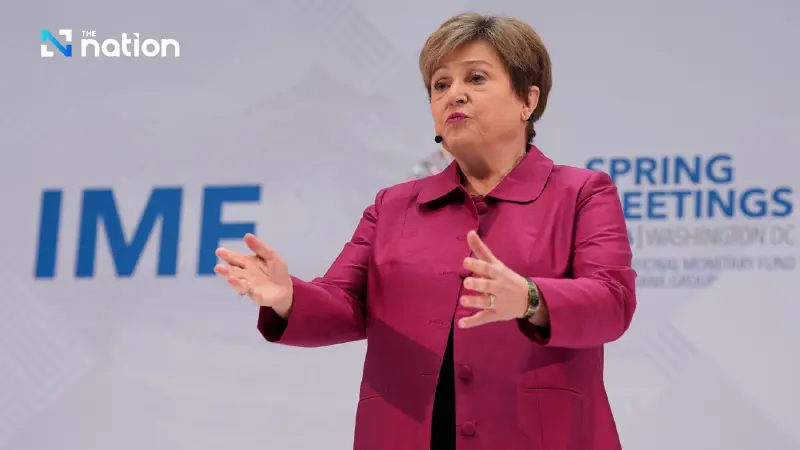


IMF chief Kristalina Georgieva says the Middle East war has cut global oil and LNG flows, lifted inflation risks and will drag on world growth even under the best-case scenario
- The IMF warns the war has triggered a major global supply shock, disrupting energy flows, raising prices, and causing lasting damage to growth, trade, and inflation.
- Even in the most optimistic scenarios involving a peace deal, the IMF has downgraded its forecast for the world economy, indicating the negative effects will persist.
- Significant damage to critical energy infrastructure, which may take three to five years to fully repair, is a key reason the economic disruption will outlast the conflict itself.
- The IMF states there will be no simple return to the pre-war economic equilibrium, with slower growth and a heavier burden on vulnerable oil-importing nations becoming the new reality.
The International Monetary Fund has warned that the Middle East war has delivered a fresh global supply shock that will leave lasting scars on growth, trade and inflation, with even the most optimistic outcome now expected to bring a weaker world economy than previously forecast.
In remarks delivered ahead of the 2026 Spring Meetings in Washington, IMF Managing Director Kristalina Georgieva said the conflict had tested what had until recently been a resilient global economy. She described the shock as large, global and uneven in its impact, with countries’ exposure depending on their distance from the conflict, whether they export or import energy, and how much policy space they still have.
At the centre of the disruption is energy. Georgieva said the war cut world daily oil flows by around 13% and LNG flows by about 20%, while Brent crude jumped from US$72 a barrel on the eve of hostilities to a peak of US$120. Prices have since eased, but remain well above pre-war levels, and many countries are still paying steep premiums to secure supply.

The IMF chief said the damage goes far beyond crude prices alone. Supply interruptions have disrupted refineries, tightened the availability of diesel and jet fuel, hurt transport, trade and tourism, and deepened food insecurity for another 45 million people, pushing the global number facing hunger above 360 million. Higher fertiliser costs and shortages of industrial inputs such as sulphur, helium and naphtha are also rippling through production chains.

She said the shock is now spreading through three main channels: direct price rises and supply shortages, the risk of inflation expectations becoming unanchored, and tighter financial conditions. While long-term inflation expectations have so far remained broadly stable, near-term expectations have moved higher in both the United States and the euro area, while emerging-market bond spreads have widened, equities have adjusted and the dollar has strengthened.

For the IMF, the growth question now depends heavily on whether the ceasefire holds and how much lasting damage the war leaves behind. Georgieva said the upcoming World Economic Outlook will present a range of scenarios, from relatively quick normalisation to a more prolonged period of much higher oil and gas prices with broader second-round effects. She added that, before the conflict, the Fund had been leaning towards an upgrade to global growth because of strong AI and technology investment, supportive financial conditions and other tailwinds. Now, however, even the most hopeful case points to a downgrade.
Part of the concern lies in the possibility that critical infrastructure damage will take years to reverse. Georgieva pointed to Qatar’s Ras Laffan complex, which produces 93% of the Gulf’s LNG and sends around 80% of that supply to Asia-Pacific, saying it has effectively been shut since March 2, was directly hit on March 19 and may take three to five years to return to full capacity. She also noted that ship passages through Bab-el-Mandeb in the Red Sea remain at roughly half their 2023 level, underscoring how difficult it may be for regional transport routes to fully recover.


Even if peace proves durable, she said, there will be no neat return to the old equilibrium. Growth will still be slower, and the burden will fall most heavily on countries directly hit by the war and on vulnerable oil importers, especially those with weak sovereign credit ratings and limited room to respond. Georgieva singled out Sub-Saharan African economies and small island states as particularly exposed, while also noting that more than 80% of countries worldwide are net oil importers.

Her policy message was equally clear. Because this is a classic negative supply shock, some demand adjustment is unavoidable. Governments, she said, should avoid unilateral moves such as export controls, price controls and other actions that could worsen global distortions. For now, central banks should stress their commitment to price stability but otherwise remain cautious, unless credibility comes under threat. Fiscal authorities, meanwhile, should focus on targeted, temporary support for vulnerable groups within credible medium-term fiscal frameworks.
If inflation expectations begin to break loose, she said, central banks should respond firmly with rate hikes, even though that would weigh further on growth. If financial conditions tighten sharply enough to create an additional demand shock, then monetary policy becomes a more delicate balancing act and fiscal policy can shift towards carefully calibrated demand support but only where there is real fiscal space.

The IMF also warned strongly against broad-based tax cuts, untargeted subsidies and price-suppression measures. Georgieva said such steps may soften the price signal, but they also delay the necessary demand response and can end up driving global energy prices even higher. She added that fiscal and monetary policy must not pull in opposite directions, likening deficit-financed stimulus in the current environment to driving with one foot on the accelerator and one on the brake.

That warning comes against a backdrop of already elevated public debt. Georgieva said the world has a fiscal space problem, with debt levels generally much higher than they were 20 years ago and interest payments consuming a growing share of public revenue across income groups. In her view, governments must use limited fiscal resources responsibly and, once the shock begins to pass, move decisively to rebuild room for future crises.

The IMF expects the spillovers from the Middle East war to drive a near-term increase in demand for its balance-of-payments support of between US$20 billion and US$50 billion, with the lower end of that range possible only if the ceasefire holds. Georgieva said the Fund is well resourced to respond and made clear that more countries may yet need programmes if the shock deepens.
Her broader message was that while countries cannot control the external shock, they can still shape how well they endure it. Strong institutions, credible policy and agility in the face of changing conditions, she said, remain the best defence in a world where geopolitical, energy and supply disruptions are no longer rare interruptions, but a recurring part of the global economic landscape.
