
Japan and Vietnam Forge Economic Security Alliance Amid Global Supply Chain Volatility
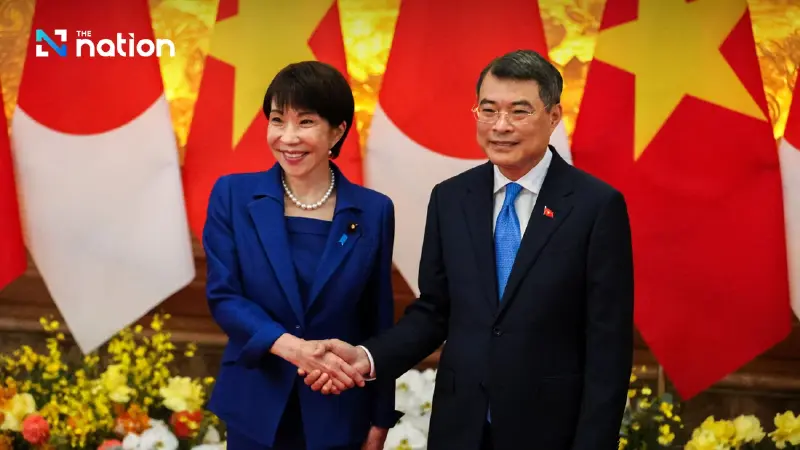


Prime Minister Sanae Takaichi pledges deeper cooperation in critical minerals and energy as Tokyo seeks to bolster regional resilience against Middle East shocks
- Japan and Vietnam have established "economic security" as a new cornerstone of their strategic partnership to build resilience against global supply chain disruptions.
- The alliance will prioritize stabilizing the supply chains for critical minerals and semiconductors, which are essential for high-tech manufacturing.
- To counter energy market volatility, Japan will assist Vietnam in securing crude oil supplies for its Nghi Son Refinery through the Power Asia Initiative.
- The partnership was formalized with the signing of six comprehensive agreements covering areas like infrastructure, climate action, and digitalization.
Prime Minister Sanae Takaichi pledges deeper cooperation in critical minerals and energy as Tokyo seeks to bolster regional resilience against Middle East shocks.
Japanese Prime Minister Sanae Takaichi and her Vietnamese counterpart, Le Minh Hung, have committed to a significant expansion of bilateral ties, pivoting towards "economic security" as a cornerstone of their Comprehensive Strategic Partnership.
During high-level talks in Hanoi on Saturday, the two leaders identified critical minerals, semiconductors, and energy self-reliance as urgent priorities.
The meeting comes at a pivotal moment; while bilateral trade rose by 12.3% to $13.7 billion in the first quarter of 2026, fresh Japanese investment in Vietnam saw a sharp 75% year-on-year decline, falling to $233 million.
A primary focus of the summit was the stabilisation of supply chains for critical minerals, which are essential for high-tech manufacturing and the green energy transition.
"The two sides identified economic security as a new priority area for bilateral cooperation," PM Takaichi told reporters after the meeting. "With regard to critical minerals, both sides agreed to strengthen close coordination to ensure stable supplies and reinforce supply chains."
The leaders formalised their intent by signing six comprehensive agreements spanning infrastructure, climate action, digitalisation, and space technology.
With the ongoing conflict in the Middle East driving crude oil prices higher and disrupting maritime routes, Vietnam has sought Japanese assistance to secure its domestic energy supplies.
Under the $10 billion Power Asia Initiative—a Japanese-led programme designed to bolster energy self-reliance across the continent—Tokyo will assist in arranging crude oil supplies for Vietnam’s Nghi Son Refinery and Petrochemical Complex. PM Hung noted that such cooperation is vital for maintaining industrial stability amid global price fluctuations.
PM Takaichi’s visit also carries significant symbolic weight. On Saturday afternoon, she delivered a keynote address at Vietnam National University, marking ten years since the late Shinzo Abe introduced the "Free and Open Indo-Pacific" (FOIP) strategy.
In her address, Takaichi emphasised the need for regional nations to maintain "autonomy and resilience." PM Hung reaffirmed Vietnam’s support for Japan’s regional visions, noting they align with the ASEAN Outlook on the Indo-Pacific and international law.

The Hanoi summit is the first leg of a five-day diplomatic mission. Takaichi is scheduled to fly to Australia on Monday to meet Prime Minister Anthony Albanese.
Preparations are reportedly underway for a joint declaration on economic security between Tokyo and Canberra, focusing specifically on the stabilising of liquefied natural gas (LNG) and critical resource supplies.
