
Japan's Koizumi concentrated on wording over China at security summit
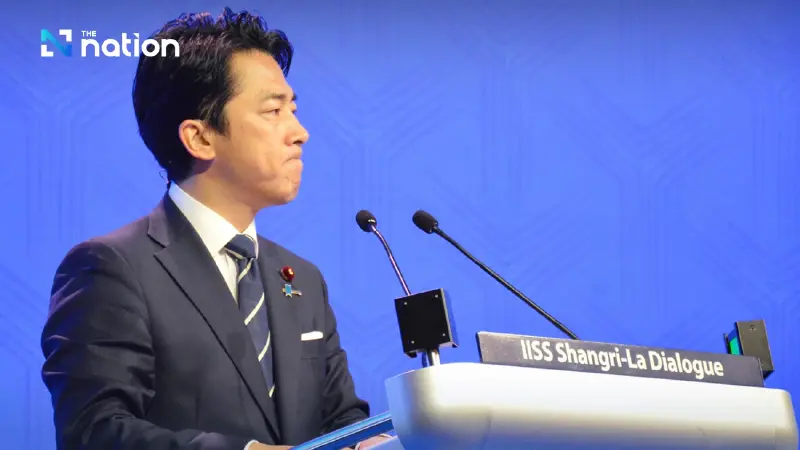


At the Shangri-La Dialogue, Japan's defence chief avoided naming Beijing while rejecting “new militarism” claims and underlining the US alliance.
- At the Shangri-La Dialogue, Defence Minister Koizumi rejected China's criticism of "new militarism" but used carefully controlled language to avoid escalating tensions.
- He criticized China's military arsenal indirectly, referring to "a country that has a huge arsenal of nuclear weapons" without explicitly naming it.
- Instead of direct confrontation, Koizumi repeatedly called for "direct and candid dialogue" and expressed regret that he could not meet with his Chinese counterpart.
Japanese Defence Minister Shinjiro Koizumi used his latest three-day visit to Singapore for the Asia Security Summit, better known as the Shangri-La Dialogue, to respond to China while keeping his language carefully controlled.
In his address on Sunday (May 31), Koizumi rejected Beijing’s criticism that Japan was pursuing “new militarism”, but he avoided wording that could excessively unsettle the neighbouring country.
Without naming China, he said, "There is a country that has a huge arsenal of nuclear weapons and strategic bombers. Japan has neither of these weapons. And yet Japan is labelled 'new militarism.' Isn't it strange?"
The target of the remark was clear, although Koizumi chose not to identify it directly. He also said, "Differences in perception and friction do arise between nations. What is needed at such times is not the repetition of unfounded claims in the other side's absence. What is needed is direct and candid dialogue."
Koizumi voiced regret that he was unable to hold talks with China’s defence minister, who did not attend the Shangri-La Dialogue. "I am feeling sad that we were unable to have the opportunity to have a meeting this time."
His cautious tone reflected Japan’s dilemma.
Tokyo could not leave Beijing’s criticism unanswered, but it has also struggled to find a path towards improving bilateral relations, which worsened after Japanese Prime Minister Sanae Takaichi’s remarks last November about a possible contingency involving Taiwan.
A senior official at Japan's Defence Ministry said the Japanese side kept adjusting the tone of Koizumi’s speech until the last minute.
During the question-and-answer session after the address, a Chinese participant asked Japan to apologise for its activities during World War II.
Koizumi avoided giving a direct response and said Japan’s door to dialogue was always open.
The United States’ stance remains central to how Japan deals with China.
Koizumi sat in the front row during US Defence Secretary Pete Hegseth’s address to the Shangri-La Dialogue on Saturday and was the first person selected by the moderator to ask a question.
Koizumi told Hegseth he was certain of Washington’s unwavering commitment to Asia.
But he said that commitment was underestimated in some countries and asked the US defence chief to send a reassuring message to them.
The Japanese minister appeared to be trying to keep the United States engaged in Asia as Washington shifts some military focus towards the Middle East, while also showing the audience the strength of the Japan-US alliance.
Hegseth, however, used his address to urge US allies in Asia to raise defence spending to levels equivalent to 3.5 per cent of gross domestic product.
He specifically called on Japan to take on a greater burden, saying, "We have high expectations of our Japanese allies, and together we can and must each pull our weight to strengthen the US-Japan alliance."
The issue of higher defence spending was also discussed when Koizumi and Hegseth met later on Saturday.
In the region, Australia and South Korea have set targets of increasing defence spending to 3 per cent and 3.5 per cent of GDP, respectively.
Japan’s government plans to revise its three key security documents by the end of the year.
Many lawmakers in the ruling Liberal Democratic Party, however, remain cautious about setting a numerical target for defence spending increases.
A senior Japanese Defence Ministry official said, "The United States is seeking a high level of contributions."
