
China’s opening-up drive gives Thai exporters new momentum
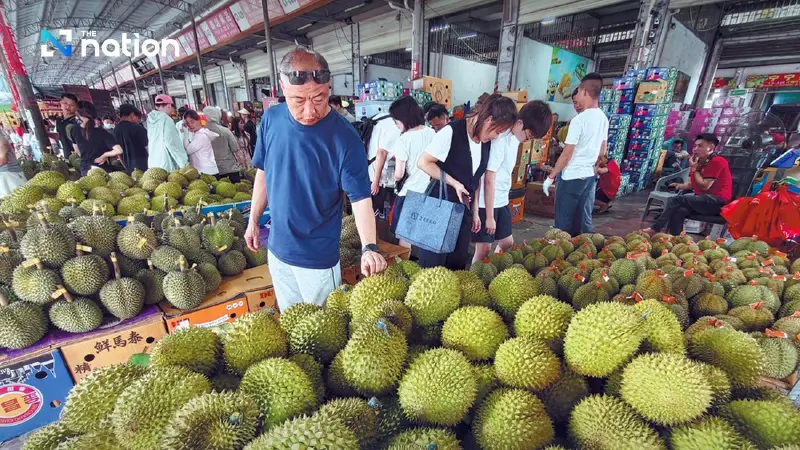


Thai Chamber of Commerce in China leader Phaichit Viboontanasarn says premium durian, cosmetics and services are well placed to benefit as Chinese demand expands.
- China's continued market opening is providing a boost to Thai exporters, particularly for premium goods such as durian and cosmetics, with bilateral trade increasing by 15.1% in 2025.
- Government initiatives like the "Big Market for All" campaign, major trade expos, and policies to lower taxes and widen market access demonstrate China's commitment to welcoming foreign products.
- The expectation that China will become the world's largest retail market, combined with Thailand's geographical proximity, creates significant opportunities for Thai businesses.
- China remains Thailand's most important trading partner, with an increasingly diverse range of Thai products gaining favor among the country's large and sophisticated consumer base.
China’s continued market opening is giving fresh impetus to trade with Thailand, particularly for premium Thai goods such as durian and cosmetics, according to Phaichit Viboontanasarn, vice-chairman and secretary-general of the Thai Chamber of Commerce in China.
Phaichit said he expected China to become “the world’s largest retail market” within the next four to five years, creating significant opportunities for Thai businesses.
He described the Chinese market as “vibrant and brimming with potential”, adding that Thailand’s proximity to China, with flights taking around four to five hours, gave Thai companies a strong advantage if they could better understand Chinese consumer preferences and offer more high-quality Thai products and services.
He said he was optimistic that “meaningful progress will unfold in the near term”.
The scale of the opportunity is already reflected in trade figures.
China’s Ministry of Commerce said bilateral trade between Thailand and China exceeded 1 trillion yuan, or US$147.8 billion, in 2025, marking a 15.1% increase from a year earlier.
Thailand’s Ministry of Commerce also reported that in April the country’s exports to the rest of the world rose 23.1% year-on-year to US$31.5 billion, underlining the growing competitiveness of Thai products.
Phaichit pointed to China’s “Big Market for All: Export to China” initiative, launched by China’s commerce ministry to deepen the country’s opening-up, as evidence of Beijing’s support for foreign goods.
He said he wished to express his “sincere appreciation” to the Chinese government for its steady efforts to open the market further, saying the campaign showed China’s “genuine commitment” to welcoming overseas products and giving Chinese consumers access to a wider choice of high-quality goods.
He added that the approval of China’s 15th Five-Year Plan for 2026-30 was also encouraging because of its emphasis on further market liberalisation.
Major platforms such as the China International Import Expo in Shanghai, he said, were continuing to grow in both scale and influence each year.
Suphajee Suthumpun, Thailand’s minister of commerce, said China remained Thailand’s most important trading partner, while an increasingly diverse range of Thai products was gaining favour among Chinese consumers.
Phaichit said China’s market was expanding not only in size but also in sophistication.
Against the backdrop of China’s high-quality development, he said this was “a moment the world cannot afford to overlook”, and Thailand was no exception.
He also welcomed Chinese consumers to discover Thailand’s products and services, saying the opportunities were “boundless”, while expressing hope that the two countries would enjoy a flourishing diplomatic relationship for the next 50 years and beyond.
Zhou Mi, a senior researcher at the Chinese Academy of International Trade and Economic Cooperation, said China had a vast consumer base across many levels, while the Chinese government continued to prioritise trade and investment facilitation.
By lowering taxes, widening market access and increasing imports of agricultural products, he said, China was helping lower-cost foreign suppliers export with greater trade stability.
Zhou added that China’s market was crucial for import and export companies around the world.
Some products, he said, could gain added value through Chinese industrial chains before being exported more effectively to other markets.
He also said trade fairs, including the CIIE and the Canton Fair, helped promote exports from other countries to China.
