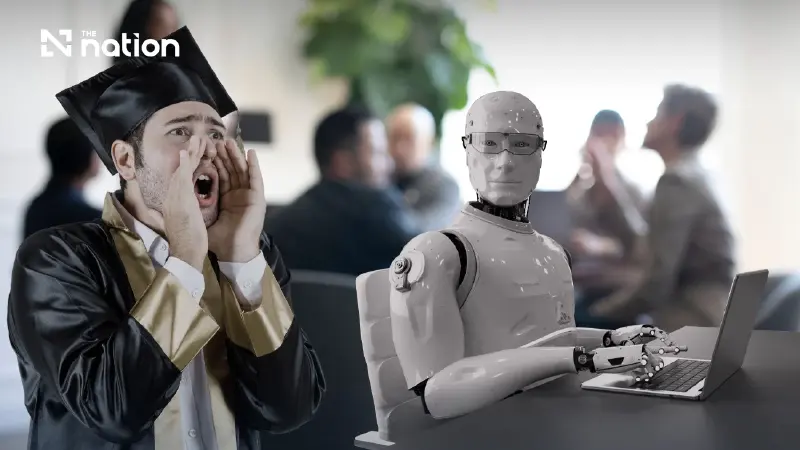
AI anxiety is spreading beyond campuses as students and young workers question whether automation will reduce early-career opportunities
Recent university graduates at several US commencements have booed speakers for promoting AI, demonstrating a visible and growing anxiety about the technology's impact on their future careers.
This fear is intensified by a difficult entry-level job market, with graduates worried that AI will automate or eliminate the very junior roles like research, data support, and content production that serve as the first step on a career ladder.
The graduates' concern stems from their familiarity with AI; having used tools like ChatGPT in their studies, they understand its capabilities and fear employers will use the same technology to reduce hiring.
Recent surveys confirm this sentiment, with a Harvard Youth Poll finding that 59% of young Americans view AI as a threat to their job prospects, and a Gallup poll showing increased anger and anxiety about AI among Gen Z.
Graduation ceremonies are usually built around applause, encouragement and carefully polished advice about the future. But at several US universities this year, one word has been enough to change the mood in the hall: AI.
The backlash became highly visible at the University of Arizona in May, when Eric Schmidt, the former chief executive of Google and one of the most influential figures in technology, addressed new graduates. His speech began in familiar commencement style, reflecting on his own student years and the rise of computing, the internet and smartphones.
But when Schmidt turned to artificial intelligence, some graduates began to boo. The reaction did not stop after one interruption. Each further mention of AI brought more noise from the audience, forcing him at one point to pause and acknowledge the anxiety in the room.
Schmidt attempted to reassure graduates that their fears were understandable. He said many in their generation were worried that the future had already been decided for them, with machines taking over jobs before they had a chance to begin their careers. He argued that AI would become part of every profession, classroom and hospital, and urged graduates to help shape how the technology is used.
Yet the response showed that many graduates were not hearing only a message of innovation. They were hearing a warning about the labour market they were about to enter.
AI becomes a commencement flashpoint
The University of Arizona incident was not isolated. During the 2026 commencement season, similar reactions were reported at other US universities when speakers described AI as a force of progress or compared it with earlier industrial revolutions.
At the University of Central Florida, Gloria Caulfield, an executive at the property development company Tavistock, was booed after describing the rise of AI as the next industrial revolution. The reaction was strong enough for her to pause and ask what was happening before continuing.
At Middle Tennessee State University, Scott Borchetta, chief executive of Big Machine Label Group, also faced boos after speaking about AI’s impact on entertainment and creative production.
The pattern has turned AI into one of the most sensitive subjects of this year’s US graduation season. For executives and commencement speakers, it may represent transformation and productivity. For many graduates, it represents uncertainty before they have even secured their first full-time job.
Why graduates are worried
The anxiety is being fuelled by a more difficult entry-level labour market. Many graduates have been told for years that a degree would open the door to better employment, but the first step into work has become harder for many.
Recent labour-market data has added to those concerns. The New York Federal Reserve tracks recent college graduates aged 22 to 27 with at least a bachelor’s degree, and its data shows that this group is facing a weaker jobs market than older degree-holders.
The pressure is especially visible in entry-level roles. ZipRecruiter’s 2026 graduate report said competition for early-career jobs has intensified, with more applicants chasing fewer openings. It also found that many recent and soon-to-graduate students believe AI is already affecting hiring or could reduce entry-level opportunities.
For graduates, this is where the AI debate becomes personal. Roles that once helped new workers learn the basics of a profession: research, summaries, junior analysis, data support, administrative work and content production, are among the areas where companies are increasingly testing or using AI tools.
To employers, this may look like efficiency. To graduates, it can look like the disappearance of the first rung on the career ladder.
Gen Z knows AI and that may be the problem
The students booing AI are not necessarily unfamiliar with the technology. Many are among the first university cohorts to have studied through the rapid rise of generative AI.
They have used ChatGPT and other tools for research, drafting, brainstorming and coursework. They have seen how quickly AI can write, summarise, code, design and analyse. That familiarity may be one reason their concern is so strong.
Madison Fuentes, a creative writing graduate from the University of Central Florida, captured that tension by saying students were not uncomfortable with AI because they did not understand it, but because they feared it was reducing their work opportunities.
This helps explain why AI can provoke such a sharp response at graduation ceremonies. Graduates are not simply rejecting technology. They are reacting to the possibility that the same tools they used in class could be used by employers to avoid hiring them.
Surveys show a shift in AI sentiment
Recent polling suggests the reaction at commencement ceremonies reflects a broader change in mood among Generation Z.
Gallup’s 2026 survey of Americans aged 14 to 29 found that feelings about AI had become more negative over the past year:
Excitement about AI fell from 36% to 22%.
Hopefulness declined to 18%.
Anger rose from 22% to 31%.
Anxiety remained high at 42%.
Among working Gen Z respondents, 48% said AI in the workplace carried more risks than benefits.
A separate Harvard Youth Poll found that 59% of Americans aged 18 to 29 viewed AI as a threat to their job prospects. The finding placed AI above several other traditional employment concerns, including immigration and outsourcing.
These figures point to a more complicated relationship with technology. Younger users may be among the most active adopters of AI, but use does not necessarily mean trust.
The Thailand angle: high use, low readiness
The debate also carries relevance for Thailand, where AI adoption among students is already high.
Nation Thailand has reported that Thailand leads ASEAN in generative AI usage among students, with more than 90% of Thai students using AI tools and more than 80% of teachers also using them. The same regional research, however, warned of a readiness gap, with institutions still needing stronger training, ethical frameworks and clear rules on responsible use.
At The Nation Visionary Club’s education roundtable, Thai educators and students also warned that AI should support learning rather than replace the process of thinking, questioning and building judgement. Speakers called for clearer classroom guardrails, stronger AI literacy and a shift in the role of teachers from simply delivering information to guiding students through responsible use.
That makes the US backlash a warning beyond American campuses. The issue is not only whether students can use AI, but whether education systems and labour markets can prepare them for a world in which AI is already changing how skills are valued.
Opportunity for some, risk for others
The sharpest divide in the AI debate may be between those who already have careers and those trying to start one.
For technology leaders, AI is often presented as the next great platform shift, comparable to the internet or the smartphone. For graduates facing a tighter job market, the same message can sound less like opportunity and more like displacement.
Daniel Zhao, chief economist at Glassdoor, has argued that the boos reflect real labour-market anxiety among Generation Z. If the economy felt stronger and graduates were finding jobs more easily, fear of AI might not be as intense.
That may be the central point of the backlash. The sound filling commencement halls is not necessarily a rejection of innovation. It is a warning from a generation that has been told to prepare for the future and is now asking whether that future still has room for them to begin.