
Japan students face uncertainty over scholarship interest rates


Higher borrowing costs could add more than 1 million yen to some repayments, fuelling concern over how graduates can save, marry and plan their futures.
- Rising interest rates on loan-based scholarships in Japan are significantly increasing the total repayment amount, potentially by more than 1.2 million yen for a typical student.
- A primary source of uncertainty is that the interest rate is determined upon a student's graduation, not when they first take out the loan, making it impossible to predict the final financial burden.
- This unpredictability is affecting graduates' ability to make long-term life plans, such as saving or marrying, and is also causing anxiety for prospective students and their families.
Rising interest rates are increasing the cost of loan-based university scholarships in Japan, potentially leaving some borrowers with more than 1 million yen in additional repayments.
The heavier financial burden is emerging alongside inflation and rising tuition fees, prompting concern that prolonged repayments could affect graduates’ ability to save, marry or make other long-term plans.
Under fixed-rate scholarship programmes offered by the Japan Student Services Organisation (JASSO), the annual interest rate was 0.07 per cent for students who graduated in fiscal 2019.
It had climbed to 2.423 per cent for those graduating in fiscal 2025.
A student who received 100,000 yen a month for four years, borrowing a total of 4.8 million yen and repaying it over 20 years, would face a difference of about 1.28 million yen as a result of the higher rate.
Students also have little certainty over their eventual repayment burden because interest rates are determined when they graduate rather than when they begin borrowing.
“Those who graduated this spring experienced rising interest rates during their university years,” said Hirokazu Ouchi, a Musashi University professor specialising in the sociology of education.
“It’s too harsh to say that they should bear responsibility” for paying the additional interest, he added.
“The problem is that many young people who continue repayments can’t plan their futures,” Ouchi said.
“The impact of rising interest rates will begin to appear in earnest. Immediate support measures are necessary.”
Loan-based scholarships have become a common source of university funding in Japan.
In fiscal 2024, which ended in March 2025, 51.1 per cent of Japanese university students attending daytime courses received such assistance from JASSO or companies.
The proportion has remained at about 50 per cent since fiscal 2010, after rising from roughly 20 per cent in the late 1990s.
Among those still making repayments is a 32-year-old company employee in Chiba Prefecture, east of Tokyo.
She began repaying a 2.5-million-yen JASSO scholarship a decade ago but still owes 1.5 million yen.
She has used measures allowing her to reduce and postpone payments because of unstable earnings, partly after the COVID-19 pandemic forced her to change jobs from her previous post in the tourism industry.
“I didn’t think it would be this hard to repay,” she said.
“I feel guilty when I think of it as debt.”
Her scholarship is interest-free, although other schemes may carry interest depending on applicants’ family finances and grades.
Uncertainty over future rates is also affecting students who have yet to enter university.
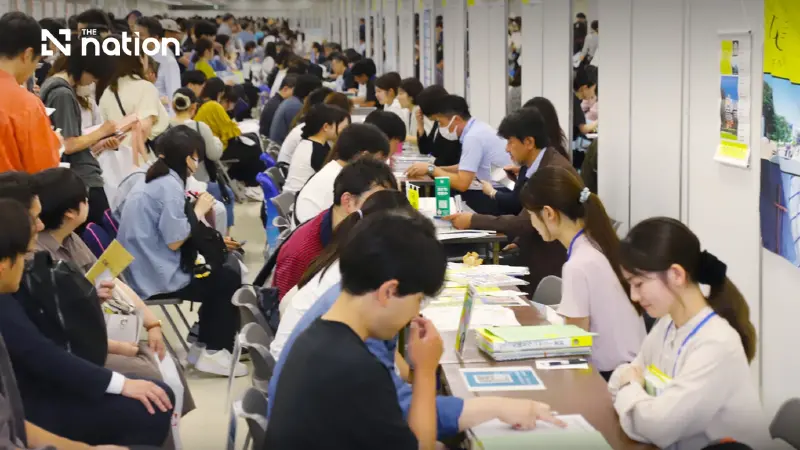
A third-year high school student from Chiba raised the issue after attending an information session organised jointly by several universities in Tokyo last month.
“I want to study the sciences, but considering my possible enrolment in graduate school, the [borrowing] amount will be large,” he said.
“I’m worried because I can’t predict the interest rate on scholarships,” his 52-year-old mother said.
“We are also looking into student loans offered by banks, as their interest rates are easy to understand.”

[Copyright The Jiji Press, Ltd.]
