
Japan’s green curtains cool disaster housing without electricity
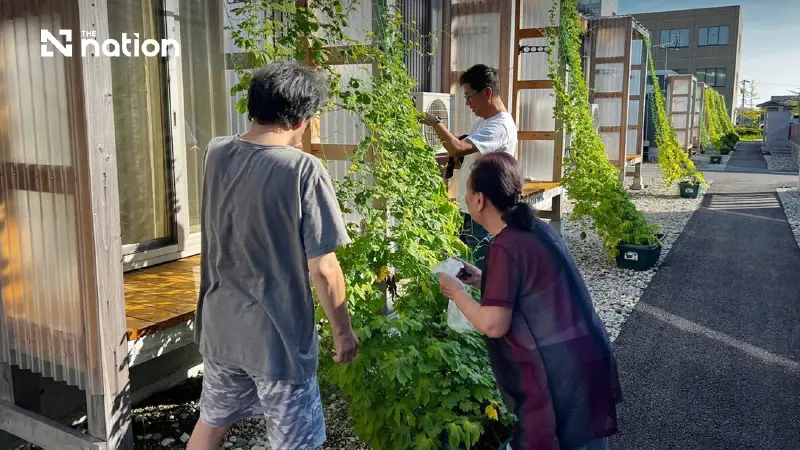


A Tokyo non-profit is using bitter melon and morning glory vines to lower temperatures in temporary homes while helping disaster survivors connect.
- A Japanese non-profit is using climbing plants like bitter melon and morning glory to create "green curtains" that cool temporary housing for disaster survivors.
- These plant-based screens cool homes without electricity by providing shade and releasing moisture, with tests showing a temperature reduction on a sun-exposed balcony from over 50°C to as low as 32°C.
- The initiative has been deployed in various disaster-hit regions, including for survivors of the 2024 Noto Peninsula earthquake and the 2011 Tohoku tsunami, where temporary homes often have poor insulation.
- Beyond cooling, the project also aims to foster community interaction, as the shared activity of caring for the plants encourages residents to connect with their neighbors.
Climbing plants are attracting attention in Japan as a way to cool temporary housing for disaster survivors without consuming electricity during the height of summer.
Midori no Curtain Oendan, a non-profit based in Tokyo’s Itabashi Ward, grows bitter melon, morning glory and other vines across windows and balconies to form “green curtains” at homes occupied by people affected by natural disasters.
The foliage provides shade, while water drawn up through the roots is released as moisture from the undersides of the leaves.
A property developer involved in the initiative tested the effect on a clear August day.
Shortly after noon, the temperature on an apartment balcony exposed to direct sunlight exceeded 50°C, while readings beneath the vine-covered shade ranged from 32°C to 38°C.
The project was extended to communities recovering from the powerful Noto Peninsula earthquake that struck Ishikawa Prefecture in January 2024.
By 2025, green curtains had been installed at 1,356 homes across four municipalities, including Nanao.
In May 2026, the NPO also supported temporary housing for people affected by forest fires in Ofunato, Iwate Prefecture.
For the organisation, the installations are intended to provide more than relief from the heat.
It places importance on social contact in disaster-hit areas, creating opportunities for residents to meet and share their feelings and thoughts.
People living in temporary housing have said that watering the plants helped them speak with neighbours, as well as making their homes cooler.

Yuji Suzuki, 58, chairman of the property company and head of the NPO, said the initiative began in 2003, when pupils at an elementary school in Itabashi Ward started growing vines to create natural screens with support from the firm.
The activity later spread as part of environmental education, leading to the establishment of Midori no Curtain Oendan in 2007.
Nationwide awareness of energy conservation increased after the March 2011 earthquake and tsunami in the north-eastern Tohoku region, followed by meltdowns in three reactors at Tokyo Electric Power Company Holdings, Inc.’s Fukushima Daiichi (No. 1) Nuclear Power Station.
Electricity shortages caused by the disasters led to scheduled blackouts in Tokyo.
Many temporary homes built after the natural and nuclear disasters had thinner insulation than conventional housing, prompting the property company to offer support through the green-curtain project.
“It would be a further tragedy if disaster-afflicted people get heatstroke,” Suzuki said.
By December 2016, the NPO had received about 21 million yen in donations.
With assistance from around 1,000 volunteers, green curtains were installed at approximately 20,000 temporary homes, mainly in the Tohoku prefectures of Iwate, Miyagi and Fukushima.
As the term “green curtain” becomes more widely recognised, Suzuki said: “I hope that creating green curtains will become part of culture.”
