
Tokaido and Sanyo Shinkansen to launch Supreme Class cabins
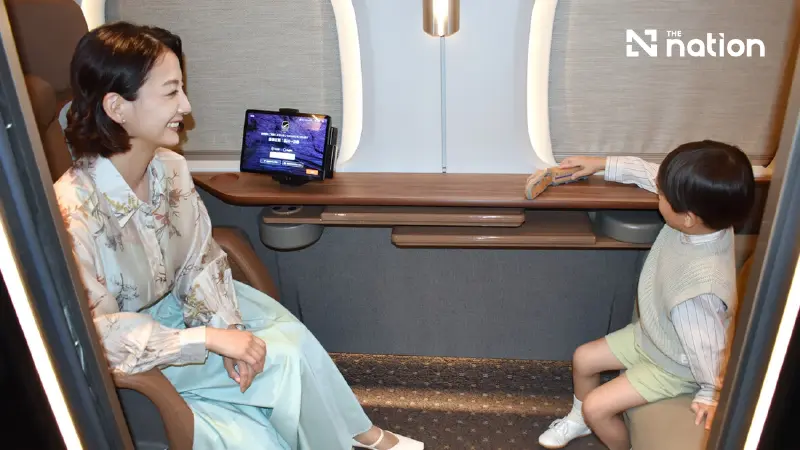


JR Tokai and JR West will introduce premium compartments offering more space, electronic locks and complimentary refreshments from October.
- Starting in October, the Tokaido and Sanyo Shinkansen lines will introduce "Supreme Class," a new premium tier featuring private compartments, positioned above the current Green Car seats.
- The new class will offer private rooms for one or two passengers with amenities like reclining seats, sofas, electronic locks, and a complimentary drink and snack.
- The fare will be significantly higher than existing options, with a one-way adult ticket between Tokyo and Shin-Osaka costing 60,790 yen, which is 41,400 yen more than a Green Car ticket.
- The launch is a response to increased demand for diverse travel choices post-pandemic and a strategic move to compete with the future Chuo Shinkansen maglev line by emphasizing comfort.
Supreme Class Cabin will be introduced on Japan’s Tokaido and Sanyo Shinkansen services in October, placing a new premium tier above the operators’ Green Car seats.
Central Japan Railway Co. (JR Tokai), which runs Tokaido services, and West Japan Railway Co. (JR West), operator of Sanyo services, are behind the launch.
For the Tokaido line, it will mark the return of private compartments after 23 years.
“We hope to offer various services to entertain customers,” JR Tokai President Shunsuke Niwa said.
In car seven, a private room for up to two passengers will combine a reclining seat and a sofa within an area comparable to about three Green Car seats.
Car 10 will contain a separate compartment for one traveller.
The one-way adult fare between Tokyo Station and Shin-Osaka Station in Osaka, western Japan, will be 60,790 yen, or 41,400 yen more than a Green Car ticket.

Electronic locks will secure the compartment doors, while passengers will receive a complimentary drink and snack during the journey.
A JR West official said the rooms were intended to let customers “spend time comfortably and freely without worrying about other passengers”.
Series 100 trains once carried private rooms on the Tokaido Shinkansen, accommodating between one and four people for roughly 1,000 yen on top of the Green Car fare.
Those earlier compartments did not allow travellers to adjust features such as lighting or air conditioning.
The option disappeared when later Shinkansen models entered service without private rooms.
JR Tokai and JR West are reviving it as demand for a broader range of travel choices has grown since the end of the COVID-19 pandemic.
Kazuta Fukushima, a senior researcher at Tokyo-based private think tank Sompo Institute Plus Inc., said the initiative was also a response to the future launch of the Chuo Shinkansen maglev line, now under construction.

“Customers who prioritise speed will be attracted to the maglev service,” he said.
“This is an experiment to explore a new role for the Shinkansen.”
Supreme Class Seat, a semi-private compartment format, is scheduled to follow in the next fiscal year.
East Japan Railway Co. (JR East) is also seeking to make rail journeys a greater part of the travel experience.
From the next fiscal year, it will operate an overnight limited express called Luna Azul, Spanish for “blue moon”, to encourage tourism along the route by making the journey itself the attraction.
From spring to autumn, Luna Azul will run overnight between Shinagawa Station in Tokyo and Aomori Station in north-eastern Japan.
Winter services will operate during the day between Shinagawa and Naganohara-Kusatsuguchi Station in Gunma Prefecture, eastern Japan.
“We recommend watching the Sea of Japan at dawn from the train,” JR East President Yoichi Kise said.
[Copyright The Jiji Press, Ltd.]
