
The handshakes that offer no genuine hope


Play
Despite the appearances of friendly gestures between rival political leaders, our society is even more deeply divided than ever before
It has not been a great fortnight for reconciliation. First, the yellow shirts were outraged by a TV meeting between one of their leaders, Suriyasai Katasila, and red-shirt leader Jatuporn Promphan. Then the red shirts became extremely unhappy with Prime Minister Yingluck Shinawatra after her dutiful handshake with Newin Chidchob.
A government package to compensate “victims” of political violence has failed to make any positive impact. On Facebook, comments were posted deploring the use of “taxpayers’ money” to please pro-government political elements accused of setting fire to Bangkok buildings.
Some may say these incidents can be expected in a society as divided as Thailand. But even that assumption is reflective of how desperate the Thai situation remains. If the handshakes between Yingluck and Newin, and between Suriyasai and Jatuporn, led to nothing but contempt and outrage in certain quarters, there seems to be no light at the end of the tunnel. Like political conflict anywhere else, the men in power started it, but they can’t be the ones who determine how or when it should end.
The brief greeting between Yingluck and Newin was awkward at best and reluctant at worst. The incident before the FA Cup final at the Supachalasai Stadium on Wednesday was probably the second biggest talking point after Newin’s Buriram PEA team’s extra-time winning goal. Newin looked tentative. Yingluck looked a bit hesitant, yet formal. But they are not the ones to judge the nature of their meeting.
The Yingluck-Newin handshake, no matter how formal or cautious it looked, did not escape criticism from the red shirts. During an “Asia Update” cable TV programme, a red leader slammed Yingluck for allegedly not taking into consideration what Newin had done to her elder brother. Adisorn Piengket said Newin’s switch of allegiance had resulted in two years of the Thaksin camp being in limbo. Comments on several pro-red Web boards also echoed Adisorn’s stinging remarks.
The match result presented an irony itself. Newin’s strong team, currently regarded as Thailand’s best, won the tournament sponsored by the Thaicom Foundation, which is chaired by Yingluck. Her brother, Thaksin Shinawatra, must have been anything but happy. Even now, the man in exile is said to still consider Newin to be his worst betrayer. But then again, even Thaksin’s opinion on the Newin-Yingluck handshake will be almost irrelevant. Of course, Thaksin can help bring peace to Thailand, but the country has gone far beyond the day when he alone can decide about war and peace.
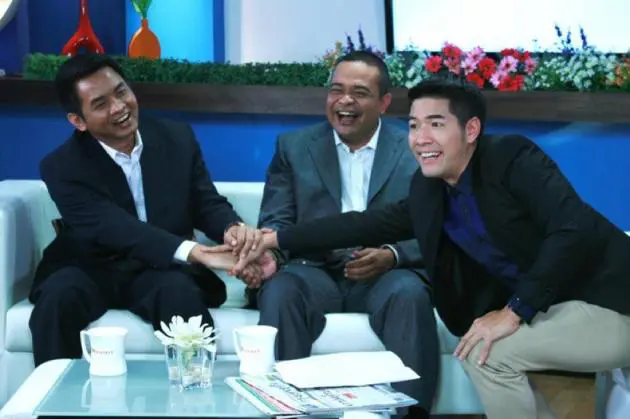
This is not the first time that a meeting between key leaders of rival political camps has sparked a furious reaction. A few days earlier, red leader Jatuporn and yellow-shirt counterpart Suriyasai drew fire from their own supporters after the two men had a very cordial moment being interviewed together by TV host Woody Milintachinda. The ASTV website was overwhelmed by angry comments from yellow-shirt members who wondered why Suriyasai had not consulted anyone first. Jatuporn also faced a similar grilling on red Web boards.
Another confirmation that reconciliation remains a very lofty goal is the lukewarm reaction to the government’s attempt to compensate people affected by the political turmoil. The yellow shirts, who will also benefit from the compensation package, have charged that the government is using them in a bid to reward the red shirts. The red shirts, meanwhile, are seeing the compensation plan as an obstacle to seeking justice for protesters killed in last year’s bloodshed. On Facebook, someone wrote, “See where our money is going. I don’t want to pay taxes anymore”, which triggered a fierce online debate.
All of this simply underlines how difficult it is to reconcile polarised Thailand. Conflicts that at first were limited to key political figures have taken solid hold of people on the street. The country’s political divide started at the top but it is now becoming deep-rooted and widespread. In other words, the leaders of each political camp may have created their own monster that will be very hard to subdue.
