
East Asia and Latin America - a bridge too far and too few?


Play
When it was first set up in 2001, the Forum for East Asia and Latin America (FEALAC) was supposed to serve as a bridge to bring the two vast and rich regions together.
After all, other regions have already joined forces both in North America and Europe as well as Asia and Europe. The whole idea of FEALAC was simple: a better-connected East Asia and Latin America can act together and shared lessons learned in holistic ways not only in trade and investment links but political and social spheres as well. After 12 years, somehow things did not turn out as they have enthusiastically envisaged. There is no showcase to be proud of.
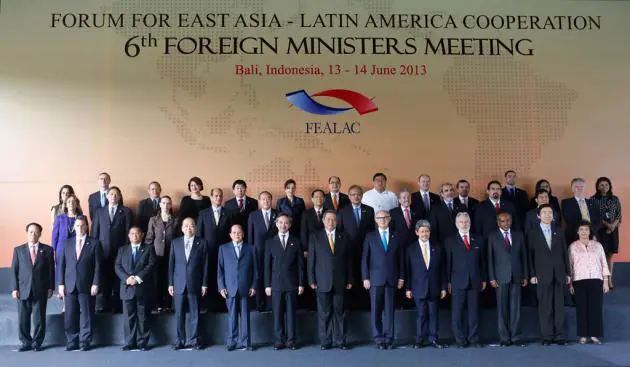
At the ministerial meeting in Bali last week, the 36-member group worked hard to revitalise their cooperation – knowing full well that the window of opportunity is now, given the rapid change in the global system and environment. Of course, one could say that the political will is there, judging from the large number of foreign ministers attending the event. But then, the discussions often boiled down to the great distance and cost.
Given the downward trend of the European economy and global recession, East Asia and Latin America have become engines for the world economy. The two regions are performing very well economically. But their cooperation in non-economic areas is still marginal. They still have to form common positions on global issues such as climate change, poverty eradication, among others. Other areas of cooperation including finance, science and technology, education, need to be strengthened.
The two regions make up 39 per cent of the world population, 33 per cent of world GDP, with total trade topping $13 trillion or 30 per cent of global trade. The FEALAC countries contribute 24 per cent of world foreign direct investment. More importantly, trade between them has grown 20.5 per cent annually, totalling $500 billion by the end of this year. Meanwhile, two-way investment has exceeded $20 billion.
However, the latest figures show that certain members of the FEALAC are doing better in bilateral arrangements than others. For instance, relations between Indonesia and Brazil have progressed by leaps and bounds with increased trade and investment volume. Their newfound friendship was a result of more government contacts, leaders’ visits and exchange of scholars. That helped explain why there is an urgent need to make the FEALAC cooperation more than just relations between two or more countries of both regions. Otherwise, the whole effort to establish the “missing link” as proposed in 1998 by former Singapore prime minister Goh Chok Tong would be forever unfulfilled.
Among FEALAC heavyweights, China, Japan, Brazil, Mexico and Indonesia should take a stronger lead, especially in trade and investment and global issues. Their status in international forums is formidable. Both Brazil and Japan aspire for a seat on the UN Security Council. However, with relations between China and Japan facing difficulties, others must step up collaborative efforts and show leadership.
Asean has long appreciated the potential of Brazil and Mexico. The grouping views them as their future source of investment and technological know-how. Indeed, they are the top candidates to become the first two Asean dialogue partners from Latin America as soon as the grouping lifts its 20-year-old membership moratorium. The other candidate is Turkey. Brazil signed the Treaty of Amity and Cooperation in 2011.
At the Bali meeting, several good recommendations were made by the FEALAC Vision Group. One of them is to increase the connectivity of the business, academic and media community. FEALAC business leaders should get together ahead of their ministerial meetings so they can provide valuable input and recommendations. Business leaders’ summits and various forms of linkages in Asia Pacific Economic Cooperation (APEC) and Asean have helped to increase investment flows and promote trade volume. The FEALAC could do the same.
Promotion of area studies in respective regions along with exchange of scholars and cooperation of university networks and think-tanks is another priority. Some Asean ministers lamented the lack of East Asian Studies in Latin America and vice versa. Exchange students would also deepen understanding of these two dynamic regions. Except for Chinese students, students from East Asia going to Latin America are few. In the near future, experts from the regions should get together and identify common ground on global issues and areas of researches. Their intellectual outcome could provide input for their leaders.
Except within the official circle, very few media outlets know about the existence of the FEALAC, let alone writing about it. Four Thai journalists joined the delegation in Bali to report on the meeting – and they were the largest group of foreign journalists. Thailand and Costa Rica will jointly serve as FEALAC coordinators for the next three years. As such, Thailand will have the opportunity to shape some of the development agenda concerning food security, small and medium enterprises, production and universal healthcare system. Next year, Bangkok will host a series of FEALAC-related meetings, including a business forum and academic seminar. At the top of the agenda is the effort to push for the first FEALAC summit. Their leaders have met at UN-related forums and Apec meetings.
In the past 10 years, links between Thailand and Latin American countries have increased greatly. Thai tourists enjoy visa-waivers in several key Latin American countries, which have promoted people-to-people contacts and tourism. Look around – Argentinian T-bone steak, Chilean wine, Mexican enchiladas and Peru’s Big Cola and Brazilian salsa are popular over here.
