
Threat in southern Philippines is far from over


Play
Nearly two weeks of clashes between Philippine government forces and a splinter Muslim rebel group in the southern city of Zamboanga have glaringly exposed the security challenge that will be faced by a self-governing Islamic homeland that is in the proce
A peace deal with the country’s largest Muslim rebel group, the Moro Islamic Liberation Front (MILF), now seems to be in the home stretch.
After four decades of insurgency, Muslim-dominated communities in the south, home to 4 million people, are fervently hoping for a peace dividend to enable this chronically poor but resource-rich region to fulfil its economic potential.
But the mayhem in Zamboanga – started by a faction of another Muslim rebel front – has starkly demonstrated that even with a final peace agreement with the MILF, there are still plenty of threats to lasting peace and a chance at prosperity.
“The peace process between the government and the MILF is already being challenged by other armed groups,” says Professor Rommel Banlaoi, director of the Philippine Institute for Peace, Violence and Terrorism Research.
The conflict areas on Mindanao, the country’s second largest island, are the stomping grounds of rebel groups of various stripes, extremists with terrorist agendas, and political strongmen, both Muslim and Christian, with armed private groups.
Veteran rebel leader Nur Misuari is believed to be behind the violence in Zamboanga. His rebel front launched the insurgency in the 1970s, eventually forging a peace deal with the government, which he claims was not properly implemented.
But Misuari is widely perceived to be a marginal and embittered figure, albeit with a loyal – and well-armed – following. More than 300 of his men besieged parts of Zamboanga.
All this raises the possibility of a revolving door of peace – and pacification – efforts even after a final agreement is signed with the MILF. President Benigno Aquino aims to do this before his term ends in mid-2016, following the signing of a framework pact last October with the MILF in Manila.
Jose Lorena, a former peace negotiator for Misuari’s rebel group during the 1990s, noted that the October agreement extended beyond the MILF.
“The framework agreement is with the Bangsamoro, not the MILF,” said Lorena, using the name of the proposed Islamic homeland and its people.
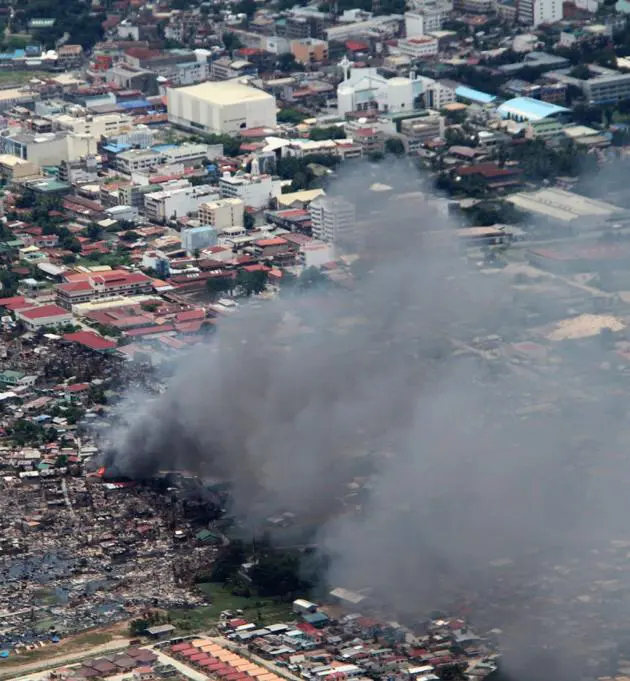
Since the rebel attack in Zamboanga on September 11, several hundred houses have been gutted by fire, more than 120,000 residents displaced, and more than 100 people killed, most of them rebels.
Philippine police have filed rebellion and criminal complaints against 29 Muslim commanders and insurgents who allegedly occupied the coastal communities and took some 200 hostages as “human shields” to deter attacks by government troops.
While fighting was raging in Zamboanga, a new round of peace talks with the MILF was being held in Kuala Lumpur. In a statement last Thursday, at the end of nine days of talks, the government’s chief peace negotiator Miriam Coronel-Ferrer said the new institutions of a self-governing Muslim region “must allow for all taking the path to peace to participate, and isolate those who continue to hold on to violence as the way of life or mode of politics”.
To this end, many would like to see the MILF, which has an estimated 12,000-strong force, bring violent rebels to heel and address a sizeable threat from extremist groups, such as the Abu Sayyaf, ahead of a final peace deal.
But its leaders seem reluctant to do this; a reflection, perhaps, of the web of blood and kinship ties among rebels and extremists despite their different affiliations and agendas.
