
Myanmar marches towards moment of truth


Play
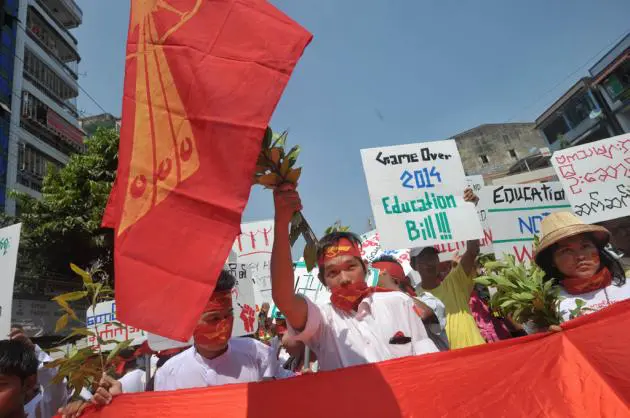
At the forefront of political activism since colonial times, student movements are rising once again in a nationwide protest
Following the 1998 crackdown on student-led demonstrations that killed 3,000 unarmed protesters, most of them students, the Myanmar military shut down all universities and colleges for a decade. Prestigious seats of learning like Yangon’s Institute of Technology and its Arts and Science University were sealed and their equipment confiscated. New colleges were built in remote areas with poor facilities in order to separate students from city folk. Under the direction of Education Minister U Thaung, the military regime set about systematically degrading higher education by employing under-qualified teachers and handing out MAs and PhDs unearned to students.
In contrast, military academies were offered the best equipment, facilities and teachers. The aim was to create a generation of military graduates more knowledgeable than their civilian counterparts in science, economics and other fields. They were not only being trained for combat but also to run the country.
Now, student activists are demanding changes to that system and an overhaul of the national education policy approved by parliament a few months ago.
Last month, when the government failed to meet their ultimatum for four-party talks between students, parliament, the government and the National Network for Educational Reform (NNER), students rallied in the second city Mandalay and began marching the 650 kilometres to Yangon. Students and teachers around the country joined in that quest and were supported by local people in every town and city. The government sent university rectors to negotiate with the students and an agreement was reached to hold the four-party meeting on February 1 in Yangon. But after one day of talks, authorities moved the meeting to the capital, Nay Pyi Taw. Next day, the government promptly announced that talks had been postponed until after February 12, and President’s Office Minister U Aung Min questioned whether the student delegation had any mandate to make decisions for the students. Outraged, the delegation gave the signal to recommence the marches to Yangon.
Fears of a violent crackdown
Interior Minister General Ko Ko responded with a televised speech, warning he would take action against those who were pulling the strings of the student movement. The warning triggered fear among protesters, their parents and ordinary folk that the government was plotting a repeat of the violent crackdowns against student movements of past years. Parents and citizens joined the marches in a bid to guard the youngsters.
Unable to stop the marching, the government called on student representatives to resume talks on February 11. It was a calculated move to kill two birds with one stone – stop the marching and deflect attention from the 100th birth anniversary of General Aung San, the father of opposition leader Aung San Suu Kyi.
So far, the government’s response to the protest had followed the pattern set by previous military regimes – hardly surprising given that it is made up of the same people as its military predecessor, only in civilian clothes. They view any protest with a military mindset – as an enemy force to be destroyed, using force if necessary. First they will ignore it, then watch how it develops, before arresting the leaders if the movement dies down. If it grows, they will use force to quell it.
But times have changed, and under the climate of semi-democratic rule the generals need to show their new international partners they are reforming. Unfortunately, their mindset and skills remain geared for the battlefield rather than the negotiating table. When they do negotiate they make sure to retain the upper hand over the opposition, whether students or armed separatist groups, so talks can never end in agreement.
Meanwhile, Aung San Suu Kyi’s National League for Democracy has not only stayed away from the protest but also fired Dr Thein Lwin, a member of the NLD’s central committee who also sat on its education committee. Dr Thein Lwin is a leading member of the NNER who took part in the four-party talks with the government.
Other political parties are also staying away from the protest, afraid of drawing government accusations that they are destabilising the country, which carry the risk of being disqualified from the coming elections. The people want change, but no political party has the power to change the current system, including the NLD. This realisation has only strengthened support for the students, whom the populace is relying on to help push much-needed reforms.
Govt’s slippery tactics
On February 14 negotiations between the students and the government seemed to deliver a breakthrough, with agreement on a draft education bill that incorporated the 11 principal concerns of protesters, broadly to loosen government control over educational institutions and expand access to education. Provisions included a decentralised curriculum and native language instruction in classrooms in ethnic minority regions.
Three days later, however, the students accused the government of reneging on the agreement by relegating the draft bill to a “proposal” and going ahead with its own legislation. Authorities also failed to drop their threat of legal action against the protesters.
In the meantime, the government is playing a waiting game, hoping to sow division by questioning who really represents the students and secretly inviting student leaders not taking part in the march to attend the four-party talks.
The authorities are also suspicious that behind the protest for changes in education lies a bigger plan for regime change. If the students stick with the main agenda and focus on educational policy, they can achieve their ends in the near future. The must focus on two goals. The first is to set up fully elected student unions in every university and college, then call a nationwide conference to form an umbrella organisation for students. Second, they must demand that student union offices run all student activities on campus. Achieving these two goals will give them power to make decisions on the future of higher education.
Ultimatum from students
The students have given parliament until Saturday to amend the education law.
The government now faces a choice: to use force to suppress the student movement, or opt for negotiations, compromise and a peaceful resolution. If it chooses force, it risks igniting a repeat of the nationwide demonstrations we saw in 1988. Only this time, the now-semi-democratic government would be under far greater pressure to abide by the law and would find that an information blackout to smother the protest was no longer possible in this age of smartphones and digital cameras.
Htun Aung Gyaw is a former chairman of the All Burma Students Democratic Front. He is currently based in Tokyo.
