
A Bangkokian writes from Nepal's disaster zone


Play
Rushing back to help victims in his homeland, Sushil Kumar Koirala found a scene of devastation still beyond the reach of government relief efforts
Fourteen days after a 7.8-magitude earthquake struck Nepal, the country is reeling from destruction on an unprecedented scale, and the loss of life as well as massive economic damage will certainly slow down progress in our already impoverished nation.
It was 1.13pm Thailand time when I received a call from a Nepalese colleague who works in our Bangkok office.
The news was: “Nepal has suffered a massive earthquake with reports of many casualties.” When the initial disbelief subsided, we frantically tried to reach our families. But the phone lines were dead. I finally got through to my brother-in-law at 3pm and learned that everyone in my immediate family was safe.
As we followed the news, the scale of the catastrophe became more and more apparent. We felt helpless so far away, but began reaching out to Nepalese friends in Bangkok and seeking donations for essential supplies. Thais who heard about our efforts were eager to help and several donors stepped up with offers of tents and medical supplies. Everyone we know chipped in, some with necessities, others with cash – a taxi driver even waived my fare.
The care and support shown by Thai people and their government has indeed been very touching.
My immediate priority was to catch a plane home to assess the damage and help coordinate relief efforts. Three days after the quake struck, I caught a THAI flight to Kathmandu. Onboard were a group of journalists, rescue workers and a medical team from the Health Ministry. The mood was sombre. Travelling back to the city I grew up in and truly love, I wondered if I could withstand the scenes of carnage.
Landing in Kathmandu
Carrying only hand luggage, I disembarked and headed straight for a prearranged rendezvous with a group of friends and began arranging to meet up with others. I then visited five major hospitals, checked out the damaged in Kathmandu and drove to Bhaktapur 12 kilometres away. The solidarity, care and concern shown by communities was overwhelming. Just three days after the disaster, many had their smiles back. Nepalese resilience and strength shone from the faces around me.
My initial impressions were dominated by the presence of international rescue teams working closely with the Nepalese military and police to extricate the trapped and injured. The massive overflow of trauma cases was subsiding. I breathed a sigh of relief as I climbed into bed in a still very shaky Kathmandu house.
But my father had delivered worrying news: many friends and acquaintances were still out of reach. I asked him to keep trying.
Rescue mission
By the next morning, it was clear the eastern highlands had been hit especially hard, with news that whole villages had been flattened.
My family hails from this area, and I asked one of my cousins to join me on a trip back to our village. We packed a tent, food and medical supplies.
By the time we reached Sukute, a small trading town 67km from Kathmandu, the extent of damage was clear. Gyanu Bhandari, a local businessman, told me he was in his shop when the ground began shaking. Grabbing his wife’s hand he ran outside. Their home collapsed mere inches behind them. The ground was shaking so fiercely that locals had to huddle in circles to stay on their feet.
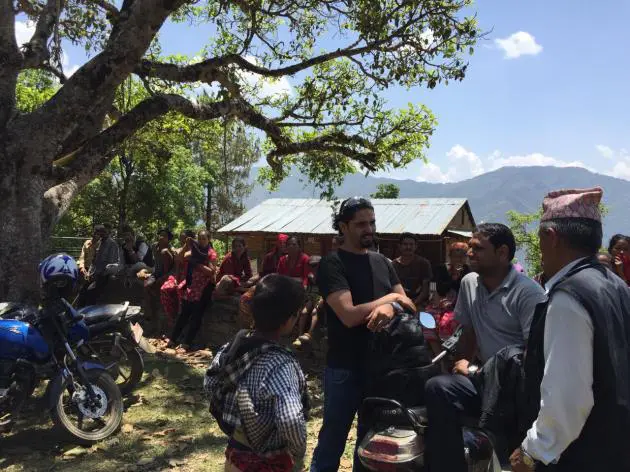
During our 11km drive to the village, we flagged down a passer-by, who said the destruction of property was massive but loss of life was minimal. In fact, the two districts of about 19,000 households had recorded just 32 deaths in the quake.
At the village, the policeman in charge told me his team had been unable to contact commanders since the quake. I met with a district official to learn how we could best help.
Initial assessment suggested that those with major injuries had either been taken to hospitals in the cities or were unable to reach health posts. We were told that people had salvaged belongings from the rubble and managed to patch together makeshift dwellings from debris.
Spending the night in my tent under pouring rain, I realised that people needed immediate help to survive – it was very cold. So I called my wife in Bangkok and asked her to coordinate a wider relief effort. The following day, my friends, family and I started collecting funds to help those in dire need.
Finding tents, medical aid
Realising that the most urgent need was shelter, I began working on arranging for tents as none were available in Kathmandu. Volunteers brought in what they had and started collecting donations to buy more. We ordered 500 tents from two towns bordering India, but only 350 arrived. The remainder were “lost” along the way. The tents were then swiftly transported to the village development committee (VDC), where I was building a list of the most urgent recipients, securing a supply route and arranging logistics.
We also began working with paramedics to set up a system to treat minor injuries and replenish medical supplies needed for post-disaster healthcare.
To our surprise, once we set up the system, a lot more people with minor injuries started coming in. It was more than we initially expected, so we brought in three doctors and six paramedics to set up a medical camp. The camp could provide treatment to 360 people, a significant number of whom did not have injuries related to the quake.
Meanwhile, we worked round the clock to get everyone on board, as there is a very weak government presence at the VDC level. There has not been an election in 18 years and the local VDC secretary is overseeing three committees. Also, the post-conflict mindset among political groups makes it very difficult to forge any consensus.
At the beginning, I was adamant that supplies go through local authorities, as they were better informed about the conditions and needs of villagers. When another relief group began distributing food rations, we decided it would be better use VDC authorities to coordinate the work. But that was easier said than done. The supplies were just not enough to cover the 2,000 destroyed households, and chaos broke out as villagers became more desperate and angry. We had to seek more help, and a team of Nepal Army officers was deployed to provide security during the distribution of tarpaulins, rice and other supplies. That relief supply reached the Thokarpa VDC of Sindhupalchowk district in eastern Nepal on May 2 – a week after the earthquake. We are now working to ensure it won’t be the last. Based on information we received from locals, no other aid apart from that from our group has reached villages yet.
SUSHIL KUMAR KOIRALA, who works as programme manager for Monitoring Access to Treatment in Asia, has formed a group called “Survivors” to provide shelter and medical aid, before helping to rebuild schools, homes and lives in the village.
Visit www.facebook.com/The15Survivors.
Twitter: @The15Survivors
