
'Friendship intact, but not business as usual'


Play
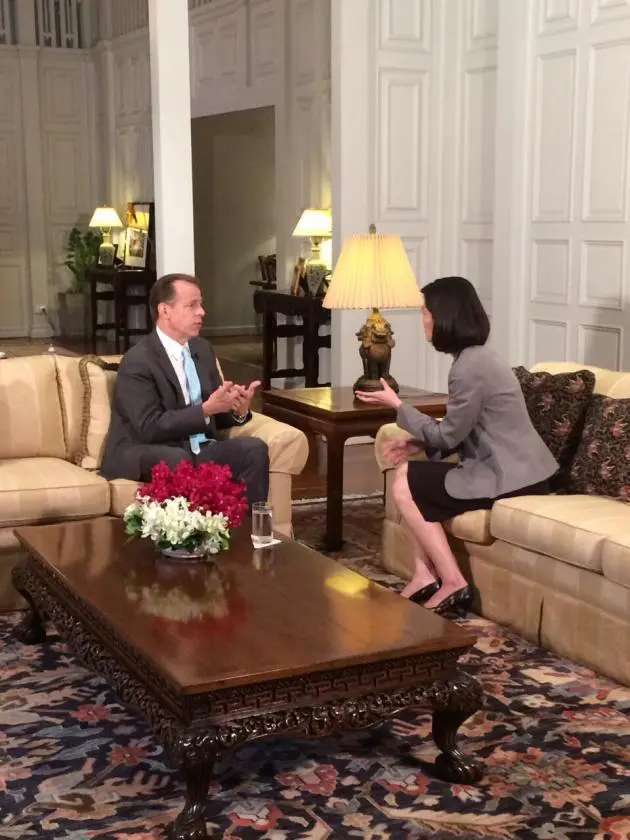
A veteran diplomat of 35 years with expertise in North Korea and nuclear issues, new US Ambassador Glyn T Davies talks to Veenarat Laohapakakul in an exclusive interview with the Nation Group
Deputy Prime Minister Wissanu Krea-ngam met with you and explained Thailand’s road map to
democracy. Was it acceptable to you?
I don’t think that it’s a question of the United States accepting or not accepting Thailand’s road map. What’s important is that the road map be acceptable to the people of Thailand. What we hope to see, as a friend of Thailand, is a process begin to open up so that the people of Thailand can discuss their future and ultimately discuss the new Constitution once it’s written.
Did the meeting with the deputy prime minister aid your understanding of the political situation in Thailand?
This word “understanding” is used a lot. I think it’s a loaded word. I don’t want anybody to think the US is here to be the judge, the jury, or we must understand or not understand. We are following the situation here. We want the best for Thailand. We’ve been friends for so many generations, for nine generations. We want Thailand’s future to be bright. We want Thailand’s politics to be stable and successful. For us, this means a democratic future for Thailand where everyone can participate.
Some Thais say that you have applied high standards and offered harsh words to a friend at a time when what we need is your understanding of the situation. Thailand is US’s oldest ally in this region, but some people here are starting to question what kind of friendship this is.
We have five allies in Asia, with our relationship with Thailand being the longest in Asia. Thailand is the only country that is not yet a democracy, but you have democratic traditions. We think that it is something you aspire to. If Thailand feels that the US is somehow pressuring Thailand, it is not the impression that we wish to leave. But as a friend of Thailand, among the very best friends, we hope that Thais understand that only friends can sometimes really tell the truth to another friend. Thais should take to heart our aspirations for your future, which I think are the same as Thais have for Thailand – to once again achieve its leadership role regionally, to play a strong role economically, and serve as a beacon in democracy. All of these things we hope to see Thailand achieve once again. It’s not pressure; it’s words from one friend to another.
US officials have in the past been seen as taking political sides by visiting only certain parts of Thailand and talking only to a certain group. Will you seek to change that perception?
With the greatest respect, we don’t choose sides, we choose principles. We don’t back particular parties. We want to support the aspiration of the Thai people. We have learned after 230 years of our own experience of democracy that it’s a very hard thing to do. We have many challenges. We have a civil war in which 600,000 people died. We know how hard it is. But we think that through the establishment of the institutions, this will guarantee the greatness that Thailand deserves. It’s not true that we visit only certain parts of the country or talk only to a certain group of people. We try to talk to everyone and try to understand the situation here as well as we can. My intention is to go everywhere and talk to everyone. It’s very important that I start this process talking to the current leaders of Thailand and that’s what I am doing.
Do you feel uncomfortable about being an
ambassador in a non-democratic country?
No, not at all uncomfortable. There is so much else that binds our two countries, for nine generations. All of the work that our businesspeople do in trade and economic relations, all of the work that our wonderful doctors and scientists do to look for cures for diseases and work on the environment, all the work that ordinary Thais and Americans do going back and forth. There are now 7,000 Thai students in the United States and there are Peace Corp volunteers here. There are all kinds of activities over the spectrum. This is where I think the true strength of the relationship between the US and Thailand lies. This is one of the things I want to emphasise, increase, build on and improve in the future.
So are you opening a new chapter in Thai-US
relations?
The occasion of the arrival of the new US ambassador, especially after 11 months of no one here in my role does provide for an opportunity for some new departures. I will do things in my fashion. I have been a diplomat for 35 years. I have a certain style. I will apply that to my job, but people shouldn’t conclude that the US is going off in a completely new direction, because we are not. Our policy remains largely unchanged, but I will be emphasising different things as I learn more, listen and evaluate the situation here. I will try to open up new avenues of cooperation and new ways that we can strengthen and deepen our ties and friendships.
Does the time it took you to arrive reflect the
significance to the US of its relationship with Thailand?
Oh goodness no! You need to give us space for our political system. The way it works, is the president announces the candidate to be ambassador and then I had to be approved by the Senate. Our founding fathers back in the 18th century created this system that is deliberate and a little bit slow. It took me a while to get out here, but that is not at all a reflection of anything less than the greatest respect and friendship for Thailand. There are many other cases like that, with some longer than a year. I am sorry it took so long. I was more eager to come here than anybody. I wanted to get out here the minute somebody whispered to me you have the possibility of going to Thailand. I said, let me go tomorrow, but we have to go through this long process, that’s all.
You have a lot of experience of North Korea and nuclear issues, which are difficult issues. Were you sent here because Thailand is becoming a
difficult issue for the US?
No. My coming here has nothing to do with my previous job about North Korea. It has everything to do with the fact that 30 years of my career, I work with very close allies of the US. Jackie (his wife) and I were posted in Paris for three years, and were posted in London for four years. When I began to work on Asia, I was the No 2 person in our bureau that deals with all of Asia. People who are saying that because I work on North Korea, that’s why I am sent here as some kind of a gunslinger to deal with a problem, that’s not right.
Are US companies still interested in investing
and doing business in Thailand in this political climate?
Absolutely. There is a great deal of interest in doing business in Thailand. I went to Rayong province and we saw the economic dynamism that is there. There is great eagerness to come here and marry up American technology and know-how with Thai talent. You have a very talented workforce here. Many American corporations are interested in moving here, investing here. They are looking for stability too but they find in Thailand a central place to operate with a great workforce and also a terrific place not only to move into the Thai economy but export from here to the region and to the world.
So whether we have military-backed or democratic governance is not important, right? It’s business as usual.
It’s not business as usual because of the coup. It can’t be, because our law in the US states very clearly that when an elected government is overturned by a military junta, that will trigger certain steps in the law – the suspension of certain assistance. And also, we haven’t had contact at some senior military levels. That leaves a great deal of other work, however, that we can do, like on the health agenda, environment, science, and people-to-people contact. Even though we are not, strictly speaking, at business as usual, there is still a lot of business that we can do. I would like to put emphasis on that.
The second and final part of this interview will be published tomorrow. The interview will also air on Nation TV’s “Mong Rao Mong Lok” programme this Sunday at 9am.
