
Towards strategic equilibrium


Play
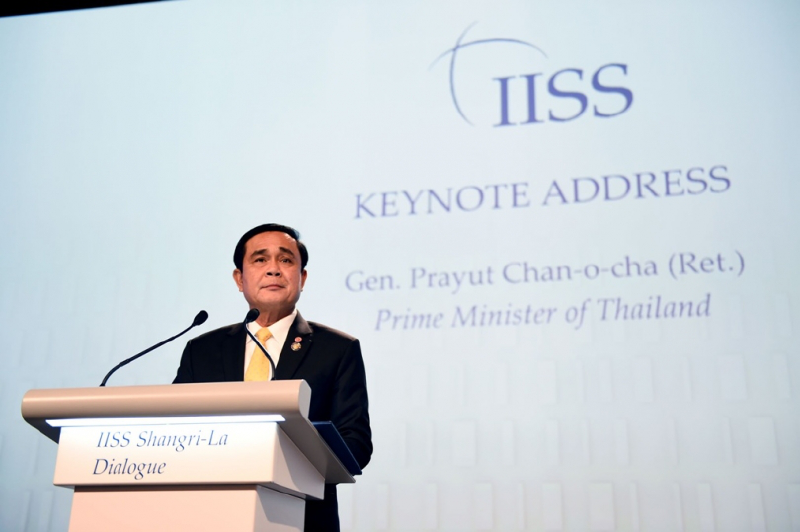
Speech by Primne Minister General (Prayut Chan-o-cha at the IISS Shangri-La Dialogue 15th Asia Security Summit at Shangri-La Hotel, Singapore, on Friday
It is indeed an honour for me to have been invited by the prime minister of Singapore and the director-general of the IISS to give the keynote speech at this year’s Shangri-La Dialogue. The success of your discussions and exchanges of ideas throughout the past 15 years prove that the Shangri-La Dialogue plays a constructive role in promoting regional security cooperation.
Fourteen years ago, Mr Lee Kuan Yew, Singapore’s founding father, was the first leader in the Asia-Pacific region to give the keynote speech for the first Shangri-La Dialogue, and his observations regarding the regional security situation remain relevant today. The key players remain largely the same, but the security situation has become more complicated, interconnected and challenging. .
The security of all communities, countries and regions are now interconnected, and the world is increasingly interdependent. We face important challenges that affect global stability, whether traditional threats such as the conflicts in the South China Sea and on the Korean Peninsula, or non-traditional threats that are a common global concern, such as challenges to democratisation, energy and food security; natural disasters and diseases; international terrorism; drug trafficking; climate change; haze; cyber-crime; illegal, unreported and unregulated fishing; human trafficking; irregular migration. Thus, maintaining security equilibrium has become increasingly difficult.
Thailand is an example of a country that has perhaps lost its equilibrium in the past several years, despite having been successful in maintaining a good balance and equilibrium in the past, even in times of crisis. But now, through cooperation between many sides both within Thailand and internationally, Thailand is getting back on track even though a number of challenges remain to be addressed.
We live in a globalised world with advances in transport and communications technology, which causes both crisis and opportunity. The international community is gradually moving from a mind-set of “One Country, One Destiny,” to “One World, One Destiny.” The challenges are increasingly transnational, hence from now on, we must share not only in each other’s happiness and success, but also in each other’s trials and tribulations. Countries should therefore join together to consider how to resolve problems and address the common challenges on the basis of mutual benefit, aiming to increase mutual trust and confidence.
Regional architecture –
lacking proper equilibrium
The end of the Cold War brought about changes to the regional architecture, creating a multipolar situation without clear-cut rules and regulations, which led to uncertainty and represents a growing challenge for the region, particularly for small and developing countries, creating a regional architecture that lacks proper equilibrium.
Many countries wish to expand their role in the region, due to the security and potentials of the Asia-Pacific region. The United States has its rebalancing policy and its move forward on the TransPacific Partnership (TPP). In addition, China has its “One Belt, One Road” policy and is seeking to advance free trade, while Russia has focused on Asia and the Eurasian Economic Union, and India has its “Act East Policy.”
The United States, China and Japan remain the most important players in the region, while India, Russia, Australia, South Korea and Asean are becoming more important. As for China, many countries remain anxious of its economic growth and the security capabilities development, even though it thinks that they are being carried out in a peaceful and constructive manner. Asean must therefore be united and increase its role in building a strategic new equilibrium in the region to support an atmosphere of peace and enable all sides to abide by principles, regulations and values that are universally accepted as constructive.
Concept of regional equilibrium
Addressing the various problems that affect global security together can be done through understanding, cooperation, giving one another support and encouragement, and giving opportunities and support to countries facing internal issues so that they can solve domestic problems by themselves. In our quest for a new equilibrium, common goals for regional and global security are needed, and 4 such goals are: Secure Peace; Sustainable Growth; Shared Prosperity; and Preserving the Planet.
This new paradigm is built on a foundation of “3 Ms” – Mutual Trust, Mutual Respect and Mutual Benefit.
Guidelines for cooperation
There are 7 important features in ensuring balance and building sustainable security in the region:
l Promoting trust and confidence between countries in the region.
l Creating equitable and supportive partnerships through regional groupings or trilateral partnerships on the basis of each country’s capabilities so as to bridge gaps and disparities in all areas.
l Avoiding the trap of having to choose sides or engaging in partisan divides. Today’s world is multipolar, and small and middle powers must seek friendly engagement with other countries .
l Promoting cooperation between major powers
l Countries should think of sovereignty in less traditional terms in order to support collective security in the long term. The examples of the founding of Asean, which was founded 49 years ago, and the establishment of international organisations across the globe are models of promoting mutual security, mutual benefits, and respect for the rule of law and international law.
l Promoting development in tandem with security. Security is the foundation for building economic, social and cultural prosperity. Thailand therefore places importance on addressing the root causes and focusing on development from within by laying down a secure and sustainable foundations, whether in terms of politics, economics and society, and initiated the “Pracharat 4Ps” policy (Public-Private-People Partnership) so that all sectors of society are involved in the country’s development. In all this, we are guided by His Majesty the King’s Sufficiency Economy Philosophy (SEP), which is based on His Majesty’s development experiences accumulated over the course of 40 years and which places the people at the core.
As Thailand is chair of the Group of 77 in New York for the year 2016, we see SEP not only as a mean to support efforts to decrease the disparity between countries in line with the 2030 Agenda for Sustainable Development of the United Nations, but most importantly, it is a way to address problems through development cooperation, finding the potential of every country and facilitating collaboration, without leaving any country behind, so that we can stand dignified on the international stage.
I believe that soldiers should not limit their roles to safeguarding their country’s sovereignty, but should also play a role in supporting their country’s development by laying the foundations for sustainable security, a role which is enshrined in all of Thailand’s constitutions.
Thailand in Transition
The security of every country and the region is intertwined. Thailand’s future is therefore connected with the stability, prosperity and to regional security of Asean. Thailand stands ready to play a constructive role in laying the foundations for sustainable regional security. Thailand is in transition towards a strong and sustainable democracy. We are facing many complex challenges to our security, while our national security has been affected by poverty, social disparities, the middle-income trap, a fall in agricultural output as a result of drought, and falling commodity prices brought on by the global economic slump.
Thailand has also been experiencing unrest in the southern border provinces, which is an internal problem and not a conflict stemming from religious tensions or one with foreign involvement.
In addition, Thailand is encountering many difficulties that have come with irregular migration and the need for foreign migrant workers who number in millions and this has led to many social problems, problems with human trafficking and IUU fishing, including crime and human rights violations, which Thailand is fervently expediting the process of addressing these problems.
Our key problem recently has been political conflict and unprecedented divisiveness in the country, which has stemmed from a political setting that has produced democracy only in form but not in function. The rampant corruption, legal deadlocks, rallying of opposing sides, manipulation of the media, the escalation of violence, the breakdown of the rule of law and ultimately, the use of weapons in conflict, led to political conflicts that could not be addressed through democratic process. If left unattended, Thailand would head towards unprecedented civil unrest and perhaps even civil war. There was no other way than to intervene to end hostilities, prevent further conflict, and restore peace and order and bring the country towards a new era of reform.
