
How Thailand became a glittering global hub for gems and jewelry


Thailand’s status as a leading global hub for gem and jewelry production and exports has been shaped by an enduring tradition of artistry, which is deeply embedded in Thai society.
Historically, Thailand was one of the world’s major sources of corundum gemstones, including rubies, sapphires, yellow sapphires and green sapphires. Although production of these stones has declined significantly, mining continues in some provinces such as Chanthaburi, Kanchanaburi and Phrae.
Despite relying heavily on imports of raw gemstones from countries such as Myanmar, Vietnam, Cambodia and more distant sources, Thailand has retained a competitive edge as home to skilled gem polishers and jewelry makers renowned for their intricate craftsmanship.
Thai artisans remain the industry’s greatest strength — and the key reason many foreign jewelry companies establish production facilities in the country.

Acting as a leading exporter
Thailand’s strategic location allows seamless connectivity with other Southeast Asian markets and beyond. The country is well-served by modern infrastructure, reliable public utilities, and efficient transport networks.
In 2025, exports of gems and jewelry are expected to see continued growth. Currently, gems and jewelry are among Thailand’s top three export products, accounting for one-third of the total value of Thailand’s exports.
From January to June 2025, exports of gems and jewelry, including unprocessed gold, reached US$14.02 billion, marking an 85.25% increase compared to the same period in 2024.
Meanwhile, exports of unprocessed gold were valued at US$6.61 billion, showing a 119.22% increase compared to last year.
Excluding unprocessed gold, the export value of gems and jewelry reached US$7.40 billion, reflecting a 62.74% increase compared to the previous year.
Thailand’s top five key export markets are India, Hong Kong, the United States, Germany, and the United Kingdom.
This year, Thailand is benefitting from positive sentiment as the price of silver jewelry has risen, nearly equaling the value of gold jewelry, which has led to increased consumer demand for gold jewelry.
Thailand has a number of Free Trade Agreements (FTAs) that support the expansion of its gems and jewelry exports. Key agreements include Thailand–Australia, Thailand–New Zealand, Thailand–Peru, Thailand–India, Thailand–China, Thailand–Chile, Thailand–Singapore, Thailand–EU–ASEAN, as well as regional pacts such as ASEAN–China, ASEAN–South Korea, ASEAN–Japan, ASEAN–India, and ASEAN–Australia–New Zealand.
Among these, the Thailand–India FTA has been particularly significant, with India increasing its imports of jewelry as a direct result of tariff reductions. At the same time, major international buyers are placing greater emphasis on sourcing products that comply with Responsible jewelry Council (RJC) standards,
Notably, large international companies that produce gemstones are increasingly holding gemstone auctions in Thailand.
However, Thailand faces several challenges, including a shortage of raw materials, particularly rough gemstones, as the country has gemstone mines but insufficient quantities for export.

Bangkok among Thailand’s key gem and jewelry hubs
Gem and jewelry districts can be found nationwide, with notable centres in Chanthaburi, Kanchanaburi, Chiang Mai, Nan, Surin, Nakhon Si Thammarat and Mae Sot in Tak province.
In Bangkok, key markets include Silom, Surawong, Charoen Krung and Yaowarat.
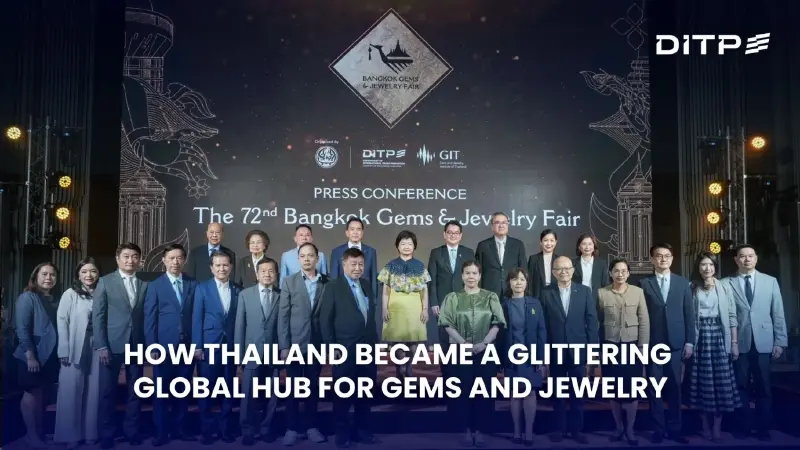
The Bangkok Gems & jewelry Fair (BGJF) is a premier international trade event showcasing high-quality products from leading companies worldwide.
Organised by the Department of International Trade Promotion (DITP) and the Gem and Jewelry Institute of Thailand (GIT), it serves as an essential platform for global trade and business expansion.
The 72nd edition of the fair will take place from September 9 to 13, 2025, at the Queen Sirikit National Convention Centre in Bangkok. The event aims to:
- Position the BGJF as a key trade platform for Thailand, promoting and expanding markets while driving Thailand’s ambition to become the global hub for gems and jewelry, in line with national strategies.
- Provide a significant international trade channel in the Asian region, offering opportunities for trade negotiations and meetings with overseas importers.
- Offer opportunities for small and medium-sized enterprises (SMEs) and regional businesses across Thailand, with potential in production, design, and export of gems and jewelry, to expand their market reach internationally.
- Promote Thai jewelry and gem designers, providing them with a platform to showcase their work.
Products to be showcased at the event include gemstones, fine jewelry, silver jewelry, gold jewelry, diamonds, pearls, lab-grown diamonds, costume jewelry, fashion jewelry, jewelry parts, synthetic stones, equipment and tools, machinery, display and packaging.
The event will gather 1,104 companies from both domestic and international participants, with an expected 40,000 visitors worldwide, generating 3.5 billion baht for the Thai economy."
DITP has implemented the 4S Strategy to boost gem and jewelry exports:
- Sourcing facilitation: Enhancing raw material management and sustainable production processes.
- Smart creative manpower: Upgrading workforce skills and technology capabilities in gem and jewelry production.
- Strategic marketing plan: Expanding distribution channels and international product credibility, enhancing the global image of Thai products.
- Sustainable infrastructure: Developing supportive infrastructure for business operations.
The DITP also pursues strategies including:
- Sourcing and seeking raw materials from abroad for the domestic industry.
- Addressing trade barriers and developing human resources to support business expansion effectively.
- Enhancing competitive capabilities in both production and marketing.
- Promoting the image of the Thai gem and jewelry industry through various media, participating in international trade shows under the Thai Pavilion, and highlighting soft power.
- Strengthening the BGIF exhibition's image with targeted PR efforts to maintain existing markets and attract new ones.
- Accelerating proactive exports and targeting potential markets such as the Middle East, Central Asia, South Asia, and ASEAN, supporting participation in trade shows, organizing trade delegations, and developing e-commerce transactions.
The Ministry of Commerce, through the DITP, has set a clear objective: to make Thailand the world’s leading trading hub for gems and jewelry, continuing to pursue this goal through consistent policies and targeted initiatives.
