
In Lompeun and loving it
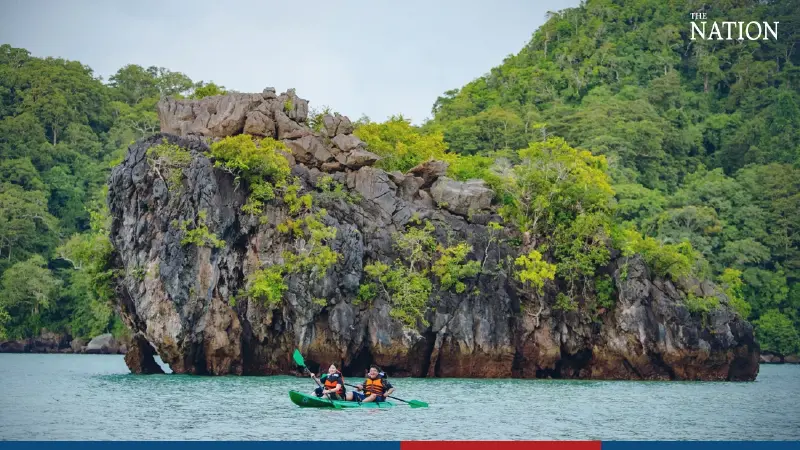


Many Thais and foreign tourists are familiar with the globally renowned Ko Lipe and its famous beaches, but Satun province has much more to offer the discerning visitor.
Of particular interest is the small community known as Ban Lompeun, which has emerged as a destination in its own right through the initiatives of a younger generation striving to ensure its survival.
Jakkrit “Ped” Tingwang, a descendant of fishermen born and raised in the Thung Nui Bay area of Ban Lompeun in Satun’s La-ngu District, has long witnessed his father working for the community in environmental conservation and natural resource management.
This includes preserving the mangrove forest and planting mangrove trees to maintain the ecosystem and natural food sources for the local community.
Jakkrit has also actively participated in volunteer projects, especially during the 2004 Indian Ocean earthquake and tsunami, which allowed him to observe sudden and impactful changes.
Over the years, Jakkrit has watched in vain as young people left to take up employment far away due to the lack of income opportunities and has set out to make a lasting impact by encouraging the younger generation to return and settle in the community.
He hoped that creating conditions that would foster a thriving local economy and generate jobs and income within the community for residents and local entrepreneurs, would ensure fair and sustainable economic development.
The concept of community tourism was thus born.
Today, he is affectionately called “Young Plant Ped” as a symbol of his leadership. By actively participating with the SCG Foundation as a “young plant”, he aims to create young and capable individuals able to develop their potential and skills through collaboration with networks from the government, private sector, and civil society.

The goal is to promote and advance his principles which deviate from the typical approach to tourism that often involves utilising resources in the area by intertwining them with conservation efforts.
This, he says, can serve as a tool to instil environmental consciousness in both the local and external communities simultaneously.
Four tourist destinations offer a new perspective on Satun through the lens of the Lompeun community.
Thung Nui Bay

Thung Nui Bay boasts a serene beach that was once a small-scale fishing port. During the rainy season,
villagers used to bring their cattle and buffalo to graze in the area. Following the impact of the tsunami, which
swept away all the trees, the community rallied together to restore and develop the area into an environmental learning hub.

That commenced with the planting of mangrove trees.
On our recent walk towards the bay, we encountered a vast mangrove forest replanted by local villagers.
The growth is so remarkable that it’s almost unbelievable.
Visitors can also choose to paddle a kayak through the mangrove forest that offers a panoramic view of Thung Nui Bay.
Beachfront areas are resembling a dragon’s spine, perfect for a leisurely stop to capture some photographs.
Upon reaching the destination, visitors will witness local villagers engaging in traditional fishing practices, customarily searching for small fish.
Panya batik

The minibus took us to the heart of the rubber tree plantation to observe the source of the soil used for fabric dyeing.
This type of soil is known as terra rossa, and it is found only in the villages within the boundaries of Satun Global Geopark. It requires some digging to reach the deep, rich, reddish-orange soil.

We were then taken to the Panya Batik production site, a small family business that has been producing batik fabrics for several decades using a technique that has been passed down through the generations.
The batik fabric here not only features the distinctive colours obtained from the soil used for dyeing, resulting in earthy tones that are soothing to the eyes but also showcases locally inspired patterns. For instance, the fossil pattern that is applied to the fabric reflects the community’s pride in Satun’s geological park area where fossils have been excavated, revealing traces of ancient times spanning hundreds of years.
Lidee Island

Lidee Island is one of the islands within the Mu Ko Phetra National Park, characterised by its twin-island formation known as Little Lidee and Big Lidee. It is surrounded by several smaller islets. In Malay, Lidee translates as “cane”. The island is known for its thriving swallow population and diverse natural features.
We embarked on our journey from the pier aboard a converted fishing boat turned tourist vessel, heading straight into the Andaman Sea.

Upon arrival, we encountered small islands with long stretches of sandy beaches, perfect for swimming in the clear waters.
Those who preferred not to get into the water headed to the adjacent mangrove forest areas, enjoying different views from a boat, or exploring caves and cliffs along the coastline.
A Bridge Across Time

The nature study trail, meanwhile, takes us back millions of years with its distinctive seaside cliffs boasting layers of intricately alternating coloured rock formations.
Walk along the lengthy path by the sea, parallel to the mountains that hug the ocean, for a truly captivating spectacle.
In one section of the cliff, the layers of rocks displaying different colours can be seen. These bear traces of rocks from two different eras, namely the Cambrian red sandstone, dating back approximately 541-485 million years, and the Ordovician limestone, with an age of around 485-444 million years.

A few steps therefore becomes a journey back through millions of years. Alongside these rocks, evidence of fossils corresponding to each era can also be found.
Working towards a sustainable community
Jakkrit’s continuous efforts and collaboration with residents have led to the transformation of the community.
In the Thung Nui Bay area, the mangrove forest has expanded by more than 20 rai. They have helped manage the cleanliness of both the coastal and mangrove areas over an area of 150 rai.

Additionally, there is effective waste management in the community. The initiative has provided educational opportunities for more than 30 children and youth to learn about natural resource conservation and community preservation.
This learning takes place through the Forest Learning Centre, which offers study tours, participation in activities, and workshops.
Moreover, this sustainable tourism approach has generated income that is distributed across the community, benefiting various sectors such as local businesses, housewives, fishermen, the elderly, and over 70 children. Each individual has seen an increase in income ranging from 3,000 to 5,000 baht.
Those who wish to travel here can do so on their way to board a boat to Ko Lipe and enjoy the chance to explore the conservation efforts of Thung Nui Bay and experience the rich natural atmosphere.
