
Thailand’s Biodiesel Turning Point: Industry Chiefs Warn Inefficient Management Has Cost State 120bn Baht
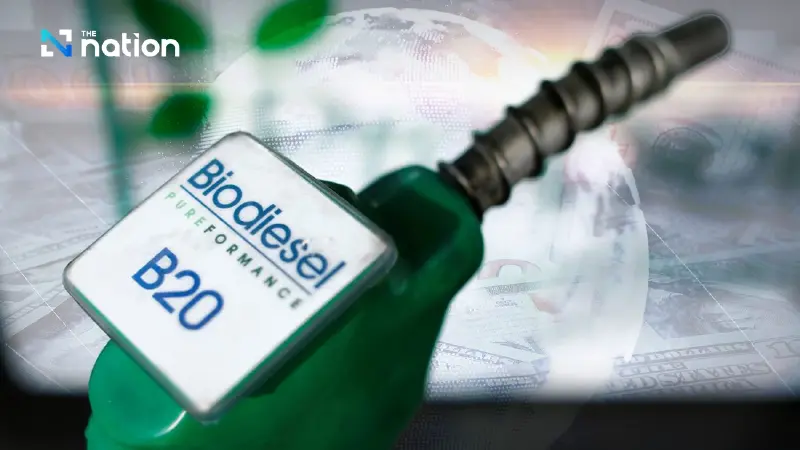


The Thai Biodiesel Producer Association urges the government to fix palm oil stock leakage and provide clear policy signals to unlock a biorefinery boom
- Industry leaders state that inefficient management of palm oil stocks has cost Thailand an estimated 120 billion baht over the past six years.
- The Thai Biodiesel Producer Association is urging the government to stabilize stocks and provide a clear, consistent policy roadmap for the industry.
- The sector's "turning point" is a proposed shift from basic fuel production to high-value biorefineries and Sustainable Aviation Fuel (SAF).
- A stable government policy is considered essential to attract the long-term investment needed for this transition and to prevent Thailand from remaining a mere raw material exporter.
The Thai Biodiesel Producer Association urges the government to fix palm oil stock leakage and provide clear policy signals to unlock a biorefinery boom.
Thailand is standing at a critical energy crossroads, with industry leaders warning that the country has squandered an estimated 120 billion baht over the last six years due to poor palm oil stock management.
As the global race for clean energy intensifies, the Thai biodiesel sector is calling for urgent government intervention to stabilise stocks and provide a clear regulatory roadmap.
Industry experts argue that more efficient management could have slashed the national Oil Fund’s subsidy burden by as much as 50 billion baht—capital that could have been redirected to drive the nation’s green transition.
According to reporting by Kanyanat Butdee of Krungthep Turakij, the current state of the industry was aptly described by Sanin Triyanond, president of the Thai Biodiesel Producer Association.
He likened Thailand’s position to a "striker who has been passed the ball right at his feet," possessing both the industrial platform and the raw materials to score, provided the government can clinicalise its policy execution.
Thailand remains a global rarity, enjoying simultaneous food and energy security. With an annual production of nearly 3.9 million tonnes of crude palm oil, the nation comfortably meets domestic consumption and energy demands while maintaining a 30% export surplus.
However, as the world’s third-largest producer, Thailand faces stiff price competition from regional giants Indonesia and Malaysia.
"If we had managed stocks efficiently and kept prices aligned with the global market over the past six years, we could have saved an average of 120 billion baht," Sanin noted.
Beyond Fuel: The Biorefinery Ambition
The industry’s "turning point" lies in moving beyond simple fuel production toward high-value "biorefineries". Previous clear mandates for B10 and B20 biodiesel successfully attracted multinational investment into "S-Curve" chemical industries.
Industry chiefs argue that these policies are not merely about emissions; they are the bedrock of a downstream ecosystem that produces high-value bio-chemicals.
The next frontier is Sustainable Aviation Fuel (SAF). With global demand for Used Cooking Oil (UCO) skyrocketing, Thailand’s challenge is to ensure raw materials are managed responsibly and transparently to meet international sustainability standards.
A Call for Policy Consistency
The private sector’s message to the state is clear: "readiness" must be converted into "competitive advantage." For businesses to commit to the long-term investments required for SAF and biorefining, they require a steady, consistent policy signal.
Without this clarity, Thailand risks remaining a mere exporter of raw materials rather than evolving into the regional bioenergy hub its resources suggest it should be.
The goal is a seamless link between agriculture, energy, and chemicals—positioning the biodiesel industry as a primary engine for Thailand’s future economic growth.
