
Thailand's Business Giants Unite to Stamp Out Agricultural Burning
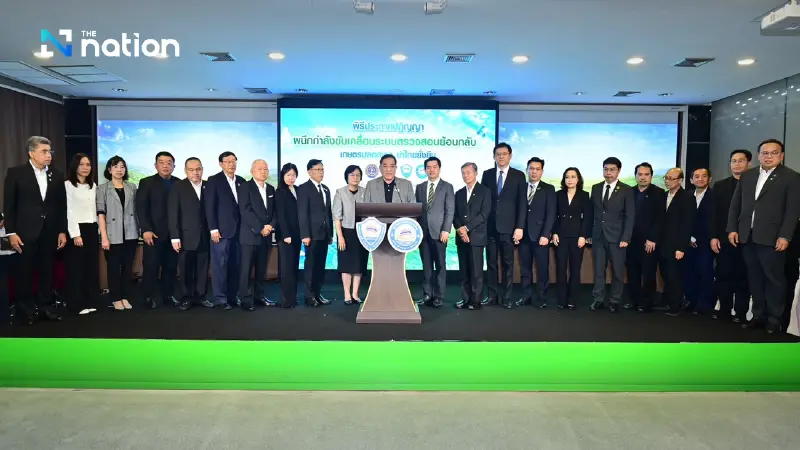


Over 100 organisations sign Earth Day declaration pledging full supply chain traceability to tackle PM2.5 smog and drive sustainable farming across Thailand
- Over 100 of Thailand's leading businesses and organizations, including CP Group and Mitr Phol, have signed a declaration to eliminate agricultural burning.
- The core strategy is to implement full supply chain traceability for crops like rice, maize, and sugarcane, using technology like satellite data and blockchain to verify burn-free origins.
- This initiative directly targets the severe PM2.5 smog pollution crisis in Thailand, which is largely caused by open burning in the agricultural sector.
- Participating companies will use market-based enforcement, committing to refuse purchases from any supplier who cannot provide traceable, burn-free verification for their products.
Over 100 organisations sign Earth Day declaration pledging full supply chain traceability to tackle PM2.5 smog and drive sustainable farming across Thailand.
Thailand's leading businesses and public institutions joined forces on Wednesday to tackle one of the country's most persistent environmental crises, signing a landmark declaration committing to full agricultural supply chain traceability as a systemic solution to smog and PM2.5 pollution caused by open burning.
The Thai Chamber of Commerce, alongside major conglomerates including CP Group, Mitr Phol, Nestlé, and Khao Hong Thong rice brand, spearheaded the initiative, which brought together more than 100 organisations spanning the private sector, government ministries, academic institutions and civil society groups.
The declaration was announced on Earth Day to signal a collective shift towards burn-free agricultural sourcing.
At the heart of the pledge is the adoption of traceability systems — digital mechanisms enabling raw materials such as rice, maize and sugarcane to be tracked from farm to factory.
Participating companies said they would deploy satellite data to detect hotspots, GPS coordinates to map farmland plots, and blockchain technology to create tamper-proof records across their supply chains.

Dr Poj Aramwattananont, chairman of the Thai Chamber of Commerce, said the PM2.5 crisis was deeply intertwined with agricultural burning and required intervention at the very source of production.
"Traceability as a shared standard will make the origins of raw materials clearly verifiable and strengthen collective responsibility across the supply chain," he said, adding that the move would align Thailand's agricultural sector with international standards.

Thiti Lujintanon, Chief Executive Officer of CP's Feed Ingredients Business and Chief Executive Officer of Bangkok Produce Merchandising said traceability had been established as the core standard for the group's sourcing operations.
"Bangkok Produce connects data from farmers and aggregators all the way through to the factory, using satellite technology, hotspot detection and blockchain, with independent verification," he said. "Every batch of feed maize must be traceable, and must have no connection to burning or forest encroachment."
He added that the company had set a firm condition to refuse purchases from any supplier — domestic or foreign — unable to demonstrate traceable origins, using market mechanisms to drive change at the source and raise supply chain standards across the region in the long term.

Dr Vallop Manathanya, chairman of the Bangsue Chia Meng Rice Mill and owner of the Khao Hong Thong brand, noted that transparency over the origins of rice was increasingly essential for export market confidence.
"Our buyers abroad need assurance, and traceability in our sourcing and production processes gives us that credibility," he said.
The declaration encompasses seven commitments: pursuing zero burning, achieving 100 per cent traceability coverage, promoting sustainable production practices, complying with laws and international standards, fostering participation across the supply chain, maintaining transparent data disclosure, and driving continuous innovation.

Signatories from the food and agriculture sector included Mitr Phol, Nestlé, Chia Meng–Khao Hong Thong, Khao Tra Chat, S&P, Saraburi Sugar, Bangkok Produce and CPP.
Academic partners comprised Chulalongkorn University, Kasetsart University, Rangsit University and Maejo University, while independent certification bodies SGS (Thailand), Control Union (Thailand) and ERM-Siam participated as verifiers.
Witness organisations included the Bank for Agriculture and Agricultural Cooperatives and the Bio Economy Development Agency.

The event also featured a panel discussion titled "Traceability and Technology for Zero-Burn Agriculture," which brought together experts from technology, certification and conservation to examine how the system could work in practice — and whether it could genuinely shift entrenched farmer behaviour.
Sudarat Rojphongkasem, director of Nature-based Solutions at the Mae Fah Luang Foundation, acknowledged that technology alone would not be sufficient.
Financial incentives and knowledge-sharing must accompany traceability systems, she said, with farmers who adopt burn-free practices rewarded through better returns and consumers playing their part by accepting a price premium for sustainably sourced produce.
She also flagged the particular challenges facing highland communities, where steep terrain makes mechanised tilling difficult, calling for solutions that incorporate agroforestry transitions and secure land tenure rights to give farmers the confidence to change.
She cited earlier projects in Myanmar where satellite monitoring had successfully reduced both burning and forest encroachment.

On the technology side, Bodin Milindankura, director of Information Technology Solutions at AXONS, outlined the workings of the company's Axon P platform, which is designed to make the origin of every lot of produce fully traceable.
Farmers register on the system using facial recognition for identity verification, after which AI analyses retrospective satellite imagery of their plots.
Throughout the growing cycle, the system monitors for fire activity, alerting field agents if a hotspot is detected. The traceability data follows the product through each stage of the supply chain, with end consumers able to scan a QR code to identify the precise farm of origin.
Crucially, he noted, AI can detect burning scars on land even if a farmer attempts to burn between satellite passes, making the system difficult to circumvent. A free companion app, Farm 1, allows farmers to log cultivation activities that feed directly into the traceability record.

Jaruwat Boonrod, Certification manager at Control Union Thailand, explained how independent third-party verification underpins the credibility of non-burning claims.
Using document audits alongside platforms such as Global Forest Watch, the company checks for burning scars over specific timeframes through a chain-of-custody process, applying international sampling standards to achieve a 95 per cent confidence level. Where documentation is complete, he said, a full traceability check back to the source can be completed within a single day.
The panel concluded on an optimistic note. The speakers agreed that replacing assumptions with evidence-based data would raise the benchmark for Thai agriculture, enabling exporters to make credible, verifiable claims about burn-free sourcing — and positioning Thai farmers to meet international market requirements more broadly in the years ahead.

The initiative represents a significant step in redefining supply chain standards for Thai agriculture, with the twin aims of reducing environmental harm and bolstering the country's long-term international competitiveness.
