
Heading the eco-friendly way


Play
Event lives up to its theme of 'mobility can change the world', despite being smaller in scale compared to previous shows
Every two years, the Tokyo Motor Show is where Japanese auto-makers suggest to the world their latest ideas.
Although most of the concept vehicles usually don’t make it to the production line, many of the design statements or technologies do become incorporated in future mass-produced models launched in the market.
This year the event has been moved to a new venue after being held in Chiba Prefecture for over two decades. The Tokyo Big Site has been chosen as the new home for the event.
However, the earthquake and tsunami earlier this year has prevented Japanese auto-makers from staging a show as large as in the previous years (the 2009 show was also overshadowed by the withdrawal of several European auto-makers due to the financial crisis in 2008). In addition, the flood crisis in Thailand also caused further disruption of parts supplies to Japanese auto-makers.
In his presentation, Toyota Motor president Akio Toyoda mentioned Thailand as one of the company’s most important production bases, and pointed out that Toyota will not withdraw from the country, but on the contrary, use its resources and technologies to help people.
Despite the smaller show, there are many interesting concept- and production vehicles on display at the 42nd edition of the Tokyo Motor Show, which opened to the public on December 2 and will go on until December 11.
The theme of this year’s show is “Mobility can change the world”. A large number of eco-friendly vehicles are being exhibited. Electric, plug-in, fuel cell and hybrid vehicles are definitely the stars of the show, suggesting that the future of automobiles will slowly deviate from fossil fuels and head in this direction.
Missing this year are supercar manufacturers like Ferrari and Lamborghini, which has a strong customer base in Japan.
Toshiyuki Shiga, chairman of the Japan Automobile Manufacturers Association and chief operating officer of Nissan Motor Co, said auto-makers have prepared sufficiently for the show with the aim of making it “the world’s foremost technology motor show”.
“While we may be smaller in size compared to motor shows held in emerging countries, we would like to give a motor show that not only promotes the products, but also presents an overview of the roles of mobility and its links to society,” he said prior to the show.
Highlights at the 2011 Tokyo Motor Show
Toyota Fun-Vii
The name originates from “Fun Vehicle interactive Internet”. This concept-car demonstrates how people, cars and society should be “connecting” in the future. Technology for displaying images sent from smart phones and next generation ITS on the body are the highlights of the Fun-Vii.
Toyota FT-EV III
An electric vehicle (EV) concept-car that uses electricity as a substitute for fossil fuels, a short-distance model is in production to enter the market in 2012. The FT-EV III will carry lithium-ion batteries, which will allow longer journeys of up to 105km fully charged.
Toyota FCV-R
With a fuel-cell unit stored under the floor and equipped with a high-pressure hydrogen tank, the FCV-R can cover a distance of 700km or more. Toyota is promoting development and implementation, and is hoping to commercialise this concept by the year 2015.
Nissan Pivo 3
The concept of this EV is integration with the future city. In parking lots where an automatic valet system is available, the driver can leave the car to park and recharge for itself. With all four wheels acting as rudders, it can make a U-turn on a street that is just four metres wide.
Nissan Townpod
The Townpod corresponds to the ever-diversifying lifestyle of today’s consumers, by fusing the riding comfort of a passenger car with the practicality of a commercial vehicle. By eliminating the b-pillar, the side doors open up almost 90 degrees.
Honda Micro Commuter
A micro-mobility unit that is only 2.5 metres in length and 1.25 metres in width, it is designed to be a casual means of transportation in an urban setting. The car can hook up to smart phones and provide occupants with various information. It uses a lithium-ion battery and has a range of 60km.
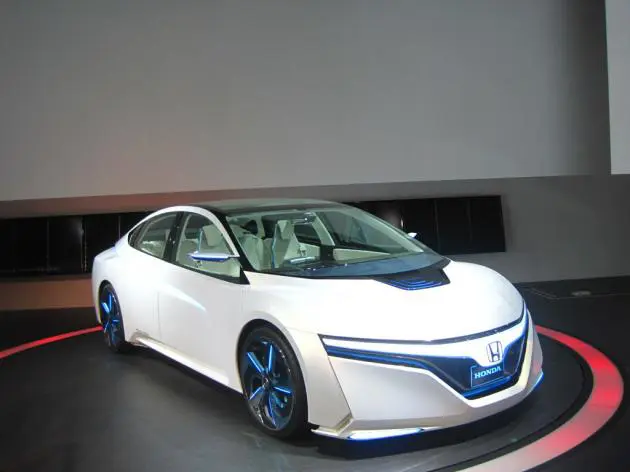
Honda AC-X
If you want to take an exciting drive, go for a cruise on the 1.6-litre engine mode. Otherwise, switch on the auto-pilot mode, let the car clear of all the manoeuvring equipment, and relax. The AC-X carries a plug-in hybrid system and will run for 50km on EV mode.
Subaru Advanced Tourer Concept
Carrying a downsized 1.6-litre turbo-charged boxer engine and an efficient continuously variable transmission, this middle-class station wagon marks the start of a new generation. Subaru’s distinctive all-wheel-drive structure with its symmetric layout is combined with a single motor hybrid system.
Suzuki Q-concept
Having both the high mobility of motorcycles and the convenience of passenger cars, this small mobility vehicle falls into a new category. With a small body that is only 2.5 metres long and 1.3 metres wide, it carries two people seated in a line. It is suitable for personal use, and for commercial purposes such as delivery service.
Mazda Takeri
This new generation mid-sized sedan has been designed based on Mazda’s new design theme “Kodo – Soul of Motion”. The Takeri offers a powerful driving experience thanks to satisfying power from the Skyactiv-D diesel engine and new lightweight and aerodynamic technologies. At the same time it is also highly eco-friendly.
Mitsubishi PX-MiEV II
This SUV has a plug-in hybrid system that integrates the EV experience from the small i-MiEV with the latest environmentally-conscious engine. The 2-litre engine and two motors power the four wheels, and the SUV achieves 60km/litre along with an 800km operating range.
Mercedes-Benz F125
The F125 (Experimental Car 125th Anniversary) is an electricity-driven, hydrogen fuel-cell-powered, full-sized luxury sedan concept. It is a hybrid with lithium-sulphur and could be
further developed into the S-Class saloon.
Mitsubishi Concept PX-MiEV II
Mitsubishi Motor Corporation (MMC) has been focusing its EV technology in the Japanese mini-car class. MMC became the first major automobile manufacturer to bring a mass-produced electric vehicle to the market when it rolled out the Mitsubishi i-MiEV next-generation EV in 2009. The company will introduce its second mass-produced EV-the MINICAB-MiEV mini-car class light commercial EV in December this year. These models are very popular as city commuters where vehicles are used for transporting small groups of passengers over short distances in urban areas.
Not anymore. The Mitsubishi Concept PX-MiEV II is Mitsubishi Motors’ idea for a mid-size plug-in hybrid PHEV model that offers a long cruising range demanded by mid-size (and larger) vehicles. The Mitsubishi Concept PX-MiEV II contains a state-of-the-art drive-train derived from MMC’s already-existing EV technology that delivers the environmental performance and quietness inherent to an EV in an SUV package that provides more comfortable motoring and allows for higher utility outside of a city commuter. The Mitsubishi Concept PX-MiEV, with its high environmental performance and fuel efficiency, effectively extinguishes many negative perceptions of SUVs.
MMC’s unique plug-in hybrid system fuses EV technology derived from the Mitsubishi i-MiEV with a small conventional engine that features MMC’s latest fuel and environmental efficiency technologies. This combination provides not only a combined fuel efficiency3 of more than 60km per litre, far superior than that of a conventional engine-driven car, but also very high levels of environmental performance while maintaining a cruising range on a par with conventional engine-driven vehicles (over 800km).
MMC’s plug-in hybrid system uses high-capacity batteries that allow the vehicle to cover over 50km in all-electric mode alone, allowing it to be driven solely as an EV for most everyday situations. Depending on power consumption and remaining battery charge, the system will start the engine automatically as a generator, and the engine can also be used to help drive the wheels necessary. In addition, with the push of a button, the driver has the freedom to select Battery Drive Mode when he/she wishes to drive quietly and emissions-free (at sufficient battery levels) in residential areas or the countryside using pure EV power. At the same time, the driver can also switch to Battery Charge Mode while on the move, controlling use of battery power and using the engine as a generator to charge the batteries.
A socket fitted to the vehicle allows the electricity stored in the drive batteries to be used to power electric appliances when camping or in other outdoor pursuits, or to provide an emergency power source. In addition, the quick-charge port is vehicle-to-home (V2H) compatible.
Another feature of the Mitsubishi Concept PX-MiEV II apart from its outstanding environmental performance is its drive-train, which uses a newly developed twin-motor four-wheel-drive system mated to Mitsubishi’s S-AWC (Super-All Wheel Control) advanced traction-control system. Based on the four-wheel-drive technology developed and honed in the Lancer Evolution X models, S-AWC delivers pure driving pleasure by manoeuvring effortlessly to the driver’s will while maintaining high levels of stability and safety. In addition to superior handling, the Mitsubishi Concept PX-MiEV‡Uprovides 100 per cent instant off-the-line torque inherent to electric motors, giving it acceleration comparable to that of a 3.0-litre V6 engine. The Mitsubishi Concept PX-MiEV‡U takes environmentally friendly vehicles to a new level with its unique blend of fuel and environmental efficiency, performance, and utility.
