
Fierce competition revving up
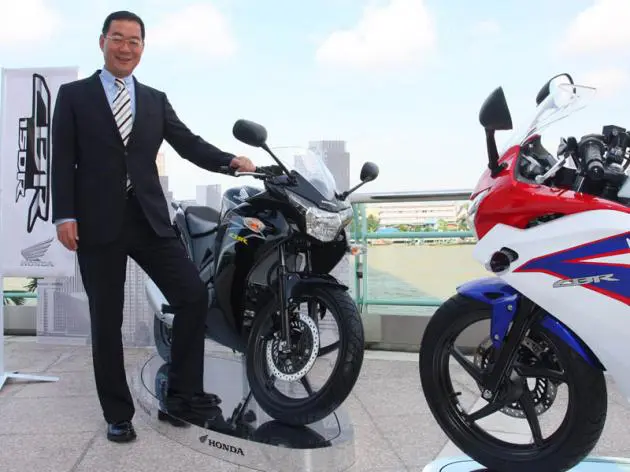


Play
Big players up the ante with new launches and intense marketing
Although the Thai motorcycle market may not be as large as those in Indonesia or Vietnam, in terms of quality and marketing strategy, this is a market where motorcycle-makers have pledged to succeed.
The commitment can be seen from the expansion of production facilities as well as the setting up of Research and Development centres by several major motorcycle manufacturers.
Although many in the industry say that the motorcycle market has reached saturation with annual sales of approximately 2 million units, competition in terms of marketing and products is intense. This could be the reason that each brand is spending more money and effort to increase market share, despite the smaller number of players when compared to the automobile market.
Right after the New Year, Honda, the market leader, has already launched seven new products and hired presenters while Yamaha followed with an annual press conference.
Honda eyes new sales record
Chiaki Kato, president of AP Honda, said Honda plans to sell 1.5 million motorcycles in 2011.
“This has been a year of challenge for Honda especially with our target of setting a new sales record,” he said.
For 2012, Honda thinks that the Thai economy will start to recover in the second quarter due to the rising demand.
“The total motorcycle market in 2012 should reach 2.1 million units, equivalent to a growth of 5 per cent,” he said.
In 2011, Honda sold a record 1.39 million motorcycles in Thailand, up 10 per cent, and was crowned as the best-selling motorcycle brand in Thailand for the 23rd year. Its market share increased from 68 per cent in 2010 to 69 per cent in 2011.
“2011 was an important year for Honda as it was our 25th year in Thailand. But it was also a year with many negative factors, including the natural disaster and economic crisis. But the motorcycle market grew higher than expected, with sales of over 2 million units, or up 8 per cent,” Kato said.
Last year, Honda announced a three-year plan that included transforming itself from the largest organisation to the strongest organisation, becoming the true market leader, as well as introducing products that are superior to market requirement.
On Tuesday, Honda launched a total of seven new models, the largest number ever in the Thai market, covering every market segment.
Apart from domestic models such as the Click 125i and Wave 125i, Honda also introduced global models such as the PCX150 and CRF250L.
“Last year, Honda launched three new models and became the leader in the automatic transmission market, and we were also highly successful with our brand communications campaign. This year, we are carrying out more marketing activities such as being the official supporter for the Euro 2012 telecast in Thailand and activities with Manchester United and Liverpool,” he said.
Honda is also planning to communicate about its 900 outlets in the country, and will introduce the “Big Wing” sales and service centre for big bikes in April.
Yamaha ready to fight
Yamaha, the No 2 brand in Thailand, may lag far behind in terms of market share, with just 23 per cent.
But in 2011, Yamaha spent more than Bt100 million, concentrating on “lifestyle marketing” and the Fino model.
Praphan Pholthanavasit, deputy managing director of Thai Yamaha Motor Co, agreed that the motorcycle market will grow dramatically this year.
Unanswered demand from the fourth quarter of the last year (due to the flood) will be carried over to this year he said.
Praphan said younger consumers are changing towards products that reflect their lifestyles, while global warming and the increasing oil price will lead to lower fuel consumption.
“We can say that Thailand has developed more than other Asean countries, but in the future the Asean markets will be more similar considering the upcoming trends,” he said.
He said Yamaha would introduce 2 new models that were delayed due to the flood crisis late last year.
Yamaha is scheduled to launch a
new marketing campaign that
concentrates on individuality.
“Yamaha has to keep on moving. We can’t fight larger brands directly but we can compete in the market where we can compete best. And right now, the scenario is very similar so we need to come up with new ideas in order to break away from the competition,” he said.
Yamaha will launch six6 new models this year, not including five other special and facelift models. The company plans to sell 600,000 units this year for a 30-per-cent market share.
“We have the right products unlike last year when we had inadequate products to respond to customer requirements,” he said.
Praphan said competition within the motorcycle market would be highly intense this year.
“The market will experience competition at a level that has not been seen in many years, because there is a historic number of new models launched. From just Honda and Yamaha, there are 20 models and other brands will also be introducing their new products. But just considering the budget for marketing and various activities, including advertisement, the few motorcycle brands will help circulate as much as Bt3 billion, according to Praphan.
According to an industry source, apart from Yamaha that appears to be comparable with Honda in terms of market share, other competitors such as Suzuki or Chinese brands appears calm.
“Honda is having less and less competitors and Suzuki has only 5 per cent share and 250 dealers, along with internal problems since the new management structure has not fit in. So, even if the product is competitive, Suzuki is not strong enough to fight against the trend. As for Chinese brands, they are still small in the market with low budgets and small sales networks. The Thai market does not accept these bikes so well due to the quality and image that is still far behind the market leaders,” he said.
