
Eco-cars start new revolution in Thailand


The arrival of the Mitsubishi Mirage and Suzuki Swift city cars has appeared to start a new revolution in Thailand's automobile industry, as the eco-car project is now close to conclusion in terms of investment figures as well as market acceptance.
Toyota is the only eco-car maker that has yet to launch a vehicle, which is scheduled for introduction in Thailand in mid 2013.
The tremendous response points to the government taking the right approach in establishing a second “champion product” for the auto industry that coincides with the global trend for smaller and more fuel-efficient vehicles.
Nissan, which is the market leader in the eco-car segment, is starting to feel the heat from the newcomers, both of which grabbed thousands of orders at the recent Bangkok International Motor Show and ranks among the top 10 models.
Other brands, including Ford and Tata, are also feeling sorry for missing out on the project.
Third ‘champion product’ planned
Thailand’s strategy does not end with the eco-car, and those behind strategy making – the Industry Ministry (IM), Board of Investment (BoI) and the Thailand Automotive Institute – are all seeing that the eco-car is leading to a third champion product: the electric car. But a major problem facing the industry is the lack of a manufacturing base for electric-vehicle batteries.
BoI secretary-general Achaka Siboonruang said the board is presently discussing with Prime Minister Yingluck Shinawatra about policies that will attract investment groups from Japan to set up factories for electric-car batteries. The Thai delegation plans to negotiate with a major Japanese battery producer to set up a manufacturing plant in Thailand during the next road show in Osaka.
According to Achaka, the electric car project is the next step in the development of eco-cars, but Thailand needs to be able to produce the batteries.
“Both Mitsubishi and Suzuki, as well as Nissan, agree that there is a possibility in producing electric cars in Thailand. So if we can wrap up investment deals, it would help make Thailand a production base for electric cars in the near future. And when the time arrives, the technology for producing batteries for electric vehicles will be more modern and have higher standards. With mass production the price will drop, lowering production costs for electric cars. And demand will surely follow,” she said.
Achaka said that the next 2-3 years is the right time for such investment, as the eco- car project has stabilised.
It is expected that more than Bt10 billion will arrive from the eco-car project in the near future as auto-makers expand investment, she said.
The BoI is presently offering high-tech battery manufacturers an 8-year corporate- tax and machinery-tax package, which could be further adjusted to convince investors.
An IM source said there is high possibility for investment in car batteries in Thailand in the future because many of the Japanese auto-makers have production bases located here.
“The infrastructure for charging electric vehicles can be initiated easily, since most buildings in Thailand use 3-phase electricity, which is high-voltage,” he said.
The source added that details of the negotiations with Japanese investors will have to be discussed with the BoI before a presentation to the prime minister.
Mitsubishi eyes electric Mirage in 2 years
Mitsubishi is one of the companies that are highly interested in the electric car project, and it had previously connected with the BoI and the Electricity Generating Authority of Thailand (Egat) in carrying out research and development of EV (electric vehicle) infrastructure.
Mitsubishi Motors Thailand president Nobuyuki Murahashi said the company plans to sell 2,000 Mirages per month, and plans to produce as much as 100,000 of the cars during the first year.
“We presently use 80-per-cent local content and plan to raise it to 90 per cent next year. And if there is strong demand, we could expand production to 150,000 cars per year,” he said, adding that Thailand is the only production base for the Mirage.
“We are also developing an electric version of the Mirage, and the project is expected to take two years before production can commence. Whether or not we will use Thailand as a production base will depend upon whether Thailand can produce the batteries, which are the heart of the EV,” he said.
TAIA gives full support
Thai Automobile Industry Association president Piangjai Kaewsuwan and vice president for government affairs, Nissan Motor (Thailand), said EVs are now widely used in many countries including Japan, the US and those in Europe. It is expected that in 2020 EVs will make up 10 per cent of the global automobile population.
EVs have lower energy consumption than gasoline or hybrid-powered vehicles and they must offer good performance, high safety, reasonable pricing and a high level of material recycling, she said.
“Governments in many countries, such as the US and Japan and even Hong Kong support the use of EVs. China and Japan will start a free highway campaign with special lanes for EVs, as well as financial support for those wishing to purchase an EV. Meanwhile, the Singaporean government has set up an EV-testing centre and carries out continuous development,” Piangjai said.
She said the government should lower the 80-per-cent import duty for EVs since there is no domestic production.
“In addition, the government should provide technological support, set up a testing centre and educate the public about the benefits of the electric car, which could well become the third champion product for Thailand in the future,” she added.
Electricity: public sector ready
Soraraj Boonsong, director for business development and marketing at Schneider (Thailand), which is an energy management adviser company, said the EV market will fully emerge next year with major markets being in Europe, US and Japan.
An intelligent energy network that uses a digital smart grid will deliver electricity from the provider to the user. This is done via a two-way communications channel that also controls electric home appliances in order to achieve the highest efficiency.
The Energy Ministry has joined hands with Egat, the Metropolitan Electricity Authority and the Provincial Electricity Authority (PEA) in developing a smart grid system using a budget of Bt12 billion, which will be increased to Bt50 billion in 2026. The first smart grid system has already been implemented in Pattaya and will be expanded to other parts of the country in the future.
PEA deputy governor Numchai Lorwattanatrakul said the authority is replacing old meters with 1 million smart meters each year, and is launching the first project in Pattaya with 10,000 smart meters, encouraging government agencies and hotels to use solar panels as well promote the use of EVs.
Hybrid market affected?
An industry source pointed out that auto-makers have been moving with the latest developments in the automotive world and towards alternative energy use.
In Thailand, Toyota has set up assembly lines for hybrid models like the Camry and Prius, as well as several Lexus models.
At the motor show, Toyota exhibited the Prius C, which is a plug-in hybrid that could be later offered to Thai customers.
It has long been considered that hybrids represent the next step towards emission-free vehicles, and if an EV project is to be initiated by the government, it needs to make sure it will be capable of managing investment promotions fairly so that every party benefits.
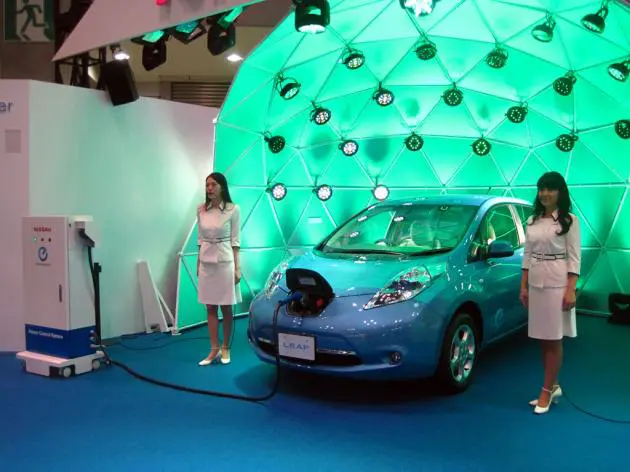
Presently, a large number of EVs are being offered in the global market such as the Nissan Leaf, which has been highly successful in Europe and Japan, the Mitsubishi i-MiEV, that has been marketed since 2010 with financial support from the Japanese government, and the Chevrolet Volt.
These are the EVs that could make their way to the Thai market in the future, while Suzuki is also expected to drive down the EV road as well.
