
STEPPING ON THE GLOBAL STAGE


Play
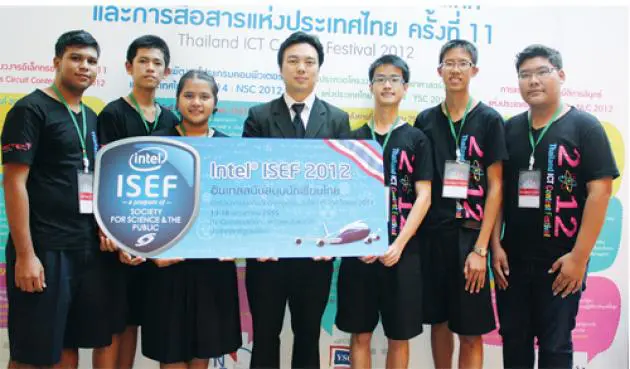
Nine Thai children, backed by Intel, will be presenting five research projects at the ISEF, an international science fair in the US that will bring together some of the finest student talents
As another solid proof of Thai children’s growing science knowledge, five of their research projects have made it to the final round of this year’s Intel International Science and Engineering Fair (ISEF), the largest pre-college science research competition.
Nine students from the five projects will present their researches to panels of esteemed judges and to the public at a fair in the US from May 14-18 in Pittsburgh, Pennsylvania.
This year marks the 12th year that Intel Thailand is supporting Thai students to compete in the ISEF, and it is a measure of their success that Thai students have won awards every year.
“We’ve been very successful from the start in getting involved with students, teachers, schools and all partners in recognising outstanding students and those who are passionate about science and technology, Accharas Ouysinprasert, country manager of Intel Microelectronics Thailand told The Nation.
He said over the years Intel has been able to raise awareness – with great support from Ministry of Information and Communications Technology, National Electronics and Computer Technology Centre, and National Science and Technology Development Agency – and make students nationwide realise their own potential, and provide an opportunity for them to compete in a world-class competition designed to widen their world.
“Our students are very talented in using what we have locally and applying that to their knowledge of science and technology to come up with an explanation or an outcome that can impact society as a whole,” he said.
Accharas said ISEF has served as an important stage to help Thai students improve their science knowledge.
The ISEF is not just a stage where students around the world come to compete, they also get a chance to learn from their peers, as well as experts or scientists from other countries, he said.
“It will open the eyes of our students to another world. It can be seen as a life experience. We know that our students gain so much from the trip and the whole process of doing the project, and they are very inspired. This is a group of talented kids gathered in one place; just imagine the energy and fruitful conversation,” he said.
Not only that, the way they will be trained and asked questions will very much lift them into another way of thinking, which is ultimately what we would like to see. Also, they will get new ideas and new thinking that they can bring back and combine with local resources to create something great for people in their own society, he said.
The ISEF competition next week will gather more than 1,600 of the world’s most promising young scientists and innovators, who have been selected from more than 550 qualifying science fairs around the globe with more than 65,000 participants. Each of these students earned top honours at local and regional competitions before being selected as finalists for the fair. The scholarships and awards in this competition are worth more than US$4 million (Bt124 million). Winners in each category will be announced on May 18.
The ISEF is funded jointly by Intel and the Intel Foundation with additional awards and support from dozens of other corporate, academic, governmental and science-focused organisations.
The Intel executive was confident that Thai students now have the potential to win awards and our children are some of the smartest.
He suggested that both the government and private sector needed to continue to support our children and take this seriously, as they are the foundation of our country.
“We need to ‘feed’ them the tools and information so they can continue to ‘digest’ and ‘grow’ with it. This not only means financially, or with equipment, but also giving them access to a greater experience and language skills that will help them communicate their ideas,” he said.
Asked if Thai students have the potential to change the world, he replied “everyone can. There is no limit to the talents of Thailand’s young people”.
Monchai Kunteekanok, education programme manager of Intel Microelectronics Thailand, who has been responsible for the project since 2008, was confident that the five Thai student projects would win some award as some of the researches have unique characteristics – for example, the study of the production of larvae from weaver ant, and the role of snail on natural rubber.
“Researches of Thai students seem to have more chance of winning compared to projects from other countries because our country has diversity in many fields such as nature, bio as well as more localisation. The students chose to study the topics that are close to their lives,” Monchai said.
Last year, a team of three Thai students from Surat Thani won Intel’s Young Scientist Award at ISEF for designing a new type of plastic out of a gelatin found in fish scales. The project has a big impact on the society as it was an invention that could have positive and long-term effects for the environment, Monchai said.
Also, the Thai students were well prepared as they were receiving intensive training for both presentation skills and English since early April, he said.
SIDEBAR
The five research projects by Thai students taking part in the 2012 Intel International Science and Engineering Fair
• Effects of mucus from Siamese snail on natural rubber coagulation and anti-phytopthora botryose activity – researched by Nattapong Chinnara, Jatuporn Chaweepak, and Nantakan Longlod from Suratpittaya School, Surat Thani. The study showed that Siamese snails consume fresh rubber latex at the tapping sites and their mucus led to faster coagulation of the fresh latex, thus reducing the amount of latex collectible by the farmers. However, the results also indicated that the mucus contains anti-phytopthora botryose activity, which potentially reduces the loss of income for the farmers as the black stripe disease caused by phytopthora botryose fungus is a major disease affecting rubber trees.
• Effect of food types on quantity and nutritional quality of weaver ant, oecophylla smaragdina, larvae – researched by Kitthanaet Thanaroungrochthawee from Kanthararom School, Si Sa Ket. The experimental results show the mixed ingredients food of rice, crickets, and fish yields the highest quantity of larvae without a decrease in nutritional value compared to other food types. This study benefits weaver ant farming as it brings a source of high-protein food for humans, increases income for rural farmers, and decreases deforestation.
• Untangling theta graphs with modified gauss codes – researched by Karn Imwattana and Varot Pakavatsoontorn from Trium Udom Suksa, Bangkok. The researchers tried to find out the cause of the “knot” and which mathematical theories can untie the knot.
• Biodiversity of millipedes – researched by Phornwimol Siabbamrung from Takhliprachasan School, Nakhon Sawan. The experiments showed that the millipedes’ faeces stimulated plant growth as effectively as chemical fertilizer. The information obtained in this study showed the diversity of the millipedes and their contribution to the richness of the soil, making a strong case for the conservation of local millipedes.
• Synthetic gem made from ashes of tamarind wood and lignite – researched by Teerapat Satjalak and Satawat Atipunyapant from Assumption College, Lampang. This project presented the use of tamarind and lignite ashes, reported to contain silica, to produce artificial gems. The lustre of synthetic gem made from tamarind wood was similar to glass and that made from lignite ashes was similar to adamantine. This work not only reported a procedure to reduce the ashes caused by the use of tamarind wood and lignite as fuel sources for heat and electricity but also the production of synthetic gem for jewellery industries.
