
Rosy future ahead for industry, says TAI ex-boss


Play
Since it was created more than 50 years ago, the Thai auto industry has never seen the sudden growth it is witnessing today.
After last year’s massive flood created havoc in the industry, it is back on a path of growth, with first quarter sales reaching 277,631 vehicles, up 16.3 per cent compared to the same period last year. Also, in March the industry set a monthly record with total sales of 110,928 vehicles, the first time auto sales broke the 100,000 mark in Thailand. The production sector has meanwhile achieved its highest production in 50 years.
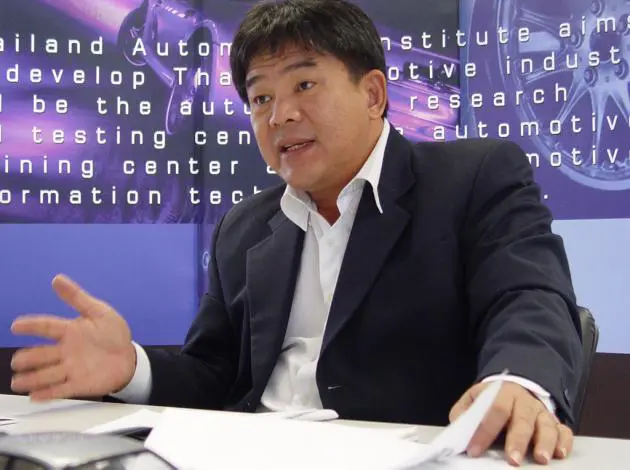
Earlier this month the Thai Automotive Institute (TAI) welcomed a new director, but the exit of former boss Vallop Tiasiri appears to be a major loss. During his 12 years at TAI’s helm, Vallop played a major role in helping the automobile industry leapfrog towards its production target of 2 million vehicles per year. After this is achieved, the next target for Thailand will be to serve as a major global production hub that churns out 4 million vehicles per year.
Vallop talked to The Nation about this plan, as well as his next role as special adviser to the Thai automobile industry.
Previous scenario
According to Vallop, the Thai auto industry has not changed much since it was created in 1961 as the government had decided to promote the assembly of vehicles to replace imports. It was 30 years later – in 1991-1992 – that the auto market was liberated, resulting in huge growth. During that period, the Anand Panyarachun government slashed import duties on automobiles from 500-600 per cent to more than half the figure, and a major auto tax restructuring took place. The government saw the improving economic trend and allowed the auto industry to grow very quickly. It was predicted that by the year 2000, auto production in Thailand would reach the 1-million vehicles mark.
“In 1994-1995, Thailand was able to produce 558,365 vehicles domestically, while total auto sales reached 589,126 vehicles. But due to the financial crisis, the market shrunk to just 146,207 vehicles in 1998. However, it was a crisis with opportunities, since it helped kickstart the Thai auto export industry. With parent companies holding major stakes in these manufacturing facilities, export quotas were given so that the Thai plants could produce vehicles for overseas markets. This was a major event that helped the Thai auto industry export vehicles to global markets up until the present day,” Vallop said.
Before the 1997 crisis, Thailand was due to become a member of the Word Trade Organisation, and had five years to prepare. Those within the auto industry then came together to discuss the direction of the industry as well as other industries, while the Industry Ministry called on the public and private sectors to join hands in designating a clear direction for the industry.
In 1998 the ministry set up two institutions – the Thai Electrics and Electronics Institute and the Thai Automotive Institute – to support local industries so they could compete globally.
These are independent institutions that are set up by the government to serve as a centre for developing the auto industry and raising competitiveness in the global market.
“Our role was to find ways to take the industry back to where we were before the crisis. Alongkot Chutinant, who was the first director of TAI, set up a pretty good system for the institute and I was also on the board during that period,” Vallop said.
Driving the industry
In 2000 a new TAI director was appointed and Vallop had been asked by members to stay in office for 12 years.
According to Vallop, when he took the helm at the turn of the millennium, the role of the TAI was to work out a 10-year plan for the direction of the industry.
“What TAI did was to set up a meeting, organising a CEO forum to produce a master plan for the industry in 2002-2006 in order to know what we need to do for Thailand to produce 1 million vehicles per year. Thailand must also have an export market equivalent to 40 per cent of production. At that time, the value of our baht currency fell and our products, especially pickup trucks, became highly competitive. Meanwhile, more than Bt200 billion worth of auto parts had to also be exported,” he revealed.
During the next five years, the primary target was to raise the local content of locally produced vehicles to 60 per cent.
“The production cost has to go down while efficiency and production quality must improve. So we concentrated on the pickup truck market and we worked very closely with the industry. The result of this hard work was the auto industry was able to reach the 1-million-vehicles production target in 2005, which was one year ahead of schedule,” he said.
Vallop said that the “Detroit of Asia” plan resulted in the creation of the eco-car project, which was pushed through five cabinets before being approved. Finally, the eco-car project was announced in 2007.
“Presently, most of the eco-cars are from Nissan, Honda, Suzuki and Mitsubishi. Toyota will launch its eco-car in 2013. It is expected that investments will reach the Bt200-billion target set by the Board of Investment,” he said.
All this took place during the almost five decades of the automobile industry (1961-2007), which is considered a period that changed the industry into a global operation. Part of the success comes from TAI and the Industry Ministry that used tax privileges to attract auto-makers to invest in Thailand.
The other major excise tax incentives include the 10-per-cent rate for fuel-efficient and alternative fuel vehicles such as hybrid vehicles (10 per cent excise duty for those with an engine displacement of 3,000cc and below and 50 per cent duty for those with an engine displacement above 3,000cc), electric vehicles and fuel-cell vehicles. The excise duty for eco-cars is 17 per cent, while duty for vehicles compatible with E10 gasohol is 20 per cent. For E20 ethanol vehicles, the rate is 25 per cent for those with engines below 2,000cc, 30 per cent for engines of 2,000-2,500cc and 35 per cent for those with engines above 2,500cc. In addition, the import duty for natural-gas vehicle retrofit parts has been waived.
“The second master plan is a continuation of the first plan and our aim is to attract investment that is long-lasting. This is more difficult than the first plan,” he said.
The second plan involves production of 1.8 million to 2 million vehicles per year, allowing Thailand to compete with other production bases.
“That is why we needed to have a second product champion, which is the eco-car. Initially we planned to produce 1.8 million to 2 million vehicles in 2010. As much as 50 per cent of production would be exported along with parts worth Bt900 billion. But the local content was required to be at least 70 per cent,” he said, adding that the target would finally be achieved this year.
Entering the era of the 3rd champion product
Vallop said that in his point of view, Thailand’s third champion product should be of a low-risk type, such as those using alternative energy including hybrids and electric vehicles.
“They will support existing products so that we will remain on the right track. Being a pickup truck and eco-car base with such volume, we need to prepare measures to prevent risk. And for the parts industry to develop and support the auto industry, the government must clearly see through the equation and prepare the country for investment. It has to take gradual steps and cannot hurry. But if we do nothing we will lose the rhythm since Thailand has already come this far. Auto companies would not want to relocate even if they have the chance to look for other markets with potential,” he said.
4 million units?
If nothing goes wrong, auto production this year should reach 2 million vehicles. It is believed that from April and May, auto-makers have achieved normal production and should produce a combined 200,000 vehicles per month, a figure that is achieved by not many countries in the world. In addition, newly built factories such as Ford’s Rayong plant have opened and will start assembling vehicles.
“This year many of the new assembly plants are not running at full capacity, whether it is Ford, Mitsubishi or Suzuki, so the 3-million production figure is not a difficult equation any more. By reaching 2 million vehicles, it is just a matter of building on top of that with more product derivatives, and this is the third champion product. Judging from the government policy and the driving power of the private sector, I say that Thailand can move ahead successfully, but we need to wait for growth in the domestic market too. Looking at the market, sales could rise to 1.5 million vehicles per year within the next five years, and the ownership ratio would be four people to one vehicle. Meanwhile, production would rise to 4 million vehicles per year. This is the same mechanism that took place in Korea and is happening in Thailand right now,” Vallop pointed out.
He said that the opening of the Chinese and Asean markets will help Thailand achieve the 4-million-vehicle production figure more quickly.
“It is expected that China will lift import duty on automobiles in 2015 and once China opens, Asean will be ready to open as well. When that happens there will be major restructuring of the mechanisms in the Thai auto industry once again. But that means that everyone must quickly adjust themselves to the regional trade mechanism that is about to take place, especially the parts makers,” he said.
Risk factors
Wallop said that the biggest fear is “ourselves”.
“The Bt300 minimum wage is not a big problem – there are mechanisms that could support it, as well as systems and machinery including robots that can do a better job. The only weak spot of the auto industry as well as Thailand as a country is the economy that is affected by the political situation. Natural disasters are not the biggest concern but it is the internal problems that make investors think hard,” he said.
Future role of TAI
“I would like to see development of the system and personnel carried out systematically. Today, there is no development or support for companies that are not large. I believe there should be someone who can help them develop and learn continuously. It would be lucky if they had a good teacher,” Vallop said.
“Before this we had the Automotive Human Resource Development Project (AHRDP), but it was not as effective as I would have liked to see. In every industrial estate there should be at least one human resources development centre. In these centres, the operator could be the companies in the estate with the government providing support. In my point of view, if we have those centres, the auto and auto parts industry will develop significantly. I believe that people come first; if there are no people, the machines and equipment would be of no use. On the contrary, without machines, people are still the heart of development,” he added.
Vallop says he does not have a special message for his successor. “I have nothing to ask him to do, since I believe that everything already being done is within the policies and vision of TAI. We have already laid out the essentials and the person who is in charge just has to make sure that the targets are achieved.”
Vallop said he is confident that with the right government policies and support from the private sector, there is no way that the Thai auto industry will not flourish.
“In the next 10 years Thailand will still be number 1 in this region and could be high on the list of the world’s top 10 auto producers,” he concluded.
