
Auto firms zoom down the eco road


Play
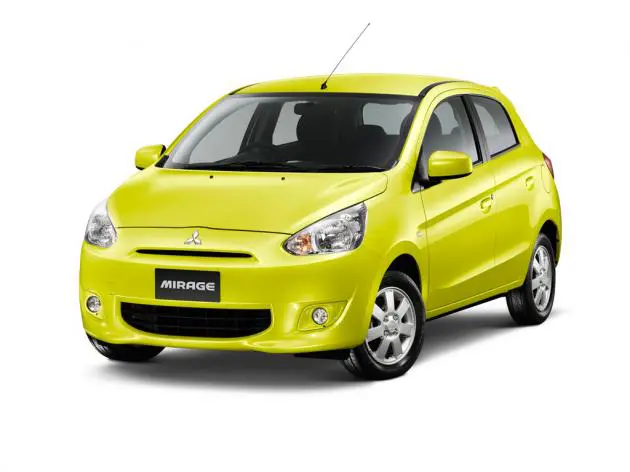
The entry of the Mitsubishi Mirage and Suzuki Swift has created a hot new trend in the Thai auto market.
Add that to the popularity of the previously launched Nissan March and total sales in the eco-car market easily breaks the 80,000 mark.
This has resulted in a major change in the auto market, and many companies are forced to revamp their marketing strategies. They are also waiting to see how the eco-cars will affect the fast-growing Thai market.
According to the Automotive Industry Group, Federation of Thai Industries (FTI), the ratio between pickup truck and passenger car sales has become much closer (45 per cent compared with 55 per cent). This shows that the market trend is towards passenger cars, which previously made up just 35-40 per cent of the market. The growth clearly comes from the eco-cars as well as subcompacts.
Mitsubishi grabbing orders
Mitsubishi Motors Thailand president Nobuyuki Murahashi said that up to 18,000 orders have been placed for the Mirage, and deliveries have commenced earlier this month.
Mirage production is estimated at 100,000 per year, with as much as 70 bound for export.
According to reports, Mitsubishi is presently trying to solve the back-order problem by adjusting the production line of the Mirage before its new plant at Laem Chabang Port starts to operate smoothly.
However, Mitsubishi will also have to adjust production for other models such as the Pajero Sport and Triton in order to prevent back-order problems.
During the launch of the Mirage in Bangkok earlier this year, Mitsubishi Motors Corp president Osamu Masuko said the local content of the Mirage is presently 80 per cent.
“We plan to raise the local content to 90 per cent next year, and if there is more demand, we can expand production to 150,000 units per year,” he said.
Thailand is the only production hub for the Mirage.
The third Mitsubishi plant required an investment of Bt16 billion, and is Mitsubishi’s second-largest production centre in the world after Japan.
The Mirage will be exported to Asean countries as well as Japan and Europe starting from mid-2012.
“Happy Problem” for Suzuki
Suzuki Automobile Manufacturing (Thailand) sales manager Wallop Treererk-ngarm said 13,000 orders have been placed for the Swift.
“Our orders are well into early next year since we have a production capacity of only 10,000 units per year,” he said.
Wallop said that it is not easy for Suzuki to raise production.
“We want to maintain high production quality and are ready to increase the number of engineers in order to raise production efficiency as well,” he said.
None of the customers have returned the orders due to the long waiting period, and 2,000 Swifts have already been delivered. All orders are expected to be delivered by February next year.
“We started delivering cars to customers in late March, and our dealers have been told to inform customers of the long waiting period, especially for those who are making the purchase using the First Car Buyer programme,” he said, adding that Suzuki presently has no plans to raise production.
“This is our first year and we want to concentrate on quality and efficiency. We want the Swift to help Suzuki make a name in the Thai market,” Wallop said.
Suzuki also plans to launch a manual gearbox version of the Swift in October.
Ford joins eco-car race
Ford Asia-Pacific and Africa president Joe Hinrichs says Ford Manufacturing Thailand, Ford’s second plant in Rayong, is worth Bt14 billion.
The 200,000-sqm plant is located in the Eastern Seaboard Industrial Estate and has an initial production capacity of 150,000 vehicles per year, with capability for expansion if needed.
Meanwhile, the AutoAlliance Thailand plant, also in Rayong, is a joint venture between Ford and Mazda, and boasts a production capacity of 295,000 vehicles per year.
It is expected that parts purchasing through domestic suppliers would reach Bt25 billion per year. The first model to roll out from Ford’s new plant is the Focus compact car, which has about 40 per cent local content. The Focus was introduced at the recent Bangkok Motor Show and to date more than 400 orders have been placed. Production will commence in August.
Apart from China and India, Thailand ranks among Ford’s top manufacturing facilities. The new plant is one of eight new Ford plants that is scheduled to be opened in the Asia-Pacific and African regions by 2015, Hinrichs said.
Under the “One Ford” programme, the American auto-maker plans to launch eight new models in the Asean region by 2015, as well as a larger number of models and engines for the Asia-Pacific and African markets within 2015.
Sources say that Ford is always looking for new investment opportunities, and is highly interested in the eco-car project.
Ford Asean president Peter Fleet was quoted as saying that Ford regrets not having taken part in the eco-car project, and if the Thai government offers the same privileges again it would definitely be interested.
“Today, we see there’s an opportunity in the eco-car and Ford has products that fit the requirement. If the Thai government continues with the programme, we will join it,” Fleet said, adding that eco-cars do not require any special technology and Ford products are well-known for their fuel efficiency.
Ford is the second largest automotive investor in Thailand with a combined investment of US$2.5 billion (Bt78.3 billion).
Combined, the Asia-Pacific and African markets became Ford’s sixth-largest market in the world in 2010. Ford sales in Asean amounts to about 70,000 vehicles, and this is expected to grow by 60-70 per cent by 2020.
The giant is still quiet
Amidst fierce competition in the eco-car market, Toyota, the largest auto company in Thailand, has not announced any further news on its own eco-car project.
However, Toyota Motor Thailand executives say that once it is launched, Toyota’s eco-car will become the market leader in this segment, just as it is in other segments.
Toyota is still able sell the Vios subcompact in large numbers under the First Car Buyer programme, which offers a Bt100,000 excise tax rebate for customers. This has lowered the total pricing of the Vios to the same level of the eco-car, while the Vios is larger both in body size and engine size.
Honda, meanwhile, is back to marketing the Brio eco-car, but the main problem is production capability. After recovering from last year’s massive flood, the Honda plant in Ayutthaya produced 20,000 vehicles in April, but the large amount of back orders means that Honda could lose out on the opportunity to attract more customers.
There has also been reports that Honda is asking the Thai government to extend the 100,000-vehicle-per-year (for the fifth year of production) requirement by another year. This is due to the disruptive flood that took out Honda’s plants late last year. Whether or not the request would be fulfilled by the government is left to be seen.
