
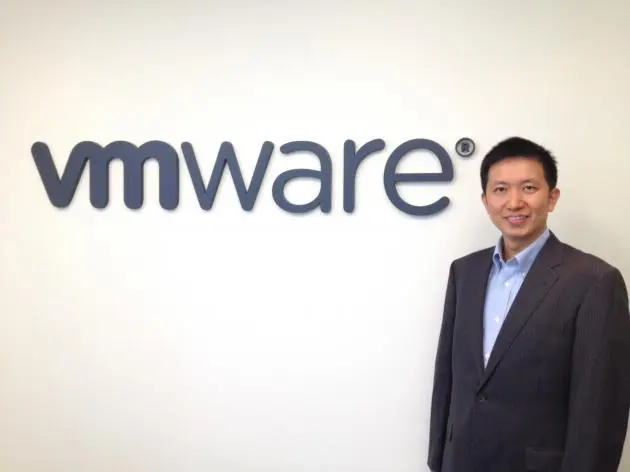
Victor Thu appointed Product Marketing Director for VMware's end-user computing business in Asia Pac


Play
VMware's newly-upgraded portfolio of end-user computing solutions has been designed to free IT from more than two decades of device-centric computing
Mware, Inc. (NYSE: VMW), the global leader in virtualization and cloud infrastructure, today announced the appointment of 15-year IT veteran Victor Thu as Product Marketing Director for the end-user (EUC) computing component of the company’s business across the Asia Pacific Japan (APJ) region.
His appointment coincides with VMware’s May launch of the VMware View 5.1 desktop virtualization product, along with an updated portfolio of EUC solutions designed to help free IT from more than two decades of PC-era computing. This is being achieved by empowering employees to use a variety of devices to access apps and data in a secure and compliant manner, whenever and wherever access is needed.
EUC represents the third level of VMware’s three-layered technology stack, through which the company is pursuing its vision of cloud-enabled IT-as-a-Service. The first two layers of the stack address the infrastructure and applications requirements of customer organizations on their journey to the cloud.
Reporting to APJ Marketing Vice President Pamela Cass, Thu takes leadership of a team of product marketing managers across the region and will shape and implement VMware’s EUC go-to-market strategy according to varying levels of market maturity. He is based in Hong Kong.
Thu said: “This is a great time to be joining VMware because enterprises in this region want to harness the latest technologies to transform their businesses. In this regard, VMware has earned enormous trust in the market and is very well positioned to help businesses move to a highly-flexible cloud infrastructure.”
“More importantly, VMware is not just thinking about the next one to two years, but the next five to ten years – and has brought together some extremely powerful technologies to form the strongest end-user computing story in the market today.”
He explained that the LTE – also known as 4G – mobile communications technology being rolled out by telecommunications operators in the region will serve to strengthen VMware’s EUC approach because portable devices will be served by far higher data download speeds than is currently possible.
Thu joins VMware from Citrix Systems, where he was responsible for the product marketing and management of the company’s entire portfolio throughout Asia Pacific. For the first three of his five years at Citrix, he worked as Senior Product Marketing Manager in the United States, responsible for the company’s desktop virtualization offering. While based in the United States, he has also worked for Siemens Communications, Electronics for Imaging and Electroglas.
Andrew Dutton, General Manager and Senior Vice President of VMware’s APJ region, said: “We are delighted that Victor has brought his valuable skills and experience to VMware. He will play a central role in ramping up the go-to-market effort behind a portfolio of advanced end-user computing solutions that will help transform businesses by making their employees more productive and collaborative on an anytime, anywhere basis.”
Thu speaks the Mandarin, Cantonese and Hakka dialects of Chinese, as well as Bahasa Malaysia, English and Japanese. He holds a Master of Business Administration degree in Marketing Management and International Business from Santa Clara University in California, as well as a Bachelor of Arts in Physics from Wartburg College in Iowa.
Thailand has already provided assistance to Myanmar in many fields including education and health, he said and noted that the US could contribute more assistance through the existing channels.
During the meeting with Clinton, Surapong said he asked Washington to lift all sanctions against Myanmar and put more assistance to refugees who were being sheltered along Thai borders for long time.
Clinton explained to him that the US could not lift all sanction at once due to complexity of legal procedure and Surapong said he urged the US administration to consider issue an executive order to have more relaxation on the sanction.
The Thai foreign minister Surapong also asked the US to fully support the reform in Myanmar to have the country moved toward democracy and reconciliation.
“The US should emphasis the importance of both President Thein Sein and Aung San Suu Kyi equally as both of them are key components for the reform in the country,” Surapong told reporters after the meeting with Clinton at the State Department.
Cooperation between Thailand and the US on Myanmar would be a part of the strategic cooperation and would be put into a memorandum of understanding to be issued in the near future.
On bilateral matters, Clinton asked the Thai government to speed up its decision to join the US sponsored Proliferation Security Initiative (PSI) to stop trafficking of weapons of mass destruction.
Prime Minister Yingluck Shinawatra told President Barack Obama when they met in Bali on the sideline of Asean summit last year that her cabinet would consider the PSI and announce to join the scheme soon but her cabinet has not yet considered the scheme until now. Surapong told Clinton that his government was still studying the PSI.
Surapong said he was working out to have an exchange visit between Prime Minister Yingluck and President Obama, if possible, within the second half of this year.
On the regional issue, Clinton said briefly to reporters before the meeting with Surapong that the US liked to see Thailand played leading role in the region to enhance peace, security and prosperity.
In the meeting, she voiced concern over the situation in South China Sea where China has territorial disputes with nations in South East Asia. The US wanted to see freedom of navigation and right of free passage in the area were guaranteed.
As the Asean’s coordinator with China, Thailand would work with Beijing on the plan of Asean to have Code of Conduct for South China Sea to replace the Declaration of Conduct which has been used for some 10 years, Surapong said.
Surapong said he did not raise the issue of Utapao to discuss with the US Secretary of State Clinton as the issue was politically too sensitive.
The National Aeronautics and Space Administration (NASA) requested to use facilities at Utapao airbase for its weather research aircraft since the previous government.
The use of Utapao by NASA was mixed up with an idea by US Navy to use the airbase for humanitarian assistance and disaster relief. Yingluck’s government was alleged that it might exchange the use of Utapoa with US VISA for former Prime Minister Thaksin Shinawatra.
Surapong said Thaksin has nothing to do with this matter. The foreign ministry might withdraw the US proposal from the cabinet consideration to end all accusation and political difficulty. “We might lose the interest from the project but as it is politicize too much, I don’t want to carry on,” he said.
