
Hyundai has a star on its hands


Play
Its Veloster Turbo comes with dramatic styling and offers good performance
Hyundai has been present in the Thai market for many years, but the brand hasn’t been able to break into the mainstream markets that are dominated by Japanese brands.
However, the Korean auto-maker has been highly successful in the niche market, particularly with its H1 11-seater van, which offers a great package compared to its retail pricing of below Bt2 million.
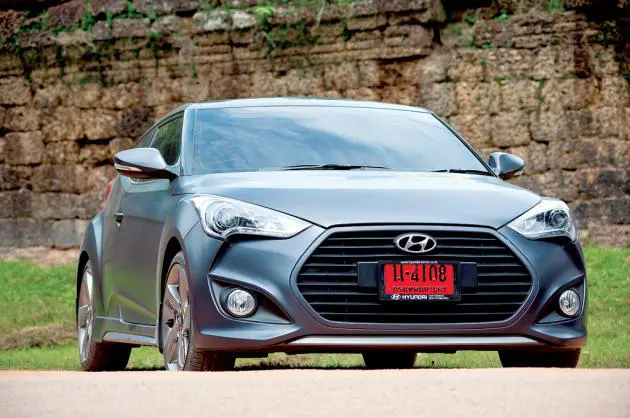
At the moment Hyundai seems to have come up with another winner, and it isn’t an eco-car or a sedan, it’s a 4-door hatchback called the Veloster. But wait a minute. There are 3-door and 5-door hatchbacks, but I’ve never heard of a 4-door hatch before. Hmmm… Well that’s because the Veloster has two front doors and only one door for the rear passengers, plus the rear hatch. So from one side it looks like a 3-door hatch and from the other it looks like a 5-door hatch – Hyundai calls this the 2+1 configuration. This could be mind-boggling to some, but forget about it and take a good look at the whole car.
You just can’t argue that the Veloster comes with a striking design that will be turning heads everywhere it goes. And if that isn’t enough, the test-drive event for the Veloster was held from Bangkok to Siem Reap in Cambodia, where the mighty Angkor Wat is located along with numerous other archaeological sites such as the Bayon Temple, Angkor Thom and Banteay Srei Temple.
Somehow the Veloster’s futuristic design makes its way into the thousand-year-old abandoned city, and it kind of matches with the extremely awesome design both have to offer. There are two versions of the Veloster available – normally aspirated and turbocharged, the latter being featured today. The Veloster Turbo is priced at Bt1.748 million (the matt petrol-grey body colour on this car costs an additional Bt10,000), which makes it stand out from the crowd. You’re not going to get an imported sports hatchback that attracts this much attention at this price.
I can’t think of any competitors for the Veloster Turbo from the Japanese stables, since they are busy selling locally assembled cars for the masses. But considering the price range, other cars that you may also consider are the Mercedes-Benz A-Class (Bt1.89 million) and BMW X1 (Bt1.99 million).
I’ve driven several Hyundai models before, and there is a significant improvement in each new model whether in terms of design or reliability. However, driving enjoyment isn’t what the Korean brand excels in. Well, the Veloster is here to change that perception. The turbocharged 1.6-litre GDI (Gasoline Direct Injection) engine pumps out a healthy 186 horsepower, while the 265Nm peak torque kicks in at 1,500rpm and stays all the way until 4,500rpm.
In normal driving situations, the wide torque band allows you to accelerate smoothly without having to kick down. But when you need to go all out, the Veloster Turbo can accelerate from 0-100km/h in 8.6 seconds and go all the way to a top speed of 214km/h. This is the fastest Hyundai I’ve driven so far. The engine delivers a sporty note at higher revs although it gets a little coarse as well, and the throttle response is great with no turbo lag. You just press and go. But when you’re not speeding, the engine is efficient too, with an average fuel consumption of 17km/litre, while carbon dioxide emission is claimed to be 159g/km (Euro 5). The transmission is a 6-speed automatic with paddle shifters. It works well for an automatic, although it still can’t beat a good dual-clutch transmission in terms of driving enjoyment. You’re not gonna get high-rev kick-downs here, and have to be content with a smoother driving style.
The Veloster is available with a DCT (Dual Clutch Transmission) in certain markets, but unfortunately it is not offered here. The steering has a nice weight, but the electric assistance still feels elastic, reminding you of an arcade game. Nevertheless there is good precision and the suspension – struts in front and torsion beam at the rear – offers loads of grip. The mono-tube gas shocks and 215/40 R18 tyres also add to the crispness, although they are no match for poor Thai roads if you want ride comfort. You can easily feel the harshness when going over speed bumps and road undulations, but that’s the price you have to pay for a sporty car. Stopping power come from discs all-round, with ABS, EBD and BA.
The interior of the Veloster is equally impressive as the exterior, boasting modern styling with sporty appointments such as the bucket seats and large electric sunroof. The rear passengers get enough headroom, although they might need to bring along a hat. The glass roof isn’t a good idea for Thailand since the sun will always be shining on your head. The standard equipment package is offered, including automatic climate control, Bluetooth (music and phone), smart entry and a multi-function steering wheel.
The Veloster Turbo is definitely a winner from Hyundai, offering good performance and dramatic styling. We’re going to see a lot of them on the road this year as the first cars are being delivered to customers.
Hyundai Veloster Turbo
Engine: 4-cylinder DOHC 16-valve D-CVVT
Displacement: 1,591cc
Bore and stroke: 77.0x85.4mm
Compression ratio: 11.0:1
Max power: 186hp/5,500rpm
Max torque: 265Nm/1,500-4,500rpm
Transmission: 6-speed automatic
Ratios: 4.639/2.826/1.841/1.386/1.000/0.772
0-100km/h: 8.2 secs
Top speed: 214km/h
Average fuel economy: 17.3km/litre
CO2: 159g/km
Suspension (f/r): McPherson struts, stabiliser/torsion beam, stabiliser
Steering: powered rack-and-pinion
Turning circle: 10.4 metres
Brakes (f/r): vented discs/discs with ABS, EBD, BA
Dimensions (mm)
Length: 4,250
Width: 1,805
Height: 1,399
Wheelbase: 2,650
Track (f/r): 1,557/1,569
Weight: 1,353kg
Wheels: 18-inch alloys
Tyres: 215/40R18
Fuel tank capacity: 50 litres
Price: Bt1.749 million (Petrol Grey)
Distributor: Hyundai Motor (Thailand)
