
Self-service registration at district offices from next year


Play
E-access planned for personal, household data; smart cards for vehicle registration also on the way
Two government agencies – the Local Administration Depart-ment and the Land Transportation Department – last week showcased new e-services that will be available to the public next year.
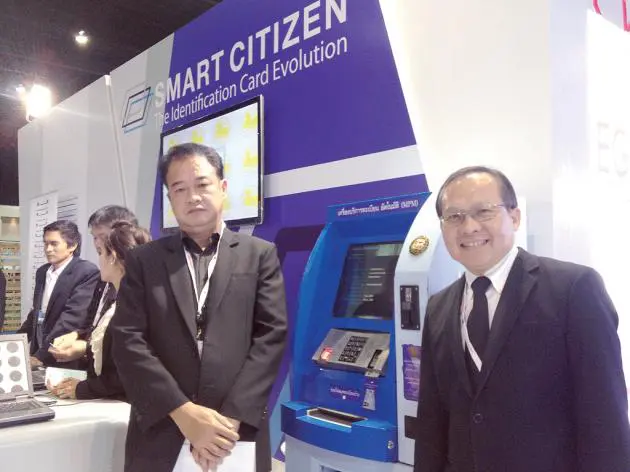
People will be able to undertake self-service operations at the Registration Administration Bureau via multi-purpose machines (MPMs), which will initially be located at district offices throughout Bangkok, thanks to a new e-service from the Interior Ministry’s Local Administration Department.
The bureau showcased its latest e-services at the “ITU Telecom World 2013” event last week.
The new service allows people to do their own online transactions in regard to personal registration administration information at an MPM. This covers information checking, making a copy of their personal information – including name, address, 13-digit citizen ID number and marital status – and their rights to medical treatment.
Vichain Chidchanognarth, director of the Registration Administration Bureau, said there had been good feedback from an e-self-service trial using 10 MPMs in Nakhon Nayok under the Smart Province project, with some 10,000 transactions being conducted per machine.
The bureau therefore plans to implement 190 MPM machines at district offices in Bangkok, where there are normally over 100 transactions of registration administration per office each day.
“The cost of the machines was Bt300,000 for each of the 10 units in the trial period, which was run from early this year. We got good feedback, therefore we will officially launch this new service next year with the implementation of 190 MPMs in Bangkok first,” he said.
To avail themselves of the service, people can use the smart ID card with a four-digit PIN code to access their personal information at an MPM. They can also use their 13-digit ID number along with a thumbprint to identify themselves, and access the personal information and use the e-service easily and conveniently.
The services available via the MPMs are individual registration administration, national ID card administration, household administration, election administration, alien administration and marriage administration.
The system is also connected to other government agencies, including those covering rights to medical treatment – including social security rights and national health security rights – the Government Pension Fund and the Passport Division.
Vichain said members of the public would be able to self-serve via an MPM for household information such as transfers and the registration of births and deaths. They can also update their household book at any of the machines.
Users can also ask to print out a copy of their official registration administration documents directly from the MPM, paying by coin to do so.
Vehicle registration
Meanwhile, the Land Transpor-tation Department plans to launch a new e-service for electric vehicle registration certificates, which will replace vehicle registration books.
Surapol Dumkor, founder and chief executive officer of Innovation Automation, a solution provider for the department, said the agency would debut the service by next April as an option for drivers.
Vehicle buyers will be able to have their vehicle registration book replaced by a smart card, which will be embedded with near-field communication and QR code technology, to store the vehicle’s registration information as well as a photograph of the vehicle, electronically.
“At the initial launch, it will be an option for people who would like to have their vehicle registration in the form of a card rather than a book. They might be charged Bt200 for this,” he said.
The beauty of the electric vehicle registration certificate is that it will prevent fraud, be easy to carry and convenient to use, and is very flexible for vehicle trading, he added.
“It comes with 3DES [Triple DES] and RSA 2048-bit security. It is contact-less, which makes it easy to use. If someone loses a card, they can contact the call centre to inform them and cancel the card immediately. The card then cannot be used any more, similar to the way we do it for ATM cards and credit cards,” said Surapol.
By April, the system will be implemented at the department’s five transportation centres in Bangkok: at Chutuchak, Taling Chan, Nong Jok, Bang Khun Thian and Phra Khanong. The system will then be rolled out nationwide in the next 12 months.
Also at last week’s ITU Telecom World event, the ICT minister of Bhutan, DN Dhungyel,
visited Thailand’s e-government pavilion.
He said his government had a policy to have all Bhutanese connected and benefiting from technology.
“We also have rolled out e-government services to our citizens, similar to Thailand’s e-government. But we not yet providing all government services in electronic format,” he added.
