
Thailand's annual auto sales could be lower than forecast


Play
Purchases drop in October, no hope November sales will increase, but Motor Expo expected to drive demand
With just about a month left before the year disappears into the sunset, the automobile industry could end up with lower annual sales than forecast.
Up until October this year, auto sales plunged by 36 per cent to just 719,260 vehicles, down from the 1,123,000 sold in the same period last year.
Figures by industry compiler Toyota show that the market was still heading rearwards in October, with monthly sales falling by 20.4 per cent from the 88,989 vehicles sold in October last year to 79,850 this year.
Major automakers, including Toyota, have been revising annual sales forecasts several times this year. While Toyota has reversed its forecast to 920,000 vehicles, other makers are not as enthusiastic, with many believing that 800,000-plus vehicles will be sold.
Toyota Motor Thailand vice president Vudhigorn Suriyachantananont said the current market decline is the result of the high debt burden and lower income by farmers, as well as the government’s First Car Buyer programme in 2013 that stole future demand for automobiles, what with tax rebates of up to Bt100,000 per vehicle.
“These factors have resulted in a decrease in consumer-purchasing power,” Vudhigorn said.
He added that the auto market had also been affected by the political uncertainty in the first two quarters of the year.
“Exports and tourism have not completely recovered, and inflation is causing the business and public sectors to be more careful about investing and spending,” Vudhigorn said.
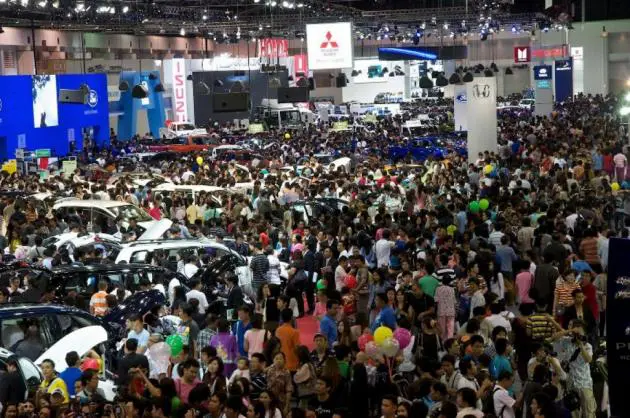
However, as the economy show signs of recovery due to the government’s stimulus programmes and automobile companies rolling out new models – mostly at the Thailand International Motor Expo that starts today – year-end auto sales are expected to shift into high gear.
“Still, uncertainty concerning a global economic recovery is a negative factor for Thai exports, and [negative] consumer sentiment on the higher cost of living [inflation] would keep November auto sales in a suspended state,” Vudhigorn added.
The organiser of the Motor Expo, Kwanchai Paphatphong, said the show is expected to generate as much as Bt54 billion. “[However] this year the automobile market will definitely drop as it has fallen by more than 30 per cent, and if the situation persists, the market would finish the year in the 800,000-unit range,” Kwanchai said.”The markets affected the most are those being driven by the middle class and down, while the upper luxury car market has not been affected,” he said.German luxury carmaker Mercedes-Benz, for example, sold 8,428 cars in the country this year, posting an 11.8-per-cent growth, thanks to the introduction of small models such as the A-Class and CLA which have gained exceptionally high popularity. Meanwhile, BMW’s car sales dropped by a mere 1.7 per cent, again thanks to the popularity of its small models such as the 1 Series and X1 models.Kwanchai expects 50,000 vehicles to be sold at the Motor Expo, thanks to the launch of new models that are whetting consumers’ appetites.Among the crowd pullers at this year’s show are the Mazda2, Honda HR-V, Nissan X-Trail, Mitsubishi Triton and Mercedes-Benz C-Class Bluetec Hybrid.Up to 40 auto and 11 motorcycle brands, along with 300 accessory retailers, are exhibiting their products at the show. Auto companies are going all out to secure high year-end sales, Kwanchai revealed.
“You can see this from the highly attractive vehicles and promotions during the show, which will help stimulate the market in the remaining part of the year,” he said.
Kwanchai said he is confident that the auto industry would recover following stronger political confidence and economic strength.”This will help auto sales to grow by 5-7 per cent next year,” he predicted.
