
Turning Thailand into a 'software-defined' country


Play
VMware offers data-centre virtualisation, hybrid cloud and end-user computing to enable companies to enhance efficiency and competitiveness
In the mobile-cloud era, the “software-defined data centre” solution can enable companies to better utilise their budgets, while increasing business performance and competitiveness, according to US-based VMware.
VMware’s chief technology officer (CTO), Ben Fathi, said the company’s three key business strategies were focused on the software-defined data centre, the hybrid cloud, and end-user computing.
The first of these entails having all main components of a data centre – computer, networking and storage – working together in software, he said.
VMware builds software-defined data centres, the idea of which is to put all the brain and technology into the software instead of into hardware, thus making it much easier to be more agile and faster in developing and building technology, he explained.
VMware also provides a hybrid cloud platform, recently renamed vCloud Air. It was previously known as VMware vCloud Hybrid Service.
The advantage and differentiation of vCloud Air is that it runs the same software that users would run locally in their data centre, and is seamless, said the CTO.
For some of the company’s competitors in this field, like Amazon and Google, the application they use means users run it on their data centre, and not on their cloud. They therefore have to completely rewrite the application, he said.
Another area the company is investing heavily in is end-user computing, which means VMware is able to help deliver applications to devices.
Users can remotely manage and control devices with VMware’s mobile-device management software product, Airwatch, which is especially good for a company’s confidentiality when devices are stolen or lost.
Airwatch allows users to manage any kind of device, whether it’s a laptop from any brand, or any operating system. It can control devices in terms of security, app management, content delivery and e-mail, said Fathi.
“VMware’s vision allows customers to run their apps and get efficiency, because we virtualise everything and are able to manage it seamlessly regardless of where it’s running, in the cloud or in your data centre, and then deliver to your customers or employees on their devices – and manage those devices so you have security of isolation and, if anything goes wrong, you can remotely manage the device,” he explained.
He added that the big challenge for customers when considering a move to virtualisation and a software-defined data centre was how to continue to support the legacy application that they have running in their environment so they do not have to rewrite the app.
Another area that is very challenging is security, having to be careful not to lose internal or customer information.
Key sectors that the company are working to assist include the financial industry, where banks and other financial institutions have the most demanding needs; the scientific field, such as cancer research and hospitals, where data and security are crucial issues; and automotive and engineering, because they need plenty of agility and work very fast, said the CTO.
“We also work with partners for small and medium-sized businesses, as they cannot afford to specialise in each of these areas. We have partners that deliver the software and hardware and help configure and manage it for them,” said Fathi.
He said hyper-converged infrastructure, network virtualisation and storage virtualisation together were the next big thing in information technology.
Hyper-converged infrastructure will dramatically simplify the delivery of software-defined infrastructure services, while lowering the operating expenses of customers.
Meanwhile, virtualisation is the area in which VMware first innovated as a company. Initially it was computing, now it includes networking and storage, which means everything in a data centre can be virtualised so that users can buy much cheaper hardware, he said.
“We commoditise hardware, and all the intelligence is in the software. And that way, you can fix software if anything goes wrong. So you get more benefits out of it,” said Fathi.
Chawapol Jariyaviroj, general manager of VMware Thailand and Indochina, said the company’s commitment is to enable Thailand businesses in their journey to building software-defined enterprises, with the unveiling of new solutions for the mobile-cloud era, which includes the latest cloud-management offerings and end-user computing solutions.
Positive attitude to virtualisation
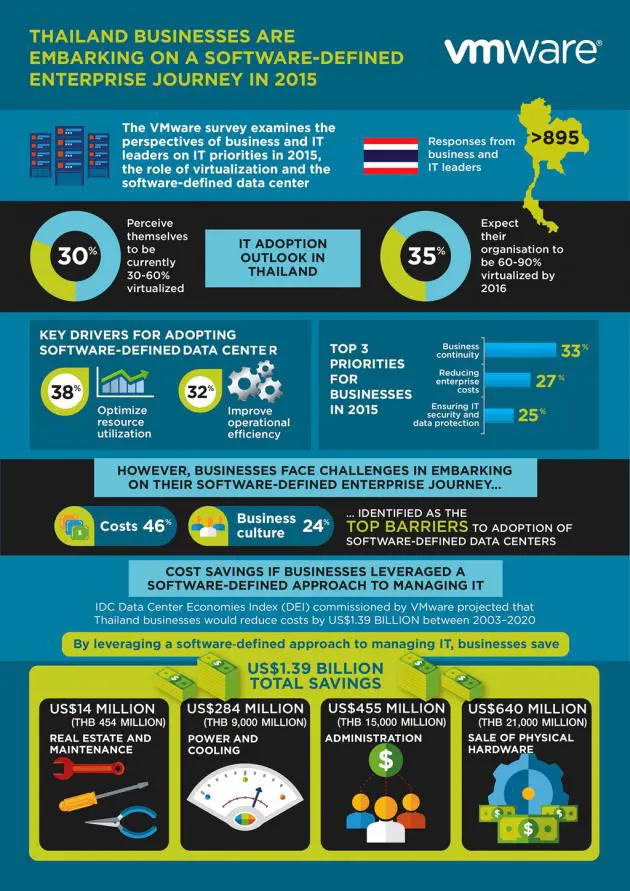
According to a recent VMware survey, Thai businesses possess a positive outlook on technology adoption with 30 per cent of them currently at between 30 and 60 per cent virtualised, and 35 per cent expecting to be around 60 to 90 per cent virtualised in two years.
The IDC Data Centre Economies Index commissioned by VMware projected that businesses in Thailand would be able to avoid US$1.39 billion (Bt45.7 billion) in costs between 2003 and 2020 by switching to virtualisation of computing, storage and networking hardware, and leveraging a software-defined approach to managing IT.
The savings, according to the report, would come from the four key areas of hardware ($640 million), administration ($455 million), power and cooling ($284 million) and real estate/maintenance ($14 million).
“Businesses in Thailand are moving in the right direction, and this will be especially useful as Thailand opens up as a key growth market in the region. Our biggest customers in Thailand are financial services, insurance and the telco industry, as well as manufacturing and education,” said Chawapol.
The company uses a range of different market approaches. For example, it directly approaches the top 100 enterprises in Thailand and national companies, all of which all are VMware clients.
Meanwhile, for small and medium-sized businesses, it uses hybrid engagement via premier partners and enterprises partners.
The company’s revenue is more from large enterprises than small businesses, he added.
“Partners play a key role. This is why VMware invests heavily in partner ecosystems to help us. We make sure they get updated on technology trends and new product categories. We have all scales of customer, from big enterprises to small companies, and this is why we need partners to cover [the market] both vertically and horizontally,” said the GM.
VMware currently has about 300 partners in Thailand, which are10 premier partners and 50 enterprise partners.
Within Asean, Singapore, Thailand, Malaysia and Indonesia are tier-one markets in which the company has significant teams.
Next in terms of market share are the Philippines and Vietnam, as well as developing markets like Myanmar.
VMware Thailand, which supports other countries in the region such as Myanmar, Laos and Cambodia, is in the process of setting up an emerging-market team, said Chawapol.
He added that VMware was continuing rapid expansion of its hybrid-cloud platform by launching new vCloud Air Mobile and Hybrid Cloud Services, which are now available across 75 per cent of the world’s cloud market.
VMware intends to make vCloud Air the industry’s leading hybrid-cloud platform for building, deploying, scaling and operating next-generation, mobile-cloud applications, he said.
He said that with the current government announcing a roadmap to move Thailand to a ‘digital economy’, information and communications technology would be a key driver for reforming the country.
VMware can participate in this through introducing its hybrid-cloud platform and virtualisation expertise, he said.
If the government could reduce the current budget by just keeping the existing system up and running, it could leverage that reduced cost to create other new things required to drive the country’s growth in terms of ICT, such as new apps, the general manager added.
“It’s not only the stability to deliver apps, but the main thing is agility. The country needs to be agile. A lot of good ideas are being pulled around, and the question is whether those in the public sector are ready to deliver on our vision, whether they have the ICT capability to deliver our vision of a software-defined country,” said Chawapol.
