
Internet of Everything godsend for traffic management


Play
Bangkok has just been identified as having the most congested traffic in Southeast Asia, and its traffic jams are listed as the eighth worst in the world.
In the mid-year update by numbeo.com, Bangkok is ranked at the top in Southeast Asia by Traffic Index – which is a composite index of time consumed in traffic due to job commute, estimation of time consumption dissatisfaction, CO2 consumption estimation in traffic and overall inefficiencies in the traffic system.
Moreover, Thailand is ranked as the second worst in the world for road fatalities, behind Namibia, according to the World Health Organisation and The University of Michigan.
When we think of how the Internet of Everything is having an impact on traffic, we focus on how traffic management is embracing the IoE. There are many ways the IoE can help build smarter cities. One method is through optimising services related to transportation such as traffic management, smart parking, and intelligent transit sy stems.
In Bangkok, the government has just implemented the intelligent transport system (ITS) which is an advanced application aimed at providing innovative services related to different modes of transport and traffic management. It aims to enable various users to be better informed and make safer, more coordinated, and smarter use of transport networks.
ITS includes automatic traffic control, vehicle-to-vehicle communications, GPS tracking, RF-ID licence plate, adaptive cruise control, voice recognition, artificial intelligence and sensor. They provide road safety, high mobility and greener transport.
To take a real step towards smart traffic, the IoE can help accelerate ITS such a by all cars being equipped with a sensor installed that would transmit real-time data on their location to the control centre at the Ministry of Transport for analysis. It would be combined with data from CCTV cameras in Bangkok. The data would be transmitted to the traffic police and to drivers via in-car navigation devices or mobile apps, enabling commuters to avoid congestion and plan their journey more effectively.
Smart parking spaces, solar roadways, self-driving cars, and automated tollbooths are examples of IoE innovations that are shaping the future of transportation and smart cities. By connecting these disparate systems, a smart car “talks” to a smart traffic signal, which “talks” to the road and realises that there are no other cars at the intersection, then the light turns green, saving drivers time and conserving gas.
At Cisco, we talk a lot about the future driven by the IoE. Cisco and our partners are helping cities around the world benefit by creating and implementing IoE-enabled solutions. For example, The smart intersection solution developed by AGT International and Cisco utilising its data in motion technology uses edge analytics to aggregate data at intersections to support vulnerable road users, improve traffic flow, monitor air pollution and optimise traffic infrastructure management. Smart analytics can also be used to manage intersections and accident-prone areas where traffic build-up usually originates. AGT and Cisco’s traffic incident management solution is part of the broader Cisco Smart and connected city traffic solution. It addresses the two most important traffic challenges facing cities today, which are road safety and congestion.
It helps traffic departments accurately detect more incidents early before they become critical and enables quicker response by monitoring and analysing traffic flow data. The solution stands out with two important innovations: the fusing of data from multiple sources to identify real incidents and reduce false.
Thailand has a long way to go to reach traffic efficiencies, and the opportunity for the public sector, business leaders and the industry is to think bigger to solve bigger problems. It is the use of data from different sources in real-time and processing information to take immediate decisions that is the key to a successful traffic management in our cities. The next step is applying these insights to enhance processes which will require new skill sets and greater collaboration at all levels. To be successful, governments must build the right network infrastructure and embed context from the IoE into the workflows.
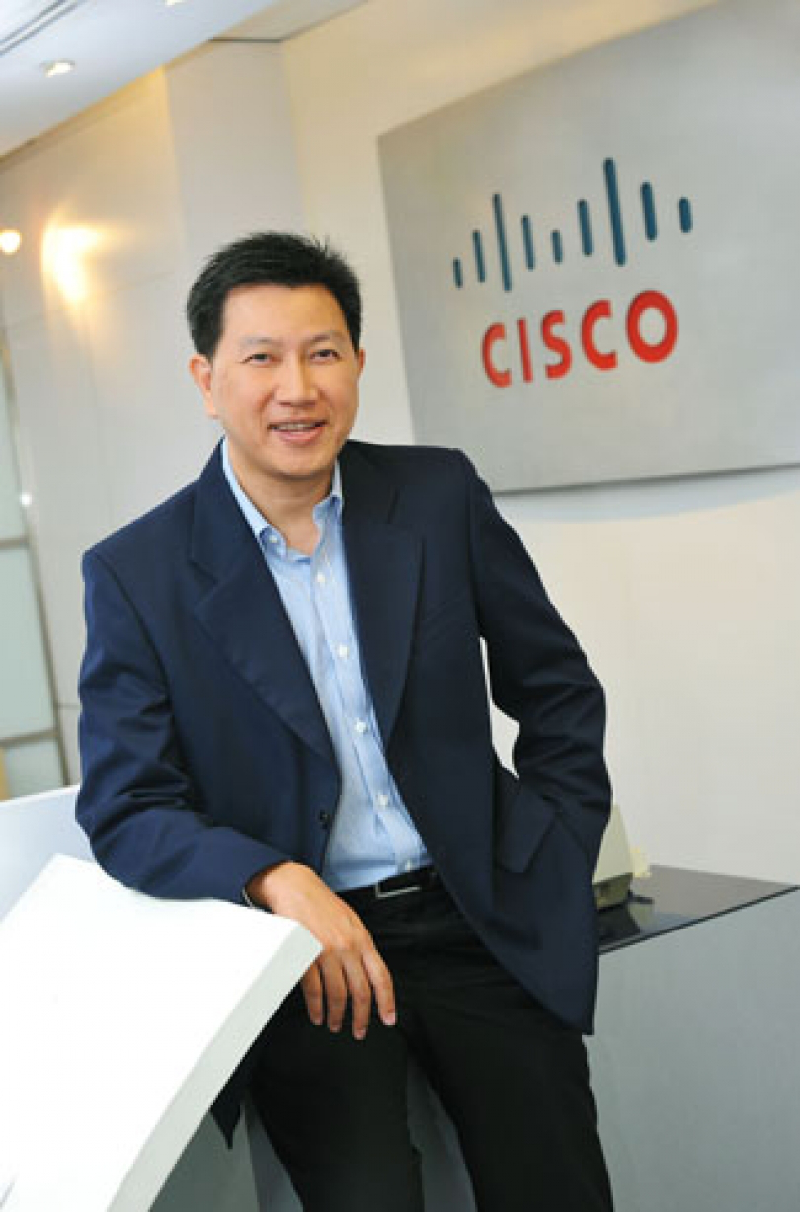
Vatsun Thirapatarapong is managing director of Cisco in Thailand and Indochina.
