
‘Pokemon Go’ catches more players


Play
“Pokemon Go,” a smartphone game that arrived in Japan on Friday riding waves of explosive worldwide popularity, has brought with it both excitement and anxiety over this new style of gaming.
People playing the game on their phones are appearing all over the country of Pokemon’s birth, suggesting it is well on its way to becoming a social phenomenon.
While there are hopes the game will have positive economic effects, some have worried about people getting into trouble because they are absorbed in using smartphones while walking.
Big anticipation
Office workers walking around staring at their smartphones began appearing in front of JR Shimbashi station in Minato Ward, Tokyo, a little after noon on Friday.
“People playing the same game have approached me, so it deepened my encounters with strangers,” said a 26-year-old company employee.
The game is free to download to smartphones, which are already widespread, so it has been taken up by many people who were not previously video game enthusiasts.
News of the game’s popularity in the United States, combined with a delayed release in Japan, only increased anticipation here.
It is standard practice in the gaming industry to announce a game’s release, but “Pokemon Go” appeared without any prior warning.
The game uses many smartphone functions, including map applications, GPS and camera, to create an experience that makes it seem like players are capturing Pokemon creatures in the real world.
Exact figures on how many times the game has been downloaded were not available, but in just over five hours, “Pokemon Go” became the most-downloaded free game on Apple Inc.’s App Store for the Japan market.
The release in Japan was probably delayed because of problems with servers crashing overseas, so the companies involved wanted to be thoroughly prepared, observers said.
“There are many cases in which smartphone games that run into problems right after their release have lost support from users and failed,” a video game industry source said.
‘Pokemonomics’
The term “Pokemonomics” has been coined to refer to the economic effects of “Pokemon Go.”
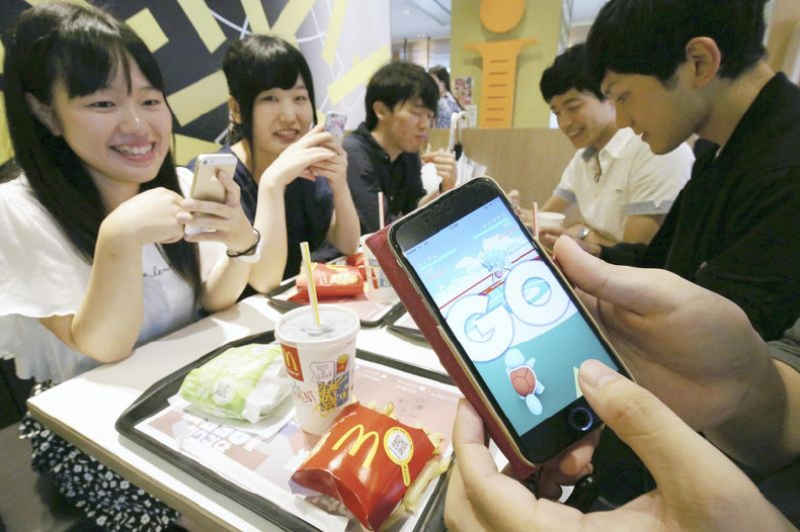
McDonald’s Holdings Co. (Japan) is trying to attract customers by distributing virtual tools players can use to capture Pokemon or letting players battle each other at about 2,900 outlets nationwide.
Railway companies are hoping the game will get more people out of the house and onto trains.
A major distribution company is said to be searching for a way to make a “Pokemon Go” tie-up.
The effects of Pokemonomics have extended to the Tokyo Stock Exchange. Shares of Nintendo Co. temporarily rose ¥1,920 (6.9 percent) from the closing price of the day before, reaching a high of ¥29,920, which is about double the value of the game’s release in the United States.
Shares of companies that manage entertainment facilities and that are part of the smartphone industry were also up significantly.
Still, in a report on its performance expectations released Friday, Nintendo said “Pokemon Go” would have “limited effects.”
The company profits when customers purchase items such as tools that make it easier to capture Pokemon, but the game is free to download.
And any profits that are generated are expected to go mainly to The Pokemon Co. and the U.S. firm Niantic, Inc., Nintendo’s partners in the project.
Nintendo “might only receive 10 percent or less of the profits,” an employee of a major securities firm speculated.
Boon for phone gaming
The “Pokemon Go” craze could accelerate the transition of gaming from game consoles to smartphones.
Japanese companies are spending less on developing stationary consoles in favor of investing in smartphone games, hoping to score a hugely profitable hit.
The domestic market for video games was a record ¥1.36 trillion in 2015, according to Famitsu, a magazine that reports on the gaming industry.
Income from smartphone games, including those for personal computers, increased 27 percent from the previous year to ¥998.9 billion, well over half of the total.
“Stationary [consoles] remain popular in Europe and the United States, but ‘Pokemon Go’ is bringing more attention to smartphone gaming. It’s a big opportunity for Japanese firms,” said Hirokazu Hamamura, representative of Famitsu.
