
Si Rattana spreads her wings


Play
Thai Airways International puts the A380-800 into the sky
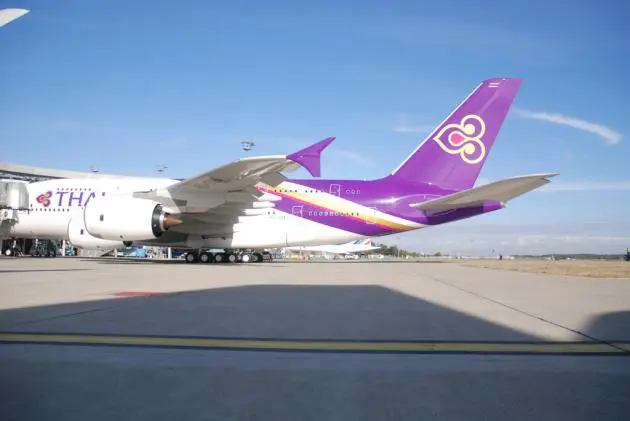
Outside the Airbus Delivery Centre in Toulouse, Southwest France, THAI’s first A380-800 stands still, waiting for her call to raise her wings for the ferry flight to Bangkok. Inside the delivery hall, the small group of passengers, champagne glasses in their hands, gathers around high-topped cocktail tables. Their eyes are glued on “Si Rattana” as the THAI A380-800 is called, every bit as admiring as if the superjumbo were the Mona Lisa of the 21st Century.
“Beautiful, isn’t she?” says Frenchman Frederic Morel, raising his glass to her as we move to the outside deck for a closer look, perhaps searching for that mystic smile.
“Absolutely. I can’t wait for boarding time,” I reply.
Pure and beautiful, with a white fuselage and wings, she is wrapped with violet, red and yellow stripes on her tail and on her vertical stabiliser. With two decks, three classes, four engines and 507 seats, Si Rattana surely rivals any bird.
THAI A380-800 takes off around 4pm. Four Rolls-Royce Trent 970 engines take the 250-tonnes aircraft to a speed of more than300 kilometres per hour on the runway before lifting her up into the Toulouse sky.
Unlike the A320, a smaller model that dashes in and out like a bat on low-cost flights, the world’s largest passenger airliner is very calm and confident when climbing up to altitude. Sitting comfortably in seat B20 seat, Royal Silk class on the upper deck, I feel only the slightest shake as the altitude changes. My girlfriend, who suffers from ear barotrauma and hates take-off and landing, would love flying in the A380-800. From taking off to cruising, thanks to the better air pressure within the cabin, I don’t get a single pop in my ears.
“Like on a double-deck bus, people on the upper deck will experience heavier vibration than those on the main deck,” says someone behind me, trying to bring the science of aerodynamics to the street level.
Inside the wide body, Thai Airways’ A380-800 features 507 seats in three classes: with 12 in Royal First class and 60 in Royal Silk class and 58 in Economy class on the Upper Deck. The remainder of the 377 Economy Class seats are on the Main Deck.
Royal First class, with 1-2-1 layout, is really luxurious with plenty of space (83-inch pitch/ /26.5-inch width), fully flat beds, 23-inch interactive touch screens and power and USB sockets – in short, mini-suites with first-class services. It offers super-sized toilets and a dressing area. The enlarged galley is equipped to prepare meals timed to each passenger’s individual preference.
The Royal Silk, or Business class is just beyond first class. All 60 shell seats, with 1-2-1 layout, are designed for greater privacy and direct aisle access. With a forwards-backwards arrangement, the seats (74-inch pitch/20-inch width) can be fully flat and slide down to recline, which is good for relaxing on a day flight and getting some sleep on a night flight. The 15-inch personal interactive touch screen, Wi-Fi, SMS and mobile communications access, plus in-seat PC power point add a new benchmark for Thai Airways’ passengers.
The two middle rows (D and G) have seats with even numbers, allowing passengers travelling as couples – honeymooners say – to sit side by side, while odd numbers keep two passengers (with a hate-and-love relationship, perhaps) apart.
While we’d all like to jet about in Business class, most of us end up at Economy class with one or two people to clamber over to get to the aisle. A380 is a big aircraft and that means many more seats are fitted into its cabin, compared with the smaller A330 or B777-300.
However, as mentioned earlier, in the A380-800, Thai Airways keeps 58 seats, with 2-4-2 layout, in the last section of Upper Deck and this is where to go for the best Economy seat.
Luxury and passenger comfort is resized down to 32-inch pitch and 18-inch width for the Economy standard seat. In-flight entertainment – a collection of 117 movies and games – come through 10.6-inch seatback touch screens.
On the 10-hour ferry flight from Toulouse to Bangkok, the cabin is totally dark and quiet. Once in a while, as I’m reading alone in the cabin, I catch a series of snores against the sweet rumbling of Rolls-Royce engines.
Thai Airways is the ninth operator of the Airbus A380. The airline has ordered six A380-800 aircraft, with two more scheduled to join the fleet before the end of this year, and three others in 2013.
THAI will inaugurate its commercial service with the A380 from Saturday flying on the Bangkok – Hong Kong and Bangkok – Singapore routes. As more aircraft are delivered, the airline will begin a service to Frankfurt at the end of the year, followed by Tokyo and Paris early in 2013.
“The A380 appeals to air travellers. People always makes people want to fly with it,” says Saen Lee, Airbus’s Communication Director in Asia. “Singapore Airlines, Emirates and other A380 operators of A380 have found that their flights on the A380 are always full.”
