
Six degrees of separation


Play
A visit to the most heavily militarised border in the world
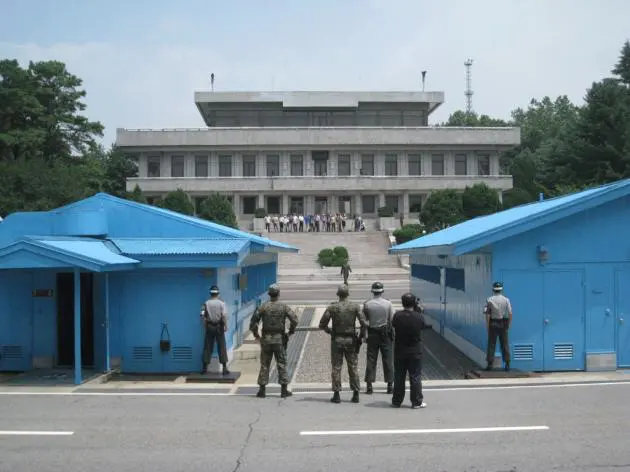
Visitors to South Korea’s beautiful countryside and the bustling and prosperous capital Seoul could be forgiven for thinking that this a country at peace with itself and others. Yet South Korea is still technically a country at war since an armistice agreement, and not a peace treaty, was signed exactly 60 years ago. A trip to the Demilitarised Zone, particularly the Joint Security Area, epitomises this reality.
The instantly recognisable blue buildings in the JSA, along with South Korean soldiers standing in a tae-kwondo position facing their North Korean counterparts, seem surreal in the bright sunshine. The military demarcation line, which cuts the blue buildings and even the negotiating table in half, dramatise the tension even more. Waving or pointing at the North Korean side is strictly forbidden.
Differences between the two sides cannot be starker, with per capita income in the south around US$25,000 while in the north it’s as low as $600 to $1,000.
“In the 20 years after the war, the North was better off thanks to its natural resources. The situation is very much reversed now,” says Kim Ji Hong, associate dean at the KDI School of Public Policy and Management.
Measuring 250 km in length and 4 km in width, the DMZ is the most heavily militarised border in the world so North Koreans are forced to find other ways to cross over. Current estimates put the number of defectors at 25,000 defectors, but for those who do make it, settling into South Korean society is tough, with newcomers having to struggle not just with new skills but also the more modern everyday language and culture.
Will there be peace and unification? And if so, when and how? Twenty years ago, public support for unification was at 90 per cent; today it’s dropped to 70 per cent.
“The younger generation is afraid of the unification costs, but they do not necessarily deny unification. They just want to delay unification until after North Korea changes. Unification is the goal of all Koreans, but people have different views on when we should achieve unification – now or a bit later. That’s the difference,” notes Dr Choi Jinwook of the Korean Institute for National Unification.
Even with North Korea’s recent provocations, Dr Choi believes that another all-out war is unlikely, “China is taking a firm position on North Korea’s nuclear weapons programme and the US-South Korea alliance is very strong. These two factors deter North Korea,” he says.
The Korean War started on June 25, 1950 and ended with an Armistice Agreement on July 27, 1953. Ever since, the 38th parallel north that divides the Korean Peninsula has been one of the tensest areas in the world.
Looking across the JSA to the North Korean soldiers and Panmungak building, they seem so very near, yet in reality are so far away.
