
A thousand years of worship


Play
Hewn from rock, Bali's Gianyar temple complex still thrives
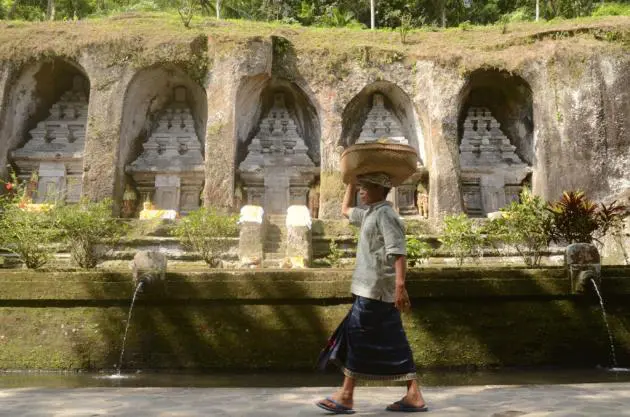
A thousand years ago, hands carved massive rock to make temples linked by holy springs along the Pakerisan River in Gianyar regency.
Today, a full millennium later, other hands continue to tend these temples with a fecund constancy of worship offered to the gods.
The ancient structures are not relics of the past; they stand witness to an unbroken thread running across 100 generations of Balinese Hindus. Along a stretch of the Pakerisan River are the temples of Tirta Empul, Candi Mangening, Gunung Kawi, Candi Pangukur-ukur, Candi Tegal Linggah and Gua Garba.
The lifeblood of the temples is holy water that bubbles up from the earth at Tirta Empul. Capillaries from this source rise in sacred springs within the temples.
However, few apart from scholars know much about the temples.
A volunteer at Tirta Empul, 50-year-old Wayan Rajag, says he does not know the story of the temple that he serves.
“It’s history. I don’t know,” he smiles.
Fifty-five-year-old Nyoman Sampua knows a little more, saying during a rest at the entrance to Candi Mangening, with its winding, Escher-like stairs, “Before we had Besakih, we already had this temple, Mangening. It is the oldest temple here.
“I don’t know what century that was, but I know we had a temple between two rivers at Tukad Pakerisan.
“These days the river has joined,” he continues. “That was the source of the holy springs, the Tukad."
It is understandable that historical temple tales are unimportant to the people of this area. Here history is not formed from disused relics observed as evidence of past reality. These people live within the ongoing story of this string of river temples.
At Gunug Kawi is Ibu Ketut. Every day, Ketut, now in her 60s, traverses the 300 steps down to the monolithic temples carved from rock.
Over the years she has developed a perfect rhythm, resting briefly after she climbs each stair. “By going slowly you can win and reach the top. I have been going up and down these steps every day for the past 20 days for the temple’s birthday,” she says.
The temples follow the gentle fall of the local topography. At the lowest point is the cave used for meditation by royal advisor Kebo Iwa in the 11th century. It is known as Gua Garba, the cave within. This intimate series of caves carved into a hill sits at the foot of Candi Pangukur-ukur, once the home of King Jaya Pangus.
Watching over this peaceful temple in the forest is 75-year-old Dewa Gede Badung. For decades, he and his wife, Dewa Ayu Swasti, have been the “keys” to this out-of-the-way temple.
Dewa, who tends to the weeds on the temple’s rock walls and removes moss from a narrow aqueduct, said that he found his salvation at the temple.
“My parents sold cotton thread – that was in the colonial era,” Dewa recalls. “They were captured by the Dutch and jailed for selling thread that helped people make clothes. They were caught because the Dutch were bosses and could do whatever they wanted to the people.”
He followed his parents into prison. “I would have been five years old then. The Japanese came and the English bombed our prison. Pak Sukarno was not yet president. Independence had been declared, but this was 1948, and in the mountains and rural villages, we had not heard of independence.
“I was very depressed and I would go to graveyards and pray to be taken to god to join my father. Then I came here to Gua Garba and I felt at peace. I feel I can meditate and I see god in a pure flame.”
An overhang above Kebo Iwa protects its delicate carvings from the ever-falling spring water erupting within the roots of a banyan tree.
Shaped like a Javanese limasan house, the cave has a priest’s bell and Sanskrit lettering in relief still clearly visible after 1,000 years.
It is this unbroken thread winding through history, protected and nurtured across intervening generations that is so moving. These river temples, carved with devotion, have been maintained with devotion across the centuries.
