
Following the tracks


Play
Take time out to visit Thailand's dinosaur country
Far from the sunny beaches of southern Thailand and the hedonist havens of Pattaya and Bangkok, the rural north-east of the country lays claim to being the true heart of Thai culture.
The region, called Isaan, is know to Thais for its fresh produce and laid-back pace of life.
But it is less renowned – even in the rest of Thailand – for its impressive history of dinosaur discovery.
With two dinosaur museums, freely accessible sites where you can see and touch fossilised dinosaur footprints, as well as numerous excavation sites joined by sign-posted hiking trails, Isaan is a magnet for enthusiasts.
In fact, as soon as you touch down in the regional hub airport of Khon Kaen, the dinos seem to have taken over.
Colourful plastic dinosaurs stand in the middle of airport halls, enormous concrete diplodocus herds roam on roundabouts, mini triceratops top road signs, and you can even find images of dinosaurs inlaid in mosaics on temple grounds.
The driving routes to the various sites are marked in Thai and English, with perhaps the most extraordinary site, in Kalasin province’s Phu Faek Forest Park, sign-posted simply as the “dinosaur footprints”.
Embedded in grey stone next to a stream, several footprints of a large two-legged dinosaur stride across the rock surface. Experts believe the prints – made in soft earth some 140 million years ago and hardened into rock – belong to a meat-eater.
One possibility is the Siamotyrannus, an ancestor of that best known of ancient reptiles, Tyrannosaurus rex.
With three toes each the length of a human foot, and each print measuring up to 45 centimetres in total, you can literally walk in the footsteps of this dinosaur.
The site is a regular feature on school trip schedules. At the time of this author’s visit, groups of teenagers were having a picnic by the side of the stream, a couple of metres from the footprints.
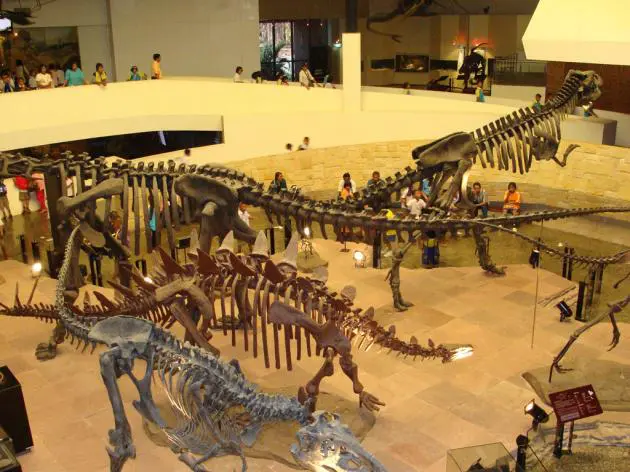
The Sirindhorn museum, also in Kalasin, is the country’s main repository for dinosaur remains. Arranged in fearsome poses, the main hall has models of four dinosaur skeletons from Thailand, while a Pteranodon flies menacingly overhead.
The dinosaurs include the 6.5-metre-long Siamotyrannus isanensis, named after the Isaan region where it was discovered. It is the oldest of the tyrannosauridae family, the explanation says, suggesting “the possibility that Tyrannus evolved in Asia” and then spread around the world.
Further along the museum’s descending corridors, a Tyrannosaurus rex skeleton found in the United States bares its considerable teeth, although the king of dinosaurs is given little space to roam compared with its Thai ancestor in the main atrium.
Holographic presentations dotted around the museum show dinosaurs on the hunt, or feeding, and provide a welcome multimedia distraction for younger visitors.
“Our moving animatronic Phuwiangosaurus sirindhornae receives a lot of attention from our visitors,” says the museum’s education officer, Benjawan Pannara.
Nearly 40,000 people visited the museum last year, but only a tenth were foreign tourists. The exhibition ticket is free for Thai citizens, and costs Bt100 for foreigners.
“The number of visitors has been decreasing in the past five years, partly because the number of student visitors has been decreasing,” Benjawan says explaining that many school groups who have seen the museum several times already and are less keen to come again.
About an hour’s drive west, Phu Wiang National Park is the region’s other key dino destination. Here you can find another well-stocked museum, more life-size models, and more footprints, but also a series of fossil excavation sites.
Linked by a 3.6-kilometre walk around a horseshoe-shaped hill, three of the sites show the places where some of Thailand’s prehistoric beasts took their final steps.
Although much less impressive to a layman than the skeletons, the bilingual signs around the sites explain exactly what part of what dinosaur you are looking at.
The by-now familiar Siamotyrannus isanensis makes a fossilised appearance, as does the herbivorous Phuwiangosaurus sirindhornae – discovered in 1976 and named in honour of Her Royal Highness Princess Maha Chakri Sirindhorn.
These two are among four species “discovered here first in the world,” according to Chotima Yama, director of Phu Wiang dinosaur museum.
Visiting all three sites can be challenge when it’s hot but the rewards include stunning wildlife, including countless butterflies of every colour, and sweeping views over lush forested valleys.
There are few amenities inside the Phu Wiang National Park, apart from one restaurant that is open only at peak times of the year, and a small shop selling snacks.
For Bt300 you can bring your own food and camp. Or fork out a little extra, and a basic room in a 12-person bungalow in the heart of dinosaur country can be yours.
Internet
_ Sirindhorn dinosaur museum (http://www.dmr.go.th/main.php?filename=Museum4_en)
_ Phu Wiang dinosaur museum (http://www.dmr.go.th/main.php?filename=Museum3_en)
_ Phu Faek national park on TripAdvisor (http://www.tripadvisor.com/ShowUserReviews-g1152742-d1743421-r130606124-Phu_Faek_Forest_Park-Kalasin_Kalasin_Province.html
