
Giving thanks to their gods


Play
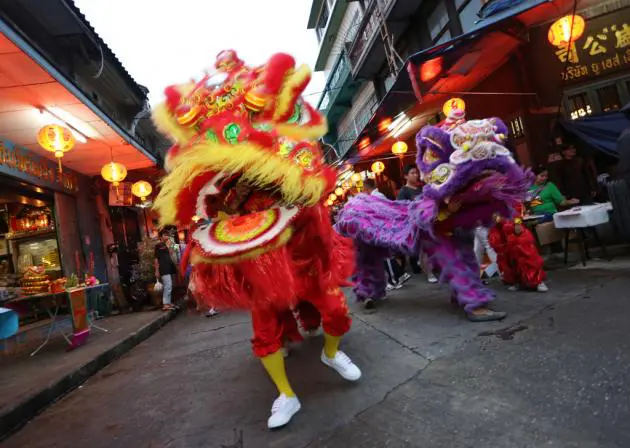
A Chinese-speaking community bids a disheartening good-bye to their century-old neighbourhood with the almost-extinct festival
For the residents of Bangkok’s 100-year-old Chinese neighbourhood of Woeng Nakorn Kasem, this year’s Xie Xing Festival, or Chinese Thanksgiving, a traditional time of celebration, will be tinged with sadness. Taking place next Monday and Tuesday, the rare celebration might be the last they mark at their homes, as a developer has other ideas for Woeng Nakorn Kasem.
But that’s another story and while we can do nothing to save one of Bangkok’s oldest communities, we should at least focus on the chance to mark a tradition that’s today is little known outside China.
Rather like its Christian namesake, Xie Xing (or Xie Shen) arrives in the winter. Celebrants cook up a feast to appease the gods and ask for their blessing and good fortune.
Fortunately, Xie Xing has been practised among the Chinese-speaking community in Woeng Nakorn Kasem for more years than anyone cares to remember. With the arrival of winter, people in this historic cluster gather to practise the century-old ritual.
“When overseas Chinese or Hua Chiew set up a community in another country, they put up the shrine so their local gods will bless and protect the community. In mainland China, our ancestors worked as farmers so they paid respect to Pae Gong, the land guardian. Once they moved to the city, they no longer farmed and gradually Pae Gong has evolved into Pueng Tao Gong, the old man of good investments,” says Visit Techakasem, an architect-turned- feng shui master and an expert in Chinese culture,
Gratitude, of course, is the most important virtue in Chinese culture.
“In China, like other ancient agricultural societies, when the harvesting season ended farmers would organise folk performances and pay respect to the gods for bringing them rich harvests over the year,” Visit says.
“As businessmen in the city, we pay respect to Pueng Tao Gong, the guardian, and thank him for good business over the year and pray for safety, good health, harmony and prosperity in the coming months.”
Xie Xing coincides with Dang Ji or Dong Zhi Festival, the arrival of winter. It is the shortest day of the year – the winter solstice. The festival always falls on the 11th lunar month or around December 21, 22 or 23 of the Gregorian solar calendar. In the southern part of China and in Chinese communities overseas, the Dong Zhi Festival is a time for the family to get together and eat yi or tang yuan, glutinous rice balls served in clear sugar syrup, which are a symbol of reunion.
The celebration held in the Woeng Nakorn Kasem follows the same tradition.
Invitation letters to important gods are sent to the respective shrines and in return, the messenger brings the ashes of the incense from those shrines back as representatives of those invited deities.
A big tablet with all the names of the important gods and goddesses in Buddhism, Taoism, and local gods are placed on the altar. Pao, or paper clothing for the gods, with different accessories, depending on his or her rank and expertise, are prepared to welcome gods on the day of worship.
The banquet table for the gods and goddesses is set to match the number of the invited deities. Tea, rice wine, yi or glutinous rice balls served in a clear sugar syrup, vegetarian dishes, sa sae – three kinds of meat representing earth (pork), sky (chicken), and water (fish) – and plenty of desserts and sugar are served for the sacrificial banquet.
“In China, sugar is very important at this time of the year because it gives us energy to fight the cold winter. After the ceremony, the sugar would be saved to make Chinese steamed glutinous rice flour cake, Nian Gao for the new year celebration,” says Visit.
Foods from the sacrificial banquet are considered sacred and are later auctioned off to the community. All proceeds go towards the following year’s Xie Xing ceremony.
As night falls, entertainment takes the place of worship, appeasing the gods and the Chinese folk themselves.
If you go
_ The Xie Xing ritual starts at 10am each day with Chinese chants and prayers to the all guardians and gods. Chinese opera, dragon dance, cultural events and outdoor cinema provide the entertainment after dusk. Visit Techakasem will give provide answers to feng shui questions from 9pm on December 23.
_ For more information, go to Facebook.com/bangkokchinatown,
