
Walking back through time


Play
The historical heritage of the City of Angels comes to life with a Thai Tourism Society tour
It’s 9 on a Sunday morning and a group of us, all strangers to each other, has gathered like a flash mob following an announcement on Facebook.
When I arrive 30-minutes early for the rendezvous at the Makkawan Intersection, opposite the United Nations-ESCAP Building, two women are already there, sitting on the concrete curb and fooling around on their smartphones. On the smaller strip of pavement next to Khlong Padung Krungkasem, a 40-something woman is reading quietly on a bench. A helmeted cyclist soon joins us. By 9am the group has expanded to 50 and while we don’t know each other, we do know what we are doing this morning – taking a walk along Bangkok’s historic lanes.
“From Makkawan Bridge, we head north along Rajdamnoen Nok Avenue, then turn right to Sri Ayutthaya Road,” begins Apivat Covintranon, a retired lecturer who has volunteered to show us around. “We will stop here and there at historical landmarks.”
This free trip is organised by the Thai Tourism Society and aims to enhance what residents love about the city through heritage tourism, ecotourism, and geotourism by using social media to bring like-mind people together.
Today’s walking tour is a stroll around Dusit, Bangkok’s first urban district.
Before King King Chulalongkorn (King Rama V) took the throne, all royal business was conducted inside the Grand Palace. The Inner Court was home to the royal family while the country’s business was discussed in the Middle and Outer Courts.
Eventually, though, the Grand Palace became too small to accommodate the royal family members.
King Chulalongkorn returned to Siam from Europe in the late 19th century and, inspired by what he had seen in the great capitals of the west, started his ideas into reality. One of his first acts was to purchase the orchards and paddy fields between Khlong Padung Krungkasem and Khlong Samsen and grow flowers, naming the area “Suan Dusit” or Dusit Garden. He then built a new palace, Vimanmek, which served as the new royal residence. The compound, which became known as Dusit Palace, was later expanded to include other throne and residential halls.
History tells us that King Chulalongkorn really loved his new palace and often cycled between the Grand Palace and the compound.
“His cycling route eventually became Rajdamnoen Avenue,” adds Tor of Thai Tourism Society.
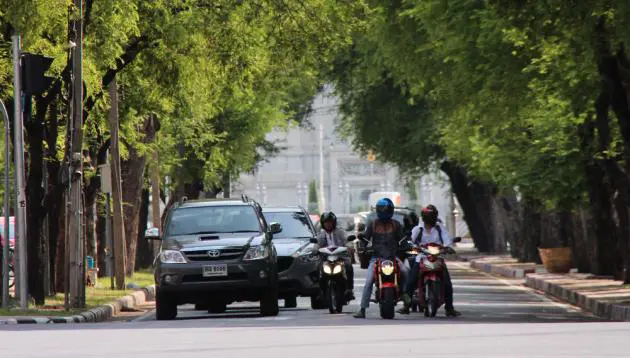
From Makkawan Bridge, we head north to the Ananta Samakhom Throne Hall along Rajdamnoen Avenue. Lined with leafy tamarind trees, this busy thoroughfare is surprisingly peaceful on a Sunday morning.
We stop at the Ministry of Education, once Chan Kasem Palace, which King Chulalongkorn built for Crown Prince Vajiravudh. With Royal Thai Army Guard 1 on our right, we keep heading north. As we wait for the lights to change at the corner of Sri Ayutthaya Road and Rajdamnoen Avenue, Apivat points to the mustard-coloured fence and olive-green gate on another side of the avenue.
“Paruskavan Palace,” says Apivat. “King Chulalongkorn built this palace for his son, Prince Chakrabongse.
Beyond this dark yellow fence is a grand mansion in the German baroque style. The palace was made famous by the autobiography of Prince Chula Chakrabongse, (son of Prince Chakrabongse and his Russian wife Catherine Desnitsky) titled “Kerd Wang Parus” or “Born in Paruskavan Palace” as it’s known in English. The palace is now a Police Museum, and open to the public from Wednesday to Sunday.
Turning right onto Sri Ayutthaya Road and heading east, we arrive at Wat Benchamabophit, also known as the Marble Temple. Built by King Chulalongkorn in 1899 to replace two unused temples knocked down to make way for Dusit Palace, the temple is considered one of the most beautiful in the city. A hybrid of Thai and European architecture, it boasts Victorian-style stained-glass windows depicting scenes from Thai mythology. Sunday morning, when city-dwellers are still in bed and the tourist buses have yet to arrive, is the best time to visit.
Dusit district is still a royal enclave, home to the Chitralada Palace, the residence of the current Royal Family. Encompassing the National Assembly of Thailand to the north of Ananta Samakhom Throne Hall and Government House, south of Wat Benchamabophit, it is also the seat of political power.
From the back of Wat Benchamabophit, we retrace our steps back to Phitsanulok Road and walk through Nakhon Pathom Road to Panichyakan junction, where the Chamai Maruchet Bridge crosses the Prem Prachakorn canal. East of the canal is Rajamangala University of Technology Phra Nakhon, once the palace of another of King Chulalongkorn’s son, Abhakara Kiartivongse, Prince of Chumphon. To the west is Government House.
“The Government House was originally meant to be a family house and was known as Baan Norasing, says Apivat. “King Vajiravudh, also a son of King Chulalongkorn, commissioned an Italian architect to build this massive mansion in Neo Venetian Gothic style for his favourite general and close aide – Chao Phraya Ramrakhop.
“The Prince of Chumphon was not pleased and promptly shut the main gate of his palace on the canal side, and used the smaller gate on the side of Khlong Padung Krungkasem,” adds Apivat.
Conflict is thus nothing new to this part of Dusit. Since Norasing House became the Prime Minister’s seat, protesters have often set up camp along the canal and even gone as far as to occupy the Government House.
We cross Phitsanulok Road, and stop at the shrine of Prince of Chumphon. Born to King Chulalongkorn and a common woman from the Bunnag Family, the prince is the Father of the modern Thai Navy. He is highly respected by Thai people for his bravery and generosity as well as his use of herbal medicine and love for the paranormal.
“People love him, and they built him many shrines. But this one, in the grounds of his palace, is the most secred,” Apivat adds.
The group retraces its steps to Khlong Padung Krungkasem, finally parting company at Nang Loeng marketplace.
CARE FOR BANGKOK
■The Thai Tourism Society often organises free trips over the weekend. Follow their activities at Facebook.com/thaitourismsociety?fref=ts
