
Elephants at the Palace
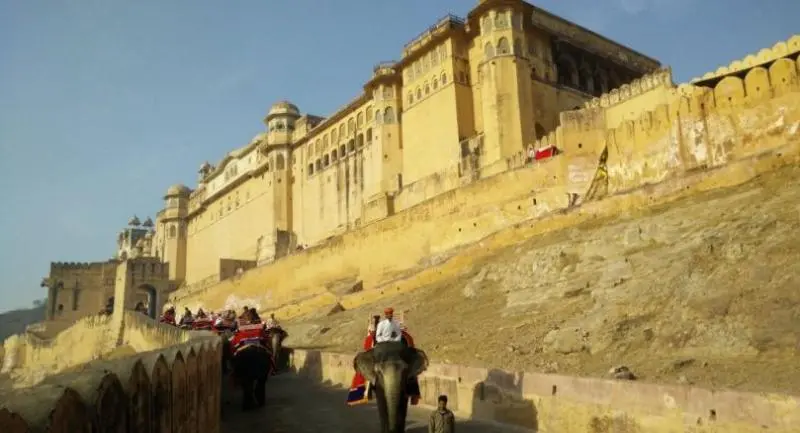


Rajasthan’s Amer Fort is well worth a visit but you’ll need to battle it out with the hawkers to get there
High on the hill above Maota Lake, Amer Fort, sometimes called the Amer Palace and also known as the Amber Fort, is one of six medieval forts in India’s Rajasthan state listed as a Unesco World Heritage site. The structures were listed as examples of Rajput military hills in June 2013 and have enjoyed an upsurge in visitors ever since.

The town of Amer was originally built by Meenas, a tribe that claimed a mythological descent from the Matsya avatar, or fish incarnation, of Vishnu. The town was later ruled by the Kachwaha Rajput clan.
Amer Fort was built in 1592 by Raja Man Singh I as the residence of the Rajput Maharajas and their families. The palace and Jaigarh Fort, which is located on the same range of hills, are considered as one complex and the two are connected by a subterranean passage. In times of war, the passage served as an escape route for members of the royal family and others in the Amer Fort to move to the more invincible Jaigarh Fort. Amer Fort was a royal palace until Sawai Jai Singh II moved the city to Jaipur because of the growing population and a scarcity of water.

“No visit to Rajasthan is complete without going to Amer Fort. When you get out of the bus. please do not talk to anybody. Don’t let me get out of your sight. Remember, do not talk to anybody,” says Hami Singh, our local guide, as the fort comes into view.
The gigantic fort perched on a hill surrounded by barren land looks like a painting of an ancient city of the type more usually seen in a history book. The wind blows the yellowish dust giving the picturesque fort a mystic appearance.
The instruction given by the guide is explained the moment we descend from the bus into a teeming mass of hawkers determined to offload their wares. The noise is deafening; the ambience scarily unreal.
“Maharaja! Buy this turban. It is 2,500 rupees! Ni hao! The shawl is beautiful. Touch it! Buy one?”

Hami leads us through the hawkers and other tourists to the elephant station where visitors queue for an elephant ride to the fort. It’s not easy to get in the line though and we have to push our way through the more persistent hawkers and tour guides who are swarming all over the narrow staircase.
Once we reach the platform at the top of the stairs, we don’t even have time to think. Hami tells us to clamber on to the seat on the back of the elephant, two of us per elephant, and we do just that.
Slowly, the elephant walks away from the noisy crowd and ambles towards the fort entrance. As the surrounding area empties and the noise decreases, I realise that sitting sideways on a howdah is not easy. With every step, I find myself clutching whatever I can find to make sure I don’t end up under the giant’s feet. The steep walkway and the elephant traffic make the 30-minute ride feel like an eternity.

From Jaleb Chowk, a stairway leads up to the main palace grounds. The Sila Devi temple where the Rajput Maharajas worshipped is on the right of the stairway.
The second courtyard houses the Diwan-i-Am – the Public Audience Hall where the king heard and received petitions from the public.
Ganesh Pol or Ganesh Gate, named after the Hindu god Lord Ganesh who removes all obstacles in life, is the entry into the private palaces of the Maharajas. Through this gate queens or ladies of the court used to welcome the battle-worn kings with scented water and flowers.

The fourth courtyard is where the Zenana or royal family women and concubines lived. The rooms are independent but open onto a common corridor so the king could visit his wives’ respective chambers without the others knowing.
The black stains on the buildings and the fading colour make me wonder how lively this quarter would have been in the days when the Maharajas and their queens lived here. Would the air have been redolent with the fragrance of flowers or would the aroma of fine Indian cuisine have prevailed? Would they dance and sing on a warm day or read by the fireplace in winter?
Hami’s voice calling for our group to gather brings me back to reality.
“We will leave the fort in a 4-wheel drive but then we have to walk for almost 10 minutes. Don’t let me out of your sight. Remember, do not talk to anybody. Okay?” says Hami.
We nod and brace ourselves for the second battle with humanity. Silk shawl anyone?
IF YOU GO
< Thai Smile Airways offers direct flights between Bangkok and Jaipur. Visit www.ThaiSmileAir.com.
