
EU measures should help Thai rubber do well in global markets
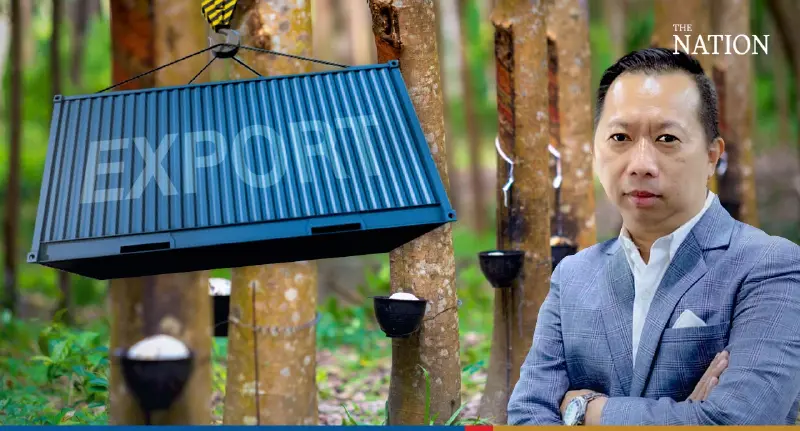


The new EU deforestation-free products regulation (EUDR) for rubber products and goods is expected to provide a good opportunity for Thailand to expand its rubber market in Europe.
A committee from the Rubber Authority of Thailand recently travelled to Brussels, Belgium to discuss with Sekha Wanamethee, the Thai ambassador to Belgium, and head of the Thai Mission to the European Union, and Pornthep Srithanathorn, the Thai Agricultural (EU) Office director, the imminent implementation of the EU deforestation-free products regulation (EUDR) for rubber products and goods, Nakorn Takkavirapat, the authority’s governor said on Monday (September 25).
The authority has taken a raft of measures to trace the origin of natural rubber products back to their sources in line with the EUDR legislation. While Thailand has been proactive in these efforts, its competitors have yet to respond to the issue and it is thus likely that the new measures will provide opportunities for Thailand to expand its rubber market in Europe beyond those of its competitors.
Under the EUDR legislation, which covers seven types of products including natural rubber products, these products must be free from deforestation. This involves verifying that natural rubber and rubber products come from rubber plantations with legitimate land rights documentation, are not located in watershed areas, conservation areas, or forests, and are managed in an environmentally friendly manner that does not harm communities. The authority places great importance on environmental and social aspects to ensure that Thai rubber and rubber products can meet the standards required by trading partners and has expedited the development and improvement of rubber plantations in Thailand to comply with sustainable forest management standards, namely MOAC 14061, which covers planting, care, harvesting, and production processes.
This aims to maintain the ecological balance of rubber plantations in the long term, conserve the environment, and benefit local communities in the area, Nakorn said
Environmental and social issues are expected to gain more significance globally in the future, with other countries likely to enforce legislation similar to EUDR. To prepare for this, the authority will focus on three essential aspects:
1. Organising and updating the database of rubber tree farmers to be the most current and comprehensive possible, including registering rubber tree farmers and operators with the authority. This will help farmers to receive benefits from various government policies. Currently, there are approximately 18 million registered rubber tree farmers.
2. Efficiently managing rubber planting areas, both those with and without land rights documentation. Assistance will be provided to allow farmers to coexist with forests, and permissions for rubber planting areas will be ensured to comply with the law.
3. Advocating various measures to enhance Thailand's competitiveness.
These measures aim to make Thailand's rubber industry more sustainable and competitive in the global market while aligning with environmental and social considerations.
