
Political despair grows as formation of new government progresses


The formation of the new government is likely to succeed, and it is not entirely unexpected. Despite the ongoing debate over the power to dissolve the House and the accompanying criticisms, the new government must inevitably come into being.
The emergence of this government appears to be influenced by socio-political factors, and it invites careful consideration of the potential consequences in the future.
Shuttle politics
In fact, political science students specialising in international relations are well-acquainted with the term “shuttle diplomacy.”
This refers to the role of a negotiator who travels between conflicting countries to facilitate successful negotiations with their leaders, aiming to achieve the set objectives. These negotiations are typically conducted in separate sessions to make discussions easier.
This diplomatic explanation can be used to describe the current political situation in Thailand, which is clearly resembling the "Three Kingdoms" scenario.
After the collection of votes for the formation of a new government, the situation has forced one party to be sidelined, while another party is relied upon for government formation. Even with the largest number of votes, there remains a risk, as parliamentary politics heavily depend on the “votes” to determine the outcome.
This situation has led to what can be described as “shuttle politics,” a phenomenon where politicians appear to be running back and forth in their quest for support to form their government.
The daily movements of these politicians, which often make headlines, seem to create a sense of "despair" among the public, as it appears that all politicians care about is the “political stability” in forming a government for themselves.
This may be because politicians, regardless of their party affiliation, are primarily preoccupied with two issues: “forming a government and overthrowing a government.” It sometimes becomes clear that forming a government and toppling one is a "cycle" of political life for them. All of them benefit from this cycle, with little distinction.
In such circumstances, the people in society are left with many questions: where does the country and the people stand in this “political equation” of government formation?
In reality, this question has been raised many times in past government formations, leading to the feeling that the people seem to only exist in the “equation” of politicians during elections.
Fueling the fire
If we look at the current issues of national security as a starting point, it is clear that politicians do not seem to pay much attention to them.
Despite the critical issues surrounding "national security" at this time, which reflect the struggles of both the country and the people of Thailand, many in society feel that politicians, across all sides, are more focused on their own futures than on that of the people. This is despite the growing severity of these issues.
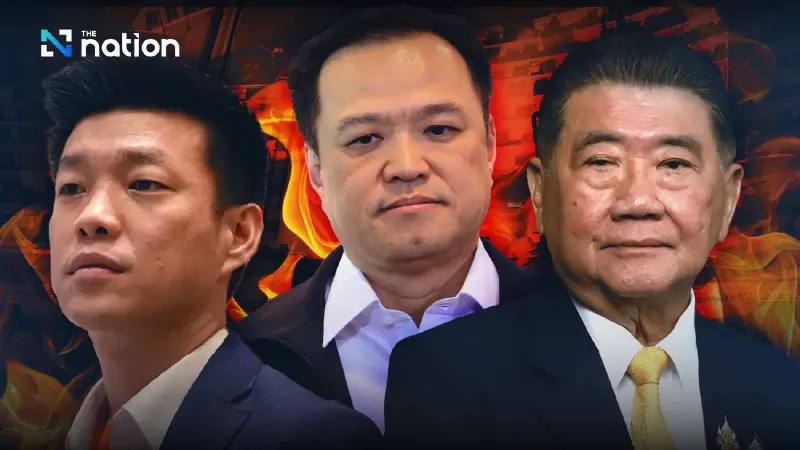
If we try to classify the security issues that are overwhelming the country, it becomes apparent that these problems are like "fires burning" in the current situation, with the lives of people and the country itself at stake. Here are the major "fires" that are currently raging:
- The Cambodian Fire – The ongoing conflict between Thailand and Cambodia seems increasingly difficult to manage. There is a growing risk of a prolonged conflict, or even a "protracted political war" between the two nations. Thailand has continually found itself in the "defensive" position since the issue escalated, especially following the release of a conversation between the two countries' leaders. The situation continues to be akin to a "Cambodian fire" burning us, with no clear way to extinguish it.
- The Southern Fire – The violence in the southern border provinces has once again posed a major challenge to the Thai state. We are facing four simultaneous wars: "the war of negotiation, the war of alliances, the military war, and the information war." Yet, to this day, the Thai state remains on the "defensive," much like the Cambodian issue, with no clear strategy for the future. This issue has been left unresolved for so long, with no government taking clear action on a "southern strategy" that could provide a policy answer to "extinguishing the southern fire."
- The Political Fire – Thai politics is trapped in a cycle of political conflict, political struggle, and power grabs. As a result, the Thai parliamentary system is extremely weak, leading to "political instability." This has also resulted in a "democratic process" in Thai politics resembling a car with a "broken engine," unable to move forward, or becoming a "rudderless state" with little progress. We can only hope that this political fire does not become the "guiding fire" for a return to politics outside the system, as suggested by polls indicating a strong desire for a return of the former military-backed prime minister, with support reaching 42.46%, far exceeding the 26.88% for civilian politicians in second place (according to a Thairath poll from August 29 to September 2, as seen on Thairath Online).
- The Economic Fire – The economy is the largest and most consuming fire in the lives of Thai people today. This fire burns through people's lives due to household debt, while the economic fire fueled by "Trump tariffs" also looms, ready to burn the Thai people in a different way. This fire is also a result of Thailand's persistent macroeconomic decline, and it is the main factor preventing the lives of people in Thailand from being brighter. This economic fire directly impacts "human security" as it fuels the problems of people's livelihoods, compounded by natural disasters like severe flooding in many provinces, where citizens are waiting for aid.
- The Fire of Faith – The most dangerous fire in the realm of political psychology is the "loss of trust" or "faith." This fire is ready to burn everything in its path. At the very least, the "anti-politician riots" currently taking place in Indonesia serve as a strong reminder of this. The "crisis of faith" can occur with individuals in politics, governments, or even with the entire political system, as seen in Nida Poll, where more and more Thais feel disillusioned with politics. This has led to a collective feeling of "bored with red, frustrated with orange, and rejecting blue," with no clear party to support in the upcoming elections.
Political despair
The statistics on political despair from a recent poll show that 41.91% of respondents are completely hopeless, while 34.19% are somewhat hopeless. This means around 76% of the population feels disillusioned, leaving only 24% with hope.
The significant number of people who are despondent—three out of four—should not be underestimated, as only 2.98% have the most hope, and 20.92% have some hope (according to the 'Nida Poll: Public Discontent with MPs, Hopelessness Towards Both Opposition and Government Parties' in Thairath Online, August 17, 2025)."
The fact that 76% of people feel hopeless indicates a growing "crisis of faith" in Thai politics, and it reminds us of the “anti-politician” sentiments seen in Indonesia, where public dissatisfaction has fuelled riots. Thai politicians might think such unrest could not happen in Thailand.
As for Thailand, predicting how this fire of disillusionment will spread is not easy. It’s uncertain whether the public’s frustration with the "three colours" will lead to demands for a "fourth colour," such as "green."
Although calling for a return to the old non-systematic politics in Thailand may not be the best solution, we cannot ignore the fact that 42.46% of the population wants the "former coup leader" back (With 26.88% supporting Pheu Thai PM candidate Chaikasem Nitisiri and 18.79% backing Bhumjaithai candidate Anutin Charnvirakul, according to the Thairath Poll.)
Such a response cannot be interpreted in any other way than as a reflection of psychological dissatisfaction with the current political system. The public feels they have little hope in the political future and sees no way out of the "big fire" that is currently burning through Thai society.
Therefore, from the issues surrounding the "Cambodian uncle" in the audio clip to the "five major fires" engulfing Thai society today, it remains uncertain whether the politics of the "Thai uncle" or "the politics of the National Council for Peace and Order (NCPO)" will make a return to Bangkok.
We can only hope that the 76% despair reflected in the Nida Poll will not become a factor in bringing back non-systematic politics.
Perhaps the best solution is to allow Thai politics to evolve naturally within the parliamentary system. This would give Thai society the opportunity to learn and develop in a way that strengthens Thailand’s democracy for the future.
In the past, we have seldom given the parliamentary system the chance to grow. Meanwhile, the ideal democratic stage has often been a mere dream, while in reality, the political stage has been dominated by politicians of all colours and factions, who have not given much hope to the lives of the people in the present day.
A challenging future
However, the pressing issue without an immediate answer for Thai society is how we can collectively extinguish the major fires within the current political context. The inability to see a clear future has led to an alarming rise in the despair rate, reaching 76%.
The 76% figure from the Nida Poll signals that Thai society is in an era of political despair like never before. Yet, one can't help but worry: If society is consumed by hopelessness, how will we move forward in the future?
