
Panitan warns Trump’s arrest of Maduro could push world towards forever war era
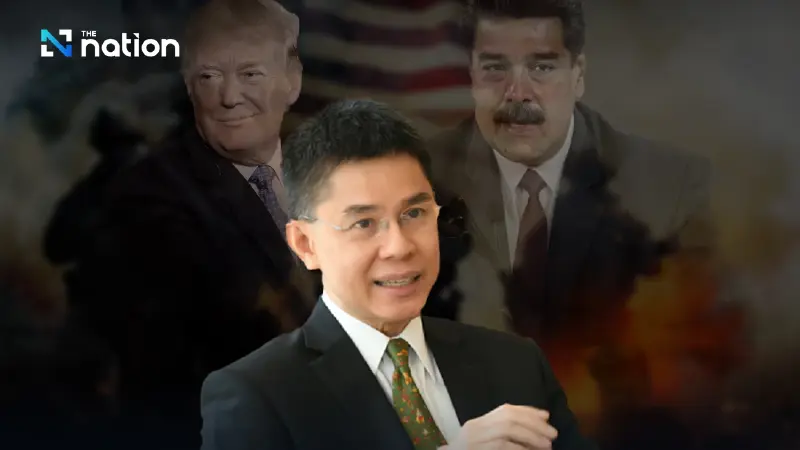


Assoc Prof Dr Panitan Wattanayagorn says the US operation to detain Venezuela’s Nicolas Maduro reflects Trump’s MAGA strategy and risks weakening international rules.
Associate Professor Dr Panitan Wattanayagorn, a security and international relations expert, has analysed the situation in which the United States, under President Donald Trump, sent forces to detain Venezuelan President Nicolas Maduro and his wife under an operation dubbed “Absolute Resolve”, as follows:
The New Age of MEGA War: ‘War for greatness’ in the modern world
1. A ‘war for greatness’ by nation-states in a new context
The idea of a “war for greatness” (Make ME Great Again – MEGA War) is taking shape clearly in 2026.
On January 3, the United States sent forces to detain Venezuelan President Nicolas Maduro and his wife under “Absolute Resolve”, an operation prepared over many months, before taking them to court in New York on charges including “narco-terrorism”, possession of weapons of war, and other offences.
The US also declared it would steer Venezuela’s political transition in line with American interests.
Historically, “wars of glory” by ethnic groups, city-states or nation-states have existed throughout world history. However, the brutality of wars that affect civilians has meant people today do not support warfare in its traditional form.
Even so, amid geopolitical or great-power competition, many countries still believe they can wage a new form of limited conflict—hybrid warfare—to protect their own security.
Clear examples include the Russia–Ukraine war (the return of the Russian Empire) since 2023; Israel’s conflict with Hamas, Hezbollah, the Houthis and some Arab states, which led to Israel’s tactical victories; and tensions between Thailand and Cambodia late last year, in which Thailand was able to reassert sovereignty and regain territory beyond expectations (a war of opportunity).
2. The US and the “Make America Great Again” strategy
The United States, Panitan argues, is the clearest example of a country pursuing a continuous war for greatness. President Trump’s “Make America Great Again” (MAGA) policy has now been elevated into the National Security Strategy 2025.
The strategy states that the US will use every policy tool to make America strong, great and feared again—at home and internationally—in the shortest possible time.
Trump has claimed that in just nine months the US has used military force to restore order at the border, stop migrant incursions, strike Iran’s nuclear programme, designate drug trafficking networks as terrorist organisations, halt eight conflicts, and raise import tariffs to bring industry back to the US—moves he argues no previous US administration has achieved so quickly.
3. Venezuela and the “Monroe Doctrine”
The violation of Venezuela’s sovereignty, he says, reflects the MAGA framework and the new national security strategy. However, many believe the deeper foundation lies in the Monroe Doctrine, declared by the US in 1823 to prevent interference by other major powers in the Western Hemisphere.
The expansion of Chinese, Russian and Iranian influence in Latin America—especially in Venezuela, which holds the world’s largest proven oil reserves and rare mineral deposits in the Orinoco Mining Arc valued at more than US$2 trillion—is seen as a strategic threat to the United States.
4. Military success versus long-term risk
While the US military operation may have achieved tactical success, it has triggered deep concern about international norms. If major powers can use military force to change another country’s government without punishment, others may follow.
That would weaken international law and the role of the United Nations, leading to long-term instability.
5) Scenarios from here
Panitan sees three possible approaches the US may take towards Venezuela:
- Claim victory and negotiate with a caretaker government
- Support the overthrow of the old government and the establishment of a new one
- Use hybrid war to directly control the political transition
6. Impact on Thailand
This “world-shocking” event could affect Thailand across energy, capital markets, investment and diplomacy. Thailand may face growing pressure to choose sides amid major-power competition, even as official statements continue to emphasise peaceful means and respect for the UN Charter.
International relations, he warns, are “changing shape” from adherence to global rules towards the use of force to protect national interests—particularly by the US. If the trend continues, the world may inevitably enter an era of “forever war”.
