
Panitan urges military to swiftly ‘close the game’ in Thailand–Cambodia border war before US intervenes
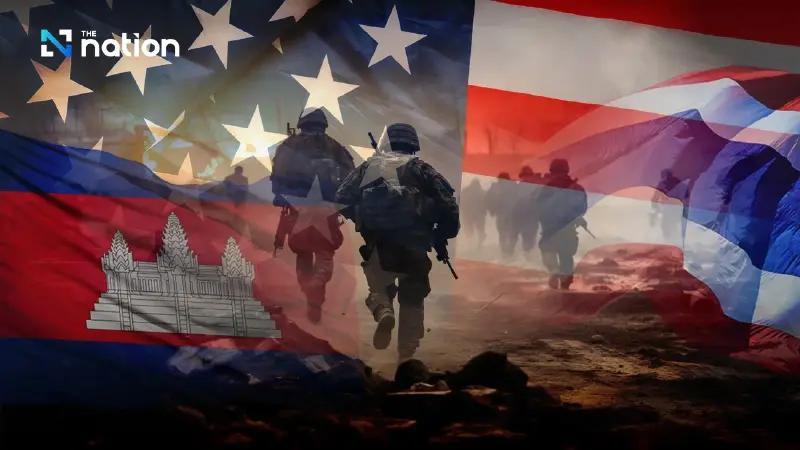


Security scholar Panitan urges Thailand to end its Cambodia border war fast, before US steps in with tariffs and turns it into a proxy conflict
On December 11, 2025, Associate Professor Panitan Wattanayagorn, an expert in international security, used his Facebook page “Panitan Wattanayagorn” to analyse the Thailand–Cambodia border conflict at a time when US President Donald Trump is signalling that he is preparing to call Thai Prime Minister Anutin and Cambodian Prime Minister Hun Manet.
Panitan posted under the heading: “The US will intervene in us again – how much time do Thailand and Cambodia have left to keep fighting?”
President Trump has already announced that he will once again intervene in the current Cambodia–Thailand war. However, he is likely to allow some time or give Thailand and Cambodia a brief window to finish the fighting themselves, for several key reasons – including prestige, popularity, prizes, economic interests, trade balances, and the balance of power in the region and the wider world.
If Thailand and Cambodia resist or fail to end hostilities within that timeframe, the US will probably turn again to tariff measures as its main tool, but this time in a harsher form (you can see how important this is from the preface of the new U.S. National Security Strategy 2025, signed by President Trump and released last month).
For Thailand, the US may add further forms of pressure, such as suspending or reducing military logistics support or limiting combat assistance currently provided to Thailand (Thai armed forces rely on the US and Western allies for more than 80% of their structure and capabilities).
The US might also tilt its support towards Cambodia in some areas, in order to pressure Thailand and certain other countries at another level. In reality, Washington has long played such games.
For Cambodia, if it refuses to stop fighting, the US will likely cut various forms of assistance. Crucially, Washington may increase support for Thailand’s military operations to help deliver a decisive blow and “teach a lesson” to Cambodia and the countries backing it from behind the scenes (though this carries a real risk of escalation into a proxy war).
Most importantly, the US might actively move to topple Hun Sen this time. But to do so, it would have to find and support new leaders more aligned with US interests – a difficult task, especially since other powers such as China and Russia are unlikely to accept this.
If the above assessment holds weight, the things Thailand should do are:
3.1) Rapidly consolidate secure control over the border areas, urgently reducing military threats from heavy weapons and the substantial Cambodian forces massed along the frontier.
3.2) Establish a “Humanitarian/Demilitarized Zone” along all seven border provinces – a belt free of heavy weapons and offensive forces, with better-regulated demarcation of the boundary based on Thailand’s legitimate sovereignty and borders.
To do this, Thailand will need cooperation and support from allies and the international community, particularly from the US, which is highly interested in this case, and from China, which has tried to keep its distance from both sides from the outset and has only recently floated ideas about “meeting halfway” and acting as a “constructive intermediary”. In practice, these Chinese proposals have provided little real benefit to Thailand, despite Beijing’s repeated insistence that Thailand and China are as close as “family”.
3.3) Most importantly, Thailand’s political leadership (not just diplomats or military leaders) must communicate clearly, both domestically and internationally, that:
“Thailand firmly adheres to the path of peace and will pursue this course with full determination and clarity, without backing down or changing its stance.”
At the same time, Thailand should call on Cambodia to halt hostilities immediately, withdraw forces from the border line, and work with Thailand to establish safe border areas for people on both sides. It should also invite joint efforts to restore peace and normalcy, in order to prevent further unnecessary loss of life.
In summary, before great powers and the international community step up direct intervention, Thailand and Cambodia do not have much time left. It may now be a matter of days or weeks in which they can continue fighting in what has become the most serious conflict in 75 years of relations between the two countries.
If great-power and international intervention increases and then fails, the already severe situation could spiral into an uncontrollable proxy war.
But if the US (and China) succeed in intervening and bringing the war to an end, both Thailand and Cambodia may feel compelled to express thanks to them for helping to stop the fighting. Crucially, such intervention would also give the political leaders in Bangkok and Phnom Penh a way to “save face” and find an exit, because it appears that neither side thought far enough ahead before going to war about how to end it without further bloodshed (an exit strategy) or whether they could ever truly achieve an absolute victory (end state) over the other.
Photo and information: Facebook – Panitan Wattanayagorn

