
Trump says to make phone call to stop Thai-Cambodia fighting
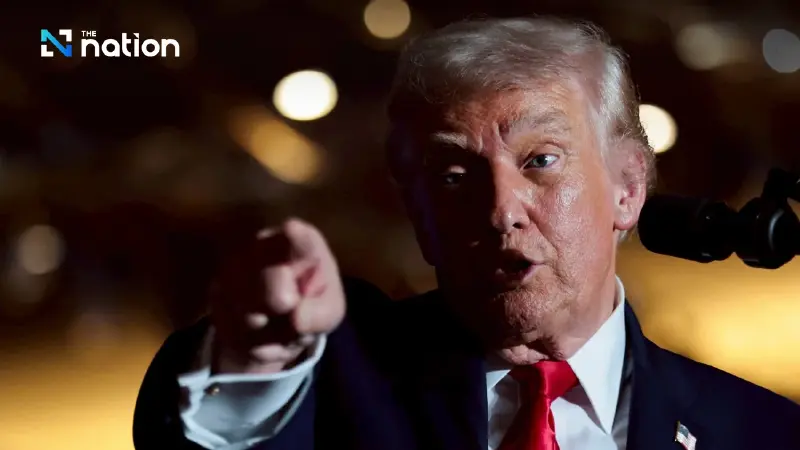


Fighting along Thai–Cambodian frontier dragged into a third day on Wednesday (December 10), as former US president Donald Trump vowed to intervene by phone to halt latest flare-up after previously brokering a fragile truce in July that ended five days of clashes.
- At a rally, Donald Trump announced his intention to "make a phone call" to stop the renewed fighting between Thailand and Cambodia.
- Trump has previously intervened in the conflict, using trade talks as leverage to help secure a ceasefire between the two nations during earlier battles.
- Despite Trump's planned call, Thailand's foreign minister stated that Bangkok is not currently open to talks or outside mediation, while Cambodia says it is ready to talk.
Thailand’s foreign minister said in an interview on Tuesday (December 9) that Bangkok saw no opening for talks at this stage and did not consider the situation suitable for outside mediation.
By contrast, a senior adviser to Cambodian Prime Minister Hun Manet told Reuters Phnom Penh was “ready to talk at any time”.
Addressing supporters at a rally in Pennsylvania on Tuesday, Trump recounted conflicts he said he had helped defuse, including between Pakistan and India, and Israel and Iran, before turning to the renewed violence in Southeast Asia.
He said he expected to “make a phone call” to stop hostilities between “two very powerful countries, Thailand and Cambodia”, after having already dealt with their leaders during earlier tensions.
Trump has positioned himself as a key player in efforts to keep the peace since the July battles, which killed at least 48 people and marked the most intense fighting between the neighbours in recent decades.
At that time, he used ongoing trade talks as leverage to push both sides into an expanded ceasefire signed at an October summit.
However, Thai Foreign Minister Sihasak Phuangketkeow told Reuters he did not believe the threat of tariffs should be used to force Thailand back into negotiations.
Tensions have been steadily rising since Bangkok last month froze de-escalation measures agreed at that October meeting, after a Thai soldier was severely wounded by a landmine that Thailand says was newly planted by Cambodian forces, an accusation Phnom Penh denies.
Both governments say they have moved hundreds of thousands of civilians away from the border.
By Tuesday night, Cambodia’s Defence Ministry reported nine civilian deaths and 20 serious injuries since Monday, while Thai officials said four soldiers had been killed and 68 wounded.
Thai commanders have openly signalled that their goal is to weaken Cambodia’s military capacity, with a senior general saying on Monday that the army aimed to “cripple Cambodia’s military capability for a long time to come”.
Cambodia’s Defence Ministry countered on Tuesday that its troops had been forced into defensive operations, accusing Thailand of “indiscriminately and brutally targeting civilian residential areas” with artillery, allegations that Bangkok has rejected.
US Secretary of State urges Thailand and Cambodia to halt fighting, return to the Malaysia peace deal framework
US Secretary of State Marco Rubio posted on X that Washington is deeply concerned about the ongoing clashes and loss of life along the Thai–Cambodian border, and called on both sides to “immediately cease hostilities, protect civilians, and return to the de-escalation measures” set out in the Kuala Lumpur Peace Accord.
Rubio highlighted the “joint declaration” signed by Thai Prime Minister Anutin Charnvirakul and Cambodian Prime Minister Hun Manet in Kuala Lumpur, in a ceremony chaired by US President Donald Trump and witnessed by Malaysian Prime Minister Anwar Ibrahim in his capacity as ASEAN chair.
However, the declaration represents a political commitment rather than a legally binding peace treaty, noting that its significance is largely symbolic.
Reuters
