
Why Holocaust Remembrance Still Matters — Everywhere
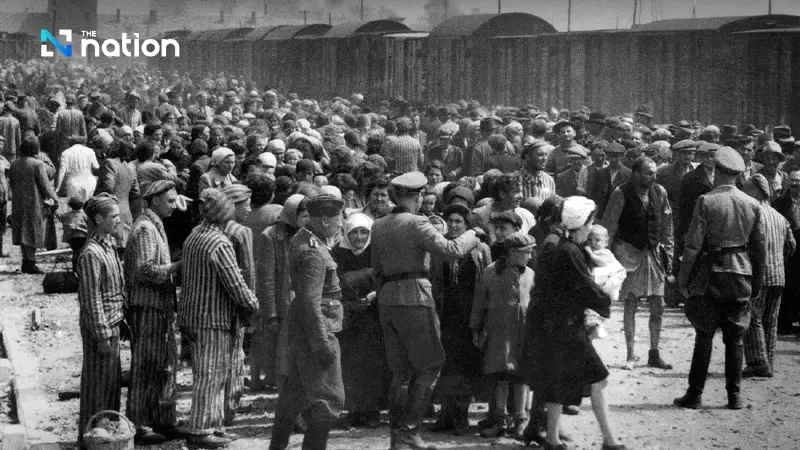


On 27 January each year, the world marks International Holocaust Remembrance Day
- It serves as a universal warning against the dangers of normalized hatred, dehumanization, and indifference, acting as a safeguard against future atrocities.
- Its relevance is demonstrated by the contemporary global rise of antisemitism, showing that the ideologies that fueled the Holocaust are not confined to the past.
- The lessons are essential everywhere because history shows hatred that begins with one group can spread, teaching all societies to recognize warning signs like scapegoating and propaganda.
- Remembering the Holocaust's unique nature as a state-sponsored attempt to annihilate an entire people helps preserve the gravity of the term "
by H.E. Alona Fisher-Kamm, the Ambassador of Israel to Thailand
On 27 January each year, the world marks International Holocaust Remembrance Day.
The date was designated by the United Nations General Assembly in 2005, marking the anniversary of the liberation of Auschwitz-Birkenau, the biggest and most notorious Nazi extermination camp in 1945.
The purpose of this resolution was clear and urgent: to ensure that the memory of the Holocaust and its universal lessons would not fade with the passing of time.
The United Nations did not establish this day only to commemorate Jewish suffering.
It did so to warn humanity of what can happen when hatred is normalized, when dehumanization goes unchallenged, and when the international community looks away.
Remembrance was meant to be a safeguard against repetition.
For many around the world, the Holocaust can feel distant or abstract. Yet it was one of the most documented crimes in human history.
Between 1933 and 1945, Nazi Germany and its collaborators systematically murdered six million Jews: men, women, and children, simply because they were Jews.
Entire communities were annihilated across Europe: in Germany, Poland, Ukraine, Hungary, Lithuania, the Netherlands, France, Greece, and beyond.
Jews were shot in mass executions, starved in ghettos, deported in cattle cars, and murdered in extermination camps designed solely for industrial scale killing.
Holocaust was unique in its intent and scope. It was the first time in history that a modern state mobilized all its resources; legal, bureaucratic, military, and technological, to eradicate an entire people everywhere they could be found.
The Jews were not targeted for what they had done, believed, or possessed. They were targeted for who they were. The aim was not conquest, conversion, or displacement.
It was total annihilation, the destruction of a people, their culture, their memory, and their future. This racial ideology sought to erase Jewish existence itself.
It is no coincidence that the term genocide was coined in the aftermath of the Holocaust.
The Polish-Jewish jurist Raphael Lemkin created the word to describe a crime that existing legal language could not capture: the deliberate attempt to destroy a national, ethnic, racial, or religious group as such.
The Holocaust was the defining case that shaped the concept and led to the Convention on the Prevention and Punishment of the Crime of Genocide. Its uniqueness is precisely what gave the term its meaning and gravity.
This is why, as daughter of Holocaust survivors and as an Israeli, it is deeply painful for me to witness the casual and careless use of the word “genocide” today, particularly when it is directed at Israel.
Such accusations ignore the historical origins of the term, strip it of its legal and moral precision, and turn it into a political slogan.
Criticism of policies is legitimate in any democracy.
But denying Israel’s right to exist, denying its right to defend its citizens: Jews, Muslims, Christians, and others, and portraying the Jewish state as inherently criminal is something else entirely.
When the only Jewish state in the world is singled out, demonized, and accused of crimes that echo the very ideology that once sought to eradicate the Jewish people, we must call things by their proper name. This is antisemitism, cloaked in the language of politics.
Holocaust Remembrance Day is therefore not only about the past. Its relevance is painfully present. More than eighty years after the Holocaust, Jews are still being murdered for being Jews.
Synagogues are burned. Swastikas are painted on Jewish homes. Antisemitism is rising openly and violently across continents.
These developments matter not only to Jews. History teaches us that hatred never stops with one target. The Holocaust did not begin with extermination camps; it began with words, lies, and indifference.
It began with the normalization of hatred and the failure to educate, to speak out, and to intervene.
That is why Holocaust education is essential everywhere, including in countries geographically and historically distant from Europe. Its lessons are universal.
In an age of global uncertainty, polarization, and chaos, societies are again vulnerable to fear-based narratives and scapegoating.
Remembering the Holocaust is not about assigning eternal guilt. It is about recognizing warning signs and reaffirming a shared responsibility to protect human dignity.
Because in times of chaos, hatred always seeks a victim. Today it may be the Jews. Tomorrow, it will be someone else.
